

U.S. Brazil ETF Faces Outflow Risk as Major Banks Downgrade Equities
U.S. emerging market investors are adjusting allocations as Itaú BBA and BTG Pactual downgrade Brazilian equities to neutral, citing fiscal roadblocks.
Key takeaways
- Itaú BBA and BTG Pactual downgraded Brazilian equities to neutral on November 19, 2026, per reports
- Itaú BBA cut Brazil's 2027 GDP growth forecast to 0.5% and sees inflation at 6.1%, per its November 19 report
- BTG Pactual projected a weak 0.6% GDP expansion and 5.9% inflation for 2027, per its November 19 report
- Both banks are advising clients to rotate from consumer and banking assets into defensive exporters, per UOL
The largest U.S. fund tracking Brazilian equities is facing reallocation pressure after the country’s top domestic investment banks downgraded local equities to neutral. On November 19, 2026, both Itaú BBA and BTG Pactual cut their investment recommendations for Brazilian stocks, joining international peers like Goldman Sachs, JPMorgan, and Morgan Stanley in cutting exposure to Latin America's largest economy, according to reports by UOL. The co-ordinated pivot signals that a challenging macroeconomic backdrop of severe fiscal hurdles and higher-for-longer interest rates has eroded the patience of domestic analysts.
The downgrades are fueled by a sharp deterioration in the medium-term economic outlook for 2027. According to a November 19, 2026, strategy report from Itaú BBA, the bank slashed its 2027 GDP growth forecast for Brazil to just 0.5%, down from an estimated 1.6% expansion in 2026. Itaú BBA also projects domestic inflation to climb to 6.1%, which would keep Brazil's benchmark Selic interest rate frozen at its restrictive 13.75% level until at least 2028. BTG Pactual shared the downbeat view in its own November 19, 2026, Latin American strategy update published by Money Times, projecting a weak 0.6% GDP expansion and 5.9% inflation for 2027.
The revised outlook has triggered a dramatic tactical shift in how regional capital is being allocated. Both financial giants are advising clients to aggressively rotate away from domestic-focused retail, consumption, and banking assets—with BTG Pactual completely removing local heavyweights like Itaú Unibanco and financial services firm XP from its model portfolio, as detailed by Money Times. Instead, analysts from both institutions are urging investors to seek shelter in defensive, dollar-hedged exporters such as aircraft manufacturer Embraer, steelmaker Gerdau, and state-controlled oil major Petrobras. These companies generate strong cash flows in foreign currency, protecting them from the domestic slowdown and the weakening Brazilian real.
While Brazilian equities are technically trading at historically cheap valuations—roughly 7.3 times estimated forward earnings according to BTG Pactual—analysts warn that cheap multiples cannot overcome structural stagnation. For global investors holding emerging market equities, the focus now turns to the Brazilian government's ability to deliver a meaningful fiscal adjustment. Without an unexpected structural change in public spending, the country's high debt burden will likely keep domestic rates elevated, keeping capital locked in cash and safe-haven exporters while the broader stock market remains stagnant.
In your brokerage app
This macroeconomic shift directly impacts several prominent exchange-traded funds and individual equities that trade on Wall Street. The iShares MSCI Brazil ETF (EWZ), the largest vehicle for direct retail exposure, is highly sensitive to the domestic banking sector, meaning downgrades to financial giants like Itaú Unibanco (ITUB) and XP Inc. (XP) will likely alter regional asset allocation strategies. Investors seeking to adjust their exposure might also track the Franklin FTSE Brazil ETF (FLBR) and the VanEck Brazil Small-Cap ETF (BRF), while looking at defensive, New York-listed players like aerospace firm Embraer or steelmaker Gerdau (GGBR) as potential dollar-hedged cushions.
Analysis · NWX analysis desk
Which Brazil assets this touches
- EWZ, ITUB, XP, ITUB4, IBOV, USDBRL — Named in this story.
Fundamentals · Itaú Unibanco (ITUB4)
Itaú Unibanco (ITUB4) trades at 9.8x its yearly earnings and 1.9x its book value. Its return on equity is 20.8%. Its dividend yield is 7.7%. The market values the company at R$464.9 billion. Its financial health score is 61 out of 100 (stable), based on profitability, liquidity, debt and growth. Latest: Q3 2026 results, published Nov 3, 2026. Next: FY 2026 results expected Feb 3, 2027 (confirmed date).
| Price / earnings (P/E) | 9.8x | How many years of the current yearly profit the share price adds up to. |
|---|---|---|
| Price / book (P/B) | 1.9x | The share price compared with the accounting value of what the company owns, per share. |
| Return on equity (ROE) | 20.8% | Yearly profit for every R$100 that shareholders have put into the company. |
| Net margin | 12.2% | The part of every R$100 in sales that is left as profit. |
| Dividend yield | 7.7% | Cash paid to shareholders over the past year, as a share of today's price. |
| Market value | R$464.9 billion | What the whole company is worth at today's share price. |
Technical picture · iShares MSCI Brazil ETF (EWZ)
iShares MSCI Brazil ETF (EWZ) closed at $30.07 on Nov 18, 2026, down 7.3% from five sessions earlier. The last close is below its 20-day average of $33.26 and below its 50-day average of $37.14. Since May 18, 2026 it has traded between $30.07 (low, Nov 18, 2026) and $43.54 (high, Oct 9, 2026).
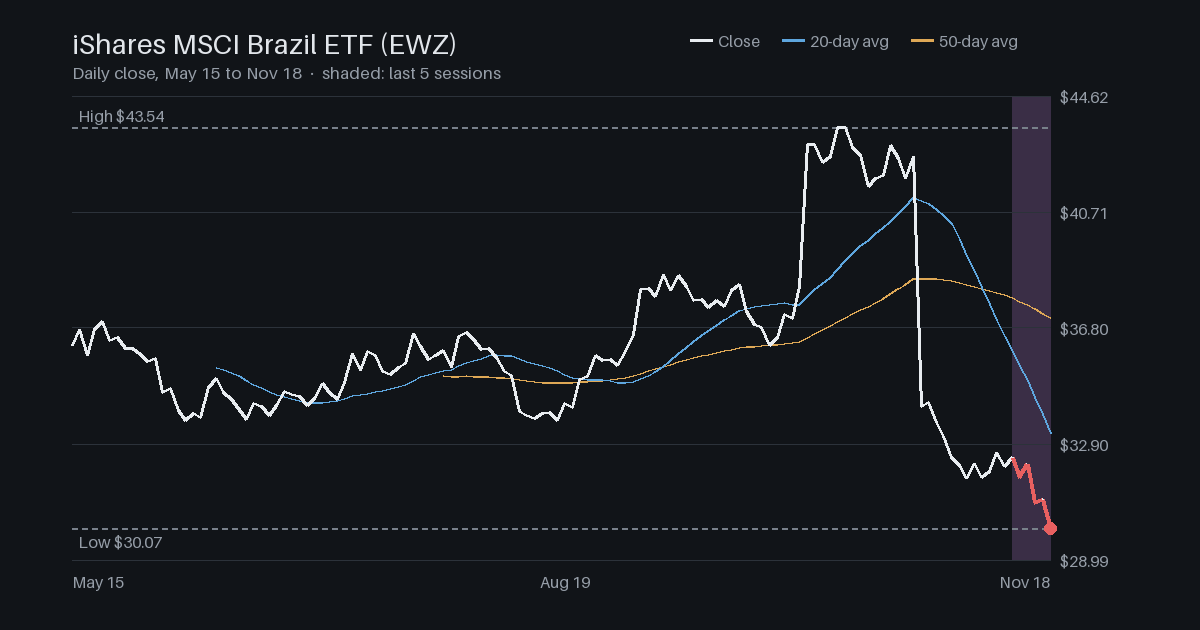
| Last close | $30.07 | Closing price on Nov 18, 2026. |
|---|---|---|
| 5-session move | -7.3% | Change in the closing price over the last five trading days. |
| 20-day average | $33.26 | The average closing price of the last 20 trading days. |
| 50-day average | $37.14 | The average closing price of the last 50 trading days. |
| Period high | $43.54 | Highest price since May 18, 2026. |
| Period low | $30.07 | Lowest price since May 18, 2026. |
Related coverage
 JBS US Shares Target 50% Upside at Itaú BBA Despite Q3 Profit DropItaú BBA reiterated its buy rating on NYSE-listed JBS N.V. with an $18 price target, pointing to a projected earnings turnaround starting in late 2026.
 Petrobras Approves 15.3 Billion Real Dividend, Missing EstimatesPetrobras approved a 15.3 billion real dividend for the third quarter of 2026, missing expectations as rising capital expenditures squeezed free cash flow.
 Copel Approves $3.6 Billion Investment to Expand Grid and HydroCopel approves R$ 21.1 billion ($3.6 billion) investment plan for 2027-2030 to upgrade its regional grid and expand hydroelectric plants in Paraná.