

Real Weakens Past 6.00 per Dollar as Congress Convenes Key Fiscal Vote
The Brazil real weakened past 6.00 per dollar on November 23, 2026, as the Chamber of Deputies prepared to vote on a crucial fiscal adjustment package.

Key takeaways
- The Brazilian real fell past 6.00 per US dollar on November 23, 2026, hitting its lowest level since April 2025, per market data
- The Chamber of Deputies scheduled an extraordinary session to vote on PLP 299/2026 on November 23, 2026, per the official legislative agenda
- The fiscal package aims to save between R$ 45 billion and R$ 56 billion in 2027 by cutting corporate tax breaks, per legislative records on November 18, 2026
American retail investors holding diversified emerging-market assets face a compounding currency drag as the Brazil real exchange rate weakened past the 6.00 threshold against the US dollar on November 23, 2026, according to foreign exchange market data. The currency's slide to its lowest level since April 2025 comes as Brazil's lower house prepares to debate a highly anticipated fiscal package aimed at containing public expenses. For US dollar-based investors who want to invest in Brazil, this depreciation directly erodes the value of Brazilian equities and fund holdings, compounding the challenge of navigating Latin America's largest economy.
The immediate catalyst for the currency pressure is the legislative progress of the government's fiscal plan. The Chamber of Deputies scheduled an extraordinary session on November 23, 2026, to vote on PLP 299/2026, a government-sponsored spending-cut and tax-tightening plan, according to the official legislative agenda published by the Chamber of Deputies on November 23, 2026. The package, which was approved by the Senate on November 18, 2026, is designed to improve the government's primary fiscal balance.
The fiscal adjustment package seeks to generate between R$ 45 billion and R$ 56 billion in savings and new revenues in 2027, according to Senate budget reports published on November 18, 2026. Under the proposal, the government would gain broader powers to block discretionary spending if budget targets are missed, while primarily cutting corporate tax breaks and restricting corporations from using tax credits to offset liabilities. These measures have drawn significant concern from local business groups, who argue that the restrictions on tax offsetting could harm industrial productivity and investment.
Despite these measures, many international investors remain cautious. Financial analysts have raised doubts about whether the bill will curb public spending over the long term, noting that the package relies heavily on revenue increases rather than structural, permanent spending cuts. This skepticism has kept the Brazil real under significant pressure on international exchange markets, pushing interest rate expectations higher.
The path forward depends entirely on the upcoming congressional vote. If the Chamber of Deputies approves PLP 299/2026 without amendments, the bill will go directly to President Luiz Inácio Lula da Silva for sanction. However, any legislative friction or modifications on the house floor will return the text to the Senate, prolonging uncertainty and adding to the headwind facing the Brazil real.
In your brokerage app
The ongoing volatility of the USD BRL exchange rate has direct implications for US brokerage portfolios. Exchange-traded funds like the iShares MSCI Brazil ETF (EWZ), which tracks large and mid-sized Brazilian equities in US dollar terms, are highly sensitive to local currency movements. Because the fund holds Brazilian stocks denominated in reais, the persistent depreciation of the currency acts as a structural headwind, eroding asset value for dollar-denominated retail investors.
Analysis · NWX analysis desk
Which Brazil assets this touches
- EWZ, IBOV, USDBRL — Named in this story.
Technical picture · iShares MSCI Brazil ETF (EWZ)
iShares MSCI Brazil ETF (EWZ) closed at $28.54 on Nov 20, 2026, down 11.4% from five sessions earlier. The last close is below its 20-day average of $31.94 and below its 50-day average of $36.77. Since May 20, 2026 it has traded between $28.54 (low, Nov 20, 2026) and $43.54 (high, Oct 9, 2026).
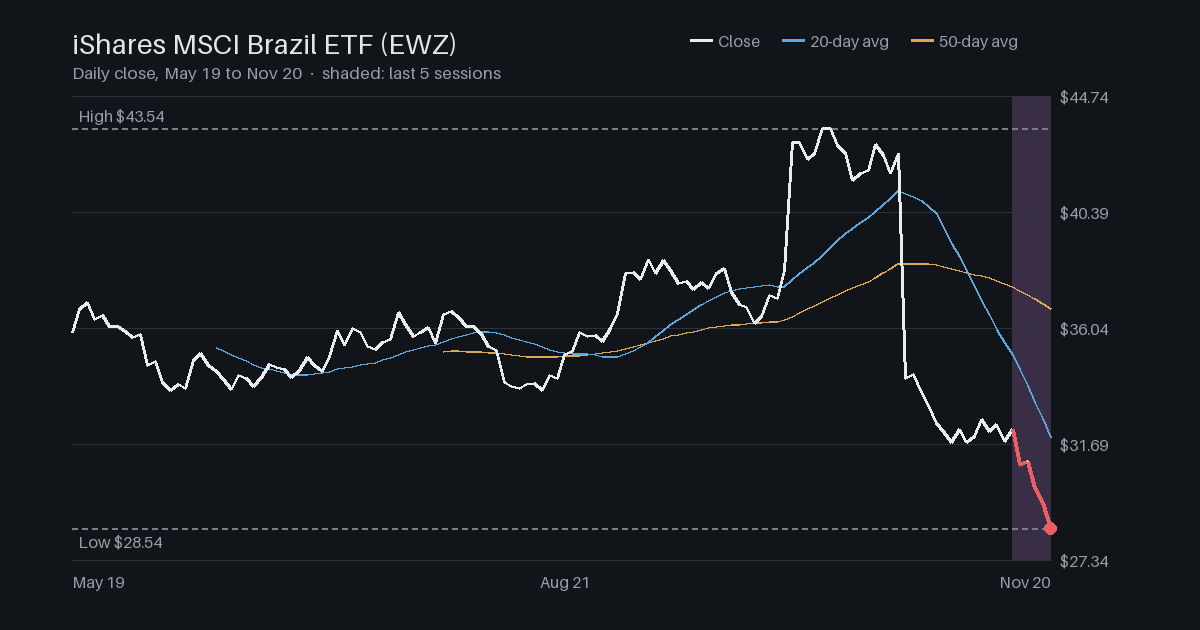
| Last close | $28.54 | Closing price on Nov 20, 2026. |
|---|---|---|
| 5-session move | -11.4% | Change in the closing price over the last five trading days. |
| 20-day average | $31.94 | The average closing price of the last 20 trading days. |
| 50-day average | $36.77 | The average closing price of the last 50 trading days. |
| Period high | $43.54 | Highest price since May 20, 2026. |
| Period low | $28.54 | Lowest price since May 20, 2026. |
Related coverage
 Dollar Breaches 6.00 Reais as Lula Pulls Minister for Fiscal VoteThe U.S. dollar briefly crossed 6.00 Brazilian reais as President Lula temporarily dismissed a minister to secure a vote on a 56 billion-real fiscal package.
 Vale Restarts Viga Iron Ore Mine After 10-Month ShutdownVale S.A. obtains judicial and federal approval to partially resume iron ore operations at its Viga mine in Minas Gerais, idle since January.
 US Soybean Speculators Hold Large Net-Long Position on CBOTWeekly CFTC data shows non-commercial traders held a net-long position of 145,816 soybean contracts as of November 17, 2026, amid strong Brazilian planting.