

Dollar Breaches 6.00 Reais as Lula Pulls Minister for Fiscal Vote
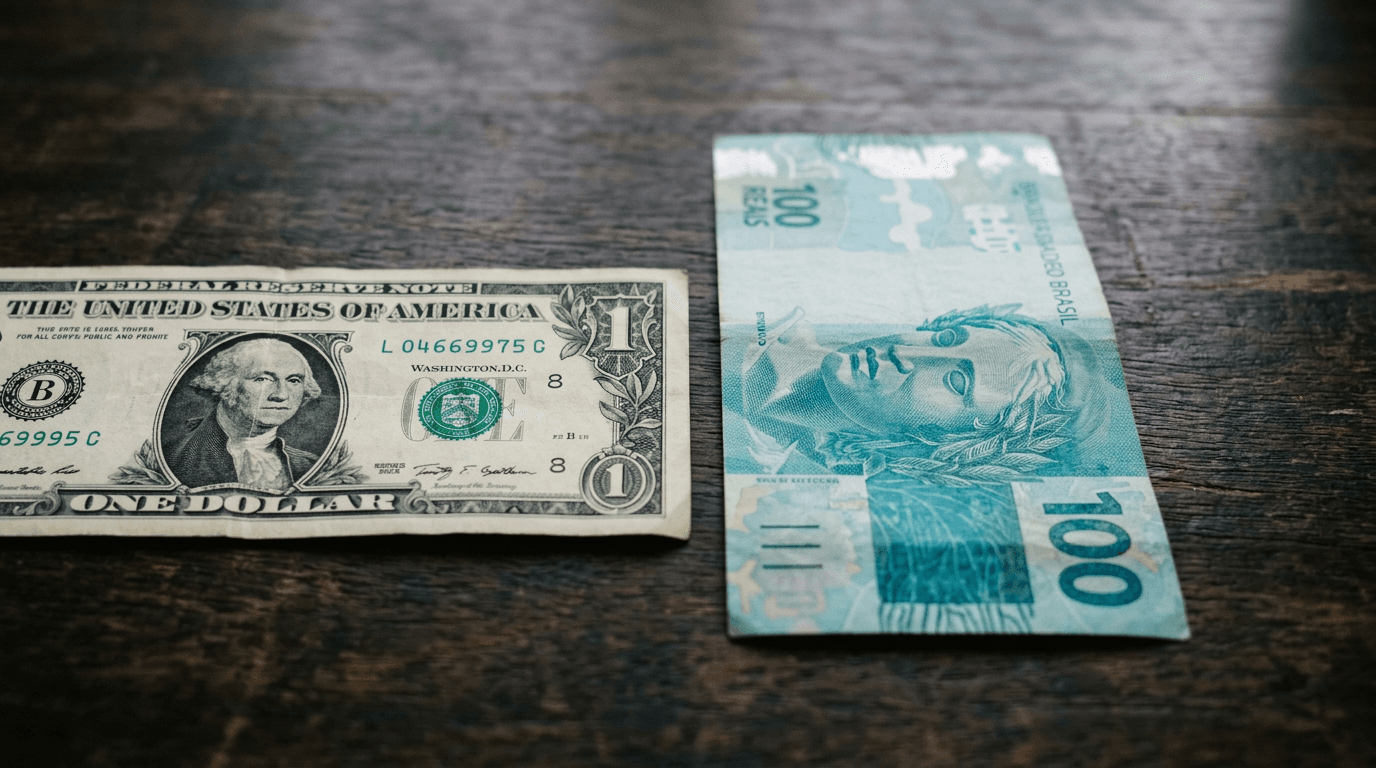
The U.S. dollar briefly crossed 6.00 Brazilian reais as President Lula temporarily dismissed a minister to secure a vote on a 56 billion-real fiscal package.
Key takeaways
- The U.S. dollar briefly crossed 6.00 Brazilian reais, touching an intraday peak of 6.0055, according to trading data reported by Valor Econômico on November 23, 2026
- President Lula temporarily dismissed Minister José Guimarães to secure a Chamber of Deputies vote on a 56 billion-real fiscal package, per UOL on November 23, 2026
- StoneCo slashed its 2026 adjusted basic EPS forecast to 9.1–9.5 reais and withdrew its 2027 targets, per its SEC filing on November 12, 2026
- MercadoLibre secured a $735 million loan from the IFC to expand working capital for Amazon-based small businesses, per the IFC on November 18, 2026
American investors holding Latin American tech blockbusters or watching the purchasing power of their currency saw a psychological barrier break on Monday as the U.S. dollar briefly crossed the 6.00 Brazilian reais mark, touching an intraday peak of 6.0055. The currency's rapid move directly reflects how high-stakes political horse-trading in Latin America's largest economy is squeezing corporate earnings and rewriting labor rules.
In Brasília, President Luiz Inácio Lula da Silva temporarily dismissed his political relations minister, José Guimarães, on Monday, November 23, 2026, so the official could reclaim his seat as a federal deputy and cast a critical vote on a 56 billion-real ($9.4 billion) fiscal adjustment package in the Chamber of Deputies. The government is pushing the measure, known as Complementary Bill PLP 299/2026, to defend the real and contain soaring public debt. However, international investors remain highly skeptical of whether the spending-cut plan—which was narrowed in the Senate to target around 50 billion reais in 2027 savings—goes far enough to stabilize the country's fiscal path.
The currency pressure has been compounded by aggressive labor intervention. On November 19, 2026, President Lula signed a sweeping labor decree regulating Constitutional Amendment 141, which cuts the national workweek from 44 to 42 hours starting December 16, 2026, and down to 40 hours in December 2027, while hiking overtime costs. While foreign investors monitor daily volatility during Brazil stock market hours, this regulatory shift represents a major operational hurdle for consumer-facing businesses, adding a new layer of wage pressure just as the central bank maintains a highly restrictive Selic benchmark interest rate of 13.75% to combat mounting inflation expectations.
This squeeze is already denting the performance of prominent New York-listed companies. Brazilian digital payments firm StoneCo missed its third-quarter earnings estimates on November 12, 2026, subsequently slashing its 2026 adjusted basic earnings-per-share forecast to a range of 9.1 to 9.5 reais and completely abandoning its 2027 targets due to higher credit-risk provisions. In contrast, regional e-commerce giant MercadoLibre has sought targeted funding, securing a $735 million loan package from the International Finance Corporation (IFC) on November 18, 2026, to shield its credit-card receivables business and finance merchants in the underserved Amazon region.
As the Chamber of Deputies debates the final details of the fiscal package, currency markets will test whether the government can preserve the remaining projected savings. Investors will also monitor whether the wide 9.75% yield gap between Brazil’s 13.75% Selic rate and the U.S. Federal Reserve funds rate can eventually stabilize the real once the new federal cabinet is finalized.
In your brokerage app
For retail investors using U.S. brokerage accounts, these developments directly affect key Latin American assets listed in New York. The financial pressure on retailers and payment providers is directly visible in the performance of digital payments player StoneCo, listed in New York, and regional e-commerce leader MercadoLibre, also listed in New York, both of which are prominent holdings in broad international funds such as the iShares MSCI Brazil ETF.
Analysis · NWX analysis desk
Which Brazil assets this touches
- EWZ, NU, STNE, PAGS, IBOV — Big swings in U.S. tech stocks tend to spill into Brazil's fintechs listed in New York and into the broad Brazil fund, as global investors change how much risk they hold.
- USDBRL — Higher U.S. interest rates tend to pull money out of emerging markets such as Brazil, which weighs on the real and on Brazilian stocks; lower rates tend to do the opposite.
Technical picture · iShares MSCI Brazil ETF (EWZ)
iShares MSCI Brazil ETF (EWZ) closed at $29.24 on Nov 23, 2026, down 5.4% from five sessions earlier. The last close is below its 20-day average of $31.70 and below its 50-day average of $36.60. Since May 20, 2026 it has traded between $28.54 (low, Nov 20, 2026) and $43.54 (high, Oct 9, 2026).
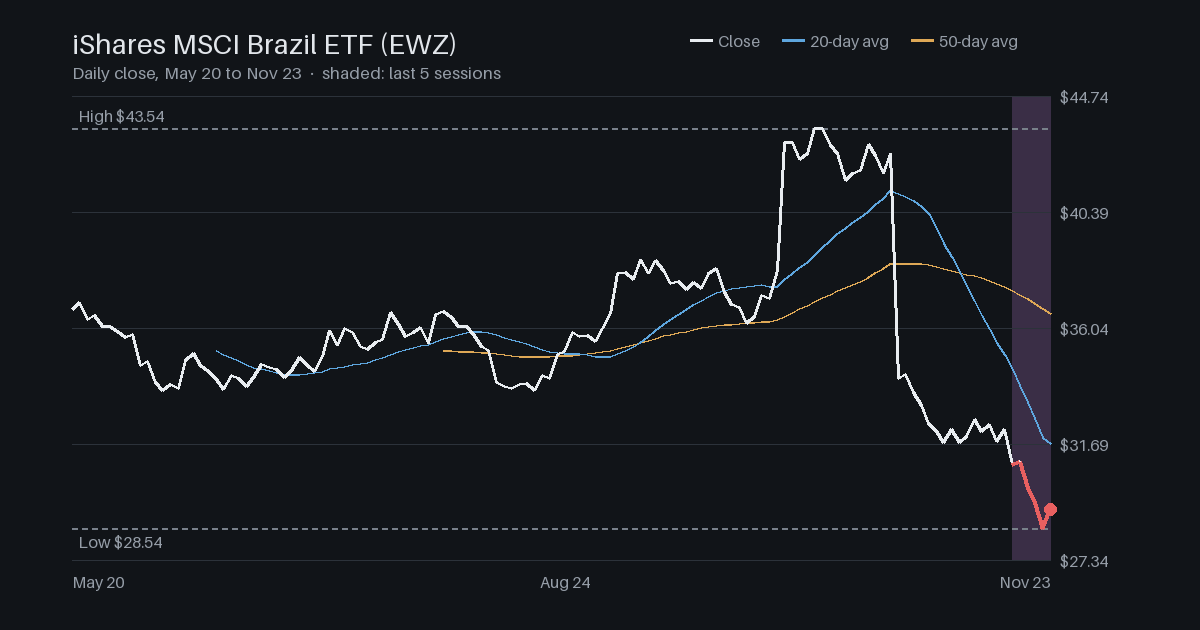
| Last close | $29.24 | Closing price on Nov 23, 2026. |
|---|---|---|
| 5-session move | -5.4% | Change in the closing price over the last five trading days. |
| 20-day average | $31.70 | The average closing price of the last 20 trading days. |
| 50-day average | $36.60 | The average closing price of the last 50 trading days. |
| Period high | $43.54 | Highest price since May 20, 2026. |
| Period low | $28.54 | Lowest price since May 20, 2026. |
Related coverage
 Vale Restarts Viga Iron Ore Mine After 10-Month ShutdownVale S.A. obtains judicial and federal approval to partially resume iron ore operations at its Viga mine in Minas Gerais, idle since January.
 US Soybean Speculators Hold Large Net-Long Position on CBOTWeekly CFTC data shows non-commercial traders held a net-long position of 145,816 soybean contracts as of November 17, 2026, amid strong Brazilian planting.
 US Dollar Breaches 6.00 Reais as Chamber Votes on Fiscal PlanThe U.S. dollar reached an intraday high of 6.005 Reais on November 23, 2026, amid market concerns over the government's fiscal adjustments.