

Dollar Hits R$ 6.00 on Brazil Budget Woes, Hurting US Retail ETFs
A historic spike in the US dollar to R$ 6.00 on domestic budget concerns directly erodes returns for American retail investors holding Brazil-focused ETFs.

Key takeaways
- The US dollar breached R$ 6.00 in intraday trading on November 23, 2026, peaking at R$ 6.0055 and closing at R$ 5.9262, per the Central Bank of Brazil.
- Brazil's Chamber of Deputies began debating the PLP 299/2026 fiscal package to save up to R$ 56 billion in 2027, per legislative records on November 23, 2026.
- The benchmark Ibovespa stock index fell 0.95% to 164,796 points on November 23, 2026, amid persistent market anxiety over public debt, per local market trackers.
For US retail investors holding broad emerging-market portfolios or Latin American funds, a sudden currency depreciation in South America's largest economy has directly eroded dollar-denominated returns. On November 23, 2026, the US dollar breached the historic R$ 6.00 mark in intraday trading, peaking at R$ 6.0055 before paring some losses to close at R$ 5.9262, according to official daily exchange rate data from the Central Bank of Brazil. This rapid currency swing means that even when Brazilian companies perform well in local terms, their value shrinks when translated back into the portfolios of American brokerages.
The sudden surge in the USD/BRL rate highlights the deep-seated budget anxieties gripping Brasília. On November 23, 2026, the Chamber of Deputies—the lower house of Brazil's National Congress—began reviewing a highly anticipated fiscal package known as Complementary Bill PLP 299/2026, according to official legislative records from the Brazilian Chamber of Deputies. This bill, which passed the Senate on November 18, 2026, aims to deliver up to R$ 56 billion in savings for 2027 by curbing tax loopholes and limiting corporate tax-credit offsets. However, global investors remain skeptical that these measures can structurally stabilize Brazil's gross public debt, which reached 82.9% of GDP earlier in 2026, according to report details published by Investing.com.
This fiscal uncertainty acts as an immediate drag on popular retail investment vehicles. For example, investors seeking a brazil vanguard etf often hold the Vanguard FTSE Emerging Markets ETF (VWO), which allocates approximately 3.9% of its portfolio to Brazilian equities as of late 2026, according to fund reporting. Meanwhile, more targeted plays like the iShares MSCI Brazil ETF (EWZ) are even more exposed to the local currency's fluctuations. Fears over the long-term efficacy of the government's fiscal adjustment drove high asset volatility throughout the session, with the benchmark Ibovespa stock index closing down 0.95% at 164,796 points on November 23, 2026, according to daily market tracking.
What happens next depends on how quickly and cleanly the Chamber of Deputies approves PLP 299/2026, and whether the country's economic team can convince international markets that further spending cuts are coming. With the central bank holding its benchmark Selic interest rate at a high 13.75%, per Investing.com reporting on November 23, 2026, the government has very little room for policy error. If the lower house dilutes the proposed savings, analysts warn that the dollar could establish a permanent foothold above the R$ 6.00 mark, continuing to weigh heavily on foreign portfolios.
In your brokerage app
For retail investors using platforms like Fidelity, Schwab, or Robinhood, broad exposure to Brazil is typically managed through the Vanguard FTSE Emerging Markets ETF (VWO) or the single-country iShares MSCI Brazil ETF (EWZ). Because these funds hold assets valued in local currency but trade in US dollars, a rising USD/BRL rate creates a direct headwind for overall returns. When the Brazilian real falls, the net asset value of these funds drops in dollar terms, making foreign exchange rates a critical metric for retail portfolios.
Analysis · NWX analysis desk
Which Brazil assets this touches
- EWZ, IBOV, USDBRL, DI1 — Named in this story.
Technical picture · iShares MSCI Brazil ETF (EWZ)
iShares MSCI Brazil ETF (EWZ) closed at $29.24 on Nov 23, 2026, down 5.4% from five sessions earlier. The last close is below its 20-day average of $31.70 and below its 50-day average of $36.60. Since May 20, 2026 it has traded between $28.54 (low, Nov 20, 2026) and $43.54 (high, Oct 9, 2026).
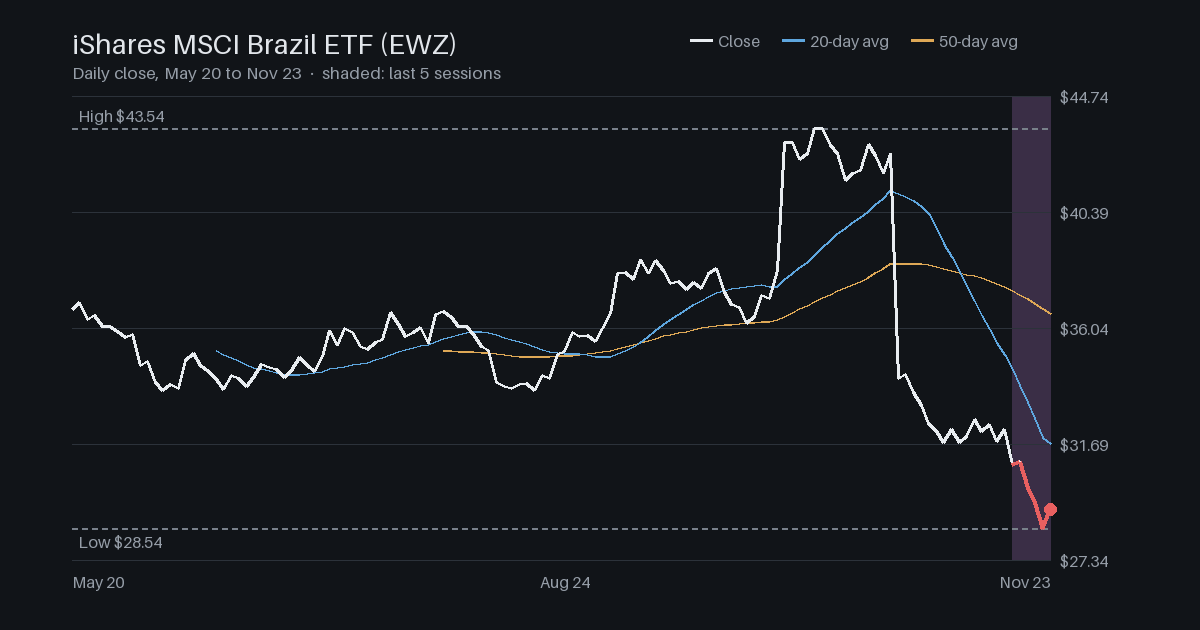
| Last close | $29.24 | Closing price on Nov 23, 2026. |
|---|---|---|
| 5-session move | -5.4% | Change in the closing price over the last five trading days. |
| 20-day average | $31.70 | The average closing price of the last 20 trading days. |
| 50-day average | $36.60 | The average closing price of the last 50 trading days. |
| Period high | $43.54 | Highest price since May 20, 2026. |
| Period low | $28.54 | Lowest price since May 20, 2026. |