

Banco do Brasil Cuts Dividend as Bad Farm Loans Hit 21 Billion Real
American investors face a steep dividend haircut as Banco do Brasil slashes payouts following a massive agricultural loan default wave in the third quarter.
Key takeaways
- Banco do Brasil reported adjusted net income of BRL 1.27 billion, down 66.5% year-over-year, per its earnings announcement on November 12, 2026
- The bank's credit costs reached BRL 21.2 billion in Q3 2026 due to agribusiness delinquency, per its third-quarter report on November 12, 2026
- Management cut the 2026 payout ratio to the mandatory 25% minimum and suspended 2027 interim payouts, per its capital plan on November 12, 2026
American income investors who hold over-the-counter ADRs of Brazil’s largest agricultural lender are facing a severe cut to their portfolio payouts. According to a regulatory filing submitted by Banco do Brasil to the Brazilian Securities Commission (CVM) on November 11, 2026, the company’s board of directors slashed its 2026 dividend payout ratio to the statutory minimum of 25%. The state-controlled bank also suspended all interim dividend distributions for 2027, as outlined in its third-quarter earnings presentation on November 12, 2026, in an effort to shore up capital, according to the transcript on Seeking Alpha.
The sudden dividend cut followed a massive collapse in profitability. For the third quarter of 2026, Banco do Brasil reported an adjusted net income of BRL 1.27 billion, a 66.5% decrease compared to the same period in 2025, according to the bank’s financial report released on November 12, 2026. The result fell far short of the BRL 3.47 billion adjusted net income that analysts had projected, according to market consensus expectations recorded by analysts on November 12, 2026.
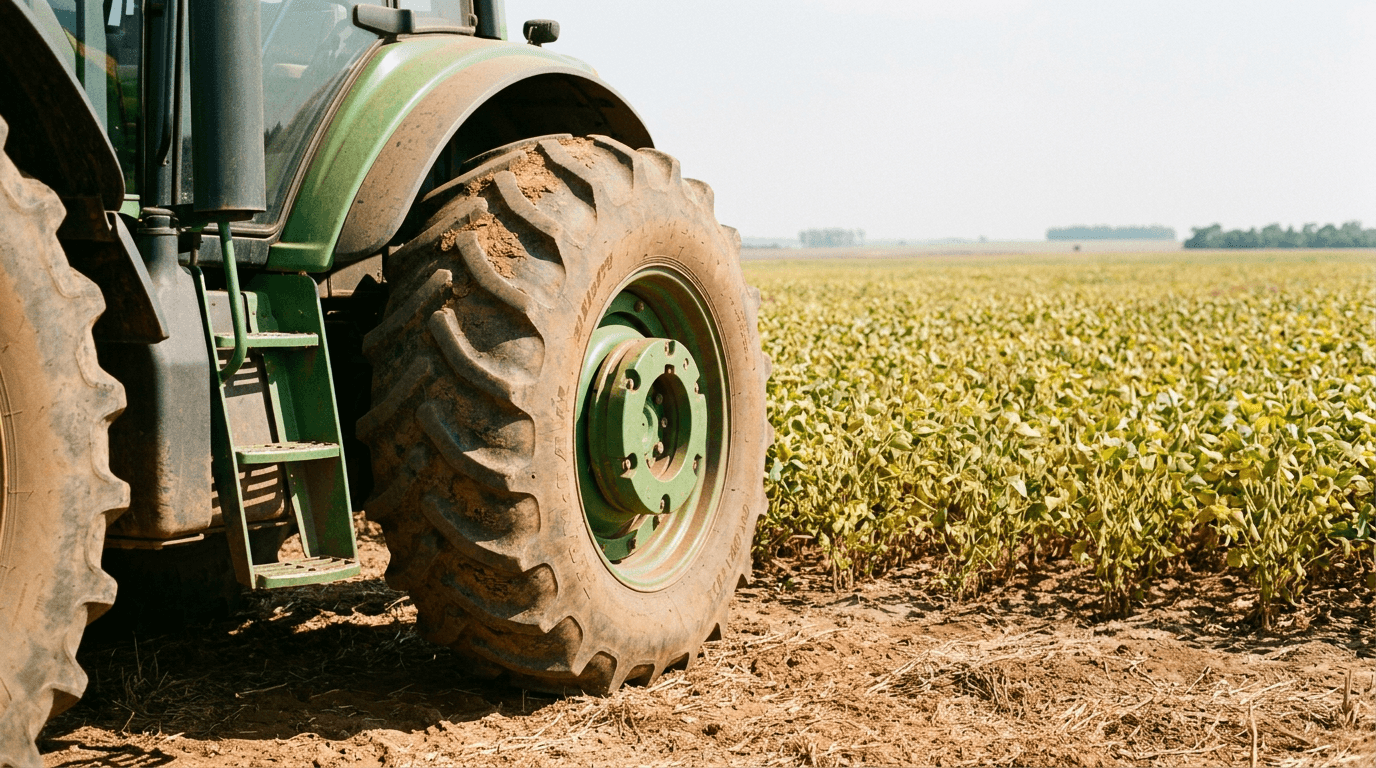
This profit collapse was driven by a historic surge in agricultural defaults. Total quarterly credit costs ballooned to BRL 21.2 billion, according to the bank’s third-quarter earnings report on November 12, 2026, as delinquency within the bank's agricultural portfolio spiked. The rate of agricultural loans past due by more than 90 days reached 6.92% in September 2026, up from 4.84% in September 2025, according to data released by the bank on November 12, 2026. Management reported that the on-time payment rate for agricultural borrowers dropped to 66% in October 2026, according to the bank's credit operations data compiled on November 12, 2026.
The delinquency crisis has been exacerbated by uncooperative large-scale debtors. Speaking during a conference call on November 12, 2026, Banco do Brasil CEO Tarciana Medeiros stated that certain medium and large-scale agricultural producers in Brazil’s Midwest region have refused to pay their debts or participate in restructuring programs, as reported by Agência Brasil. The bank set up a restructuring initiative under Provisional Measure 1376, which successfully renegotiated BRL 13.4 billion of debt as of November 12, 2026. However, the bank reported that only 15% of those defaulting borrowers actually agreed to renegotiate, according to the bank's earnings presentation on November 12, 2026, leading management to blame a culture of "moral hazard" where healthy farmers intentionally delay payments in hopes of government-mandated debt relief.
To protect its balance sheet, the lender has slashed its financial expectations for the rest of the year. According to the bank's revised guidance document published on November 12, 2026, full-year adjusted net income projections for 2026 were cut in half to a range of BRL 9 billion to BRL 11 billion, down from the previous range of BRL 18 billion to BRL 22 billion. Meanwhile, the estimated cost of credit for 2026 was raised to a range of BRL 80 billion to BRL 83 billion, up from an earlier projection of BRL 65 billion to BRL 70 billion, according to the bank's official guidance revisions on November 12, 2026.
Investors will be watching whether the bank can stabilize its agricultural portfolio or if defaults will continue to spill over into next year. Management warned that the fourth quarter of 2026 and the first quarter of 2027 will remain highly challenging as overdue loans migrate to worse credit stages, according to the bank's presentation on November 12, 2026. The next major milestone for shareholders will be on February 17, 2027, when the bank is scheduled to announce its final 2026 dividend distribution, as detailed in the bank's corporate schedule on November 12, 2026.
In your brokerage app
For US retail investors, Banco do Brasil S.A. is listed in New York as an over-the-counter American Depositary Receipt. It is also held as a component of broad-market funds like the iShares MSCI Brazil ETF, meaning retail investors tracking emerging market financials are indirectly exposed to the bank's slashed dividend payouts.
Analysis · NWX analysis desk
Which Brazil assets this touches
- BBAS3, SOYBEAN, CORN, CATTLE, USDBRL — Named in this story.
Fundamentals · Banco do Brasil (BBAS3)
Banco do Brasil (BBAS3) trades at 7.4x its yearly earnings and 0.4x its book value. Its return on equity is 6.8%. Its dividend yield is 4.9%. The market values the company at R$81.8 billion. Its financial health score is 48 out of 100 (stable), based on profitability, liquidity, debt and growth. Latest: Q3 2026 results, published Nov 11, 2026.
| Price / earnings (P/E) | 7.4x | How many years of the current yearly profit the share price adds up to. |
|---|---|---|
| Price / book (P/B) | 0.4x | The share price compared with the accounting value of what the company owns, per share. |
| Return on equity (ROE) | 6.8% | Yearly profit for every R$100 that shareholders have put into the company. |
| Net margin | 4.3% | The part of every R$100 in sales that is left as profit. |
| Dividend yield | 4.9% | Cash paid to shareholders over the past year, as a share of today's price. |
| Market value | R$81.8 billion | What the whole company is worth at today's share price. |
Technical picture · Banco do Brasil (BBAS3)
Banco do Brasil (BBAS3) closed at R$14.20 on Nov 23, 2026, down 6.0% from five sessions earlier. The last close is below its 20-day average of R$16.47 and below its 50-day average of R$20.56. Since May 28, 2026 it has traded between R$14.02 (low, Nov 19, 2026) and R$27.19 (high, Oct 5, 2026).
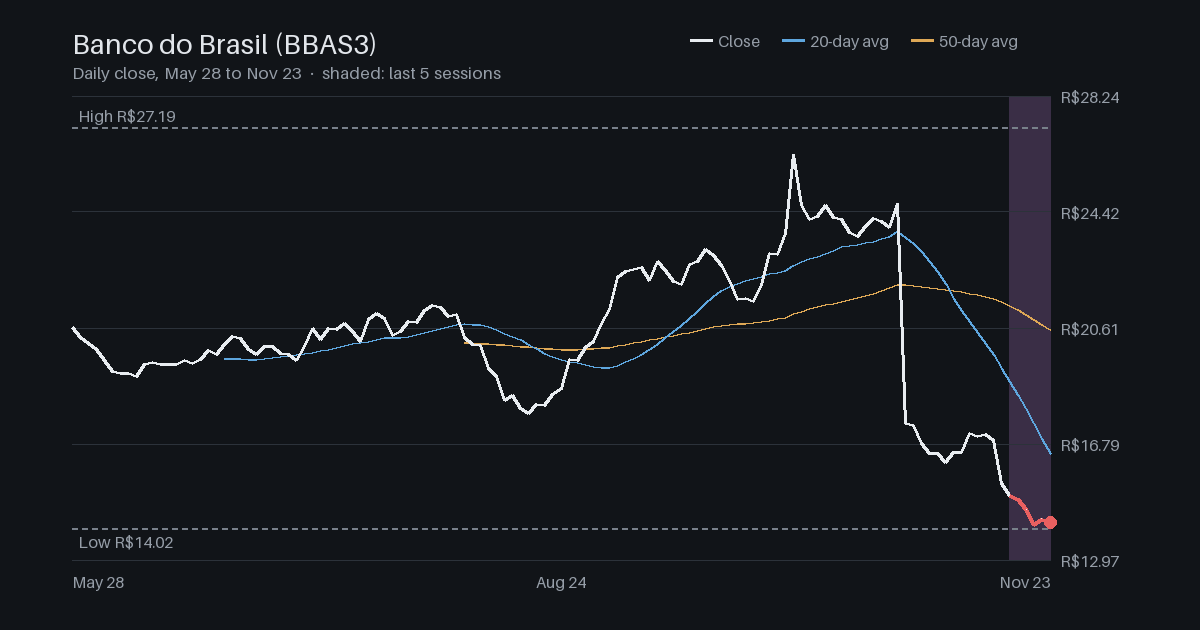
| Last close | R$14.20 | Closing price on Nov 23, 2026. |
|---|---|---|
| 5-session move | -6.0% | Change in the closing price over the last five trading days. |
| 20-day average | R$16.47 | The average closing price of the last 20 trading days. |
| 50-day average | R$20.56 | The average closing price of the last 50 trading days. |
| Period high | R$27.19 | Highest price since May 28, 2026. |
| Period low | R$14.02 | Lowest price since May 28, 2026. |
Related coverage
 Dollar Hits R$ 6.00 on Brazil Budget Woes, Hurting US Retail ETFsA historic spike in the US dollar to R$ 6.00 on domestic budget concerns directly erodes returns for American retail investors holding Brazil-focused ETFs.
 Braskem Secures $4.9 Billion Out-of-Court Debt DealBraskem has secured an out-of-court restructuring agreement with major creditors to swap debt for equity and inject $1.3 billion in cash, avoiding bankruptcy.
 Dollar Passes R$ 6.00 and Shakes Brazil ETFs Ahead of Fiscal VoteAmerican retail portfolios face erosion as the US dollar hits R$ 6.0010 and the iShares MSCI Brazil ETF reaches a 15-month low of $28.56 ahead of a fiscal vote.