

JBS Completes $150 Million Oman Halal Meat Joint Venture
JBS has completed a $150 million joint venture in Oman to build a halal protein platform, a geographic hedge against North American beef margin pressures.
Key takeaways
- JBS completed its transaction establishing a multiprotein production platform in Oman, per Business Wire on November 19, 2026
- The joint venture consolidates facilities to target an annual static capacity of 300,000 metric tons of protein, per StreetInsider on November 19, 2026
- JBS reported third-quarter net revenue of $22.74 billion but missed expectations with an EPS of $0.16, according to regulatory filings on November 9, 2026
Brazilian food giant jbs brazil meat completed its transaction establishing a multiprotein production platform in Oman on November 19, 2026, marking its largest investment in the Middle East. According to a press release on Business Wire, JBS finalized a $150 million investment to acquire an 80% stake in a newly created food holding company, while local partner Oman Food Capital (OFC) retains the remaining 20%. OFC serves as the food and agribusiness investment arm of the sovereign Oman Investment Authority. For retail investors holding brazil jbs stock, this strategic entry into upstream Middle Eastern production represents a long-term play to capture high-margin global halal meat markets and insulate earnings from cyclical pressures in North America.
The joint venture consolidates two existing production assets in Oman, aiming to build an integrated supply chain that bypasses volatile trade barriers, as detailed by StreetInsider. Capital from the transaction will primarily fund the completion of the A’Namaa integrated poultry plant in northern Oman and Al Bashayer's beef and lamb processing facility in southern Oman. Once fully operational, the platform is projected to reach an annual static production capacity of approximately 300,000 metric tons of protein. This industrial scale corresponds to processing roughly 1,000 head of cattle, 5,000 lambs, and 600,000 chickens daily, positioning the sultanate as a dominant regional export hub targeting over 2 billion halal consumers across the Middle East, Africa, and Asia.
This aggressive geographical pivot comes at a critical time for brazil jbs as it manages earnings headwinds in its traditional strongholds. While the parent company remains a dominant player in the Brazil economy, tight cattle supply in North America has squeezed beef margins. This pressure was evident in the company's Q3 2026 earnings report, where JBS posted a robust $22.74 billion in net revenue but missed quarterly consensus expectations with an earnings per share (EPS) of $0.16, according to regulatory filings on SEC.gov. Investing heavily in Omani poultry, lamb, and jbs brazil beef processing offers a geographical hedge, shifting capital toward regions where state-backed food security policies guarantee steady, long-term local demand.
Production at the beef and lamb facilities is scheduled to ramp up within the next six months, while the poultry facility is expected to come online within a year. The joint venture is also projected to create more than 3,000 direct jobs in Oman over the next five years. Investors should watch how quickly these facilities reach full capacity and whether this regional pivot can successfully offset the margin volatility currently affecting the company's US operations.
In your brokerage app
JBS N.V. is a global protein producer listed in New York on the NYSE under the ticker JBS. Retail investors holding the stock can trade its shares directly through standard brokerage accounts, while those seeking broader exposure to global consumer staples and food supply chains may look to international agribusiness exchange-traded funds (ETFs) that hold major global protein producers.
Analysis · NWX analysis desk
Which Brazil assets this touches
- JBS, JBSS3, CATTLE — Named in this story.
Technical picture · JBSS3 (JBSS3)
JBSS3 (JBSS3) closed at R$71.33 on Nov 18, 2026, up 3.4% from five sessions earlier. The last close is above its 20-day average of R$67.35 and above its 50-day average of R$64.37. Since May 25, 2026 it has traded between R$55.44 (low, Oct 1, 2026) and R$73.85 (high, Aug 19, 2026).
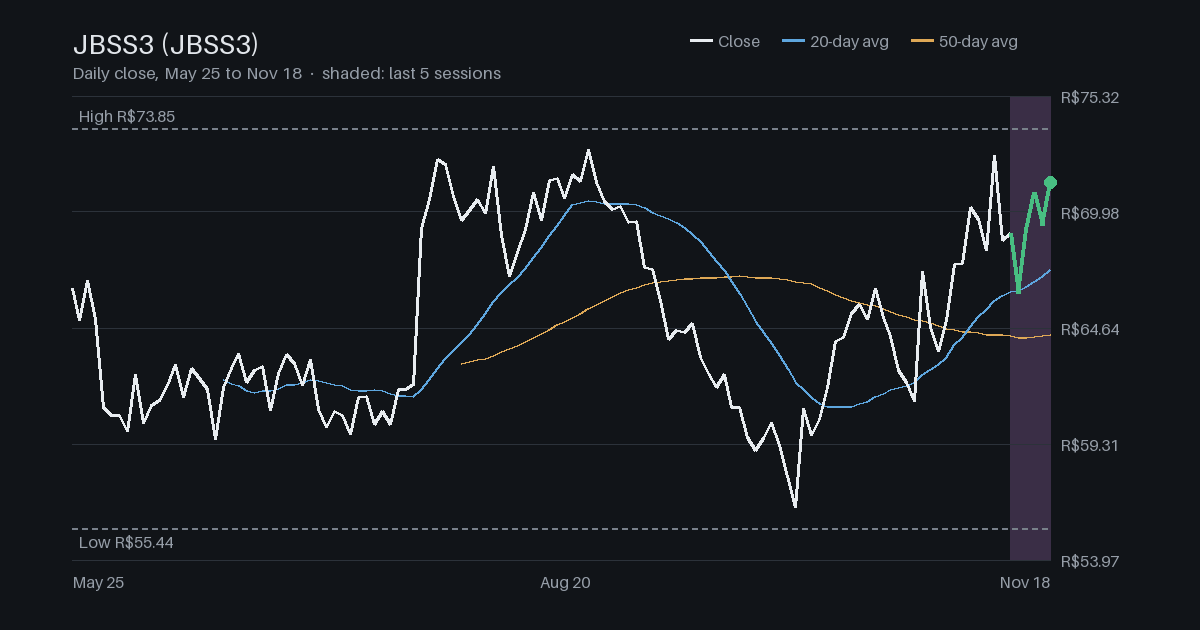
| Last close | R$71.33 | Closing price on Nov 18, 2026. |
|---|---|---|
| 5-session move | +3.4% | Change in the closing price over the last five trading days. |
| 20-day average | R$67.35 | The average closing price of the last 20 trading days. |
| 50-day average | R$64.37 | The average closing price of the last 50 trading days. |
| Period high | R$73.85 | Highest price since May 25, 2026. |
| Period low | R$55.44 | Lowest price since May 25, 2026. |
Related coverage
 Congress Fast-Tracks $8.4B Fiscal Package to Steady Sovereign BondsBrazilian lawmakers are fast-tracking a major R$ 50 billion fiscal package to prevent a sovereign bond sell-off and anchor soaring interest rate expectations.
 US Dollar Hits R$5.93, Prompting $1 Billion Brazil Central Bank SaleBrazil's central bank sold $1 billion in an emergency spot auction after the US dollar reached R$5.93 on fiscal fears and political delays.
 Spending Cap Cuts Head to Brazil's Lower House for Fast-Tracked VoteBrazil's Chamber of Deputies is set to vote Monday on PLP 299/2026, a fiscal bill lowering real spending growth to 2.0% to save up to R$56.1 billion in 2027.