

Congress Fast-Tracks $8.4B Fiscal Package to Steady Sovereign Bonds
Brazilian lawmakers are fast-tracking a major R$ 50 billion fiscal package to prevent a sovereign bond sell-off and anchor soaring interest rate expectations.

Key takeaways
- Chamber of Deputies rapporteur Mauro Benevides Filho presented a favorable report on the fiscal package keeping the Senate's text unchanged, per Band on November 19, 2026
- The fast-tracked bill is scheduled for an extraordinary vote on November 23, 2026, restricting spending growth to 2.0% during fiscal strain, per legislative filings on November 19, 2026
- The final negotiated package guarantees a net fiscal adjustment of R$ 50 billion in 2027 after governors negotiated concessions, per Estadão on November 19, 2026
Global emerging market investors managing portfolios from U.S. brokerage accounts are watching sovereign debt risks closely as rising global borrowing costs pressure international asset prices. In an effort to pre-empt a broader emerging-market bond sell-off and stabilize soaring interest rate expectations, a critical structural budget resolution in South America’s largest economy is being fast-tracked through the legislature, aiming for a final vote early next week.
On November 19, 2026, Mauro Benevides Filho, the rapporteur for the Chamber of Deputies (Brazil's lower house of Congress), presented a favorable report on the crucial fiscal package known as PLP 299/2026, according to reporting by Band on November 19, 2026. To accelerate the legislative process, Benevides Filho maintained the Senate's version of the text completely unchanged. This tactical move bypasses committee reviews, sending the bill directly to the floor for an extraordinary session scheduled for Monday, November 23, 2026, according to the Chamber’s official calendar published on November 19, 2026.
The central mechanism of the fast-tracked bill is a tighter ceiling on public spending. In years when the government is forced to implement budget freezes to meet its fiscal targets, the bill restricts the real growth of primary expenditures to 2.0% above inflation, down from the standard 2.5% cap under Brazil’s fiscal framework, according to legislative draft documents published on November 19, 2026. By creating an automatic trigger to compress spending during fiscal strain, the package seeks to reassure credit rating agencies and global investors that the government has the institutional tools to control its structural deficit.
The final negotiated version of the bill guarantees a net fiscal adjustment impact of R$ 50 billion (approximately $8.4 billion) in 2027, as reported by Estadão on November 19, 2026. This figure was reduced from the initial government projection of R$ 56 billion to accommodate regional demands from state governors, per Estadão's November 19, 2026 report. Despite pushback from opposition lawmakers who sought a more aggressive spending cut, the speaker of the Chamber of Deputies, Hugo Motta, forged a solid agreement with the administration of President Luiz Inácio Lula da Silva to block any amendments on the floor and push the package straight to presidential signature.
The final floor vote on Monday, November 23, 2026, represents the immediate hurdle for the package. Because PLP 299/2026 is a complementary law, it requires an absolute majority of 257 votes in the 513-member Chamber of Deputies to pass, under Brazilian constitutional rules verified on November 19, 2026. Analysts will watch whether the government’s coalition can hold this disciplined line without triggering further concessions, as a clean approval would allow the bill to go directly to President Lula for his signature, completing a major legislative effort before the end of the year.
In your brokerage app
American retail investors can track the progress of these structural reforms through the iShares MSCI Brazil ETF, a fund that holds major Brazilian equities listed in São Paulo. A successful passage of the budget adjustment is expected to ease pressure on local interest rate futures, offering a potential tailwind for heavily indebted local giants such as state-backed oil firm Petrobras and mining major Vale, both of which trade as American Depositary Receipts on the New York Stock Exchange.
Analysis · NWX analysis desk
Which Brazil assets this touches
- EWZ, IBOV, DI1, USDBRL — Named in this story.
Technical picture · iShares MSCI Brazil ETF (EWZ)
iShares MSCI Brazil ETF (EWZ) closed at $29.51 on Nov 19, 2026, down 7.1% from five sessions earlier. The last close is below its 20-day average of $32.64 and below its 50-day average of $36.96. Since May 18, 2026 it has traded between $29.51 (low, Nov 19, 2026) and $43.54 (high, Oct 9, 2026).
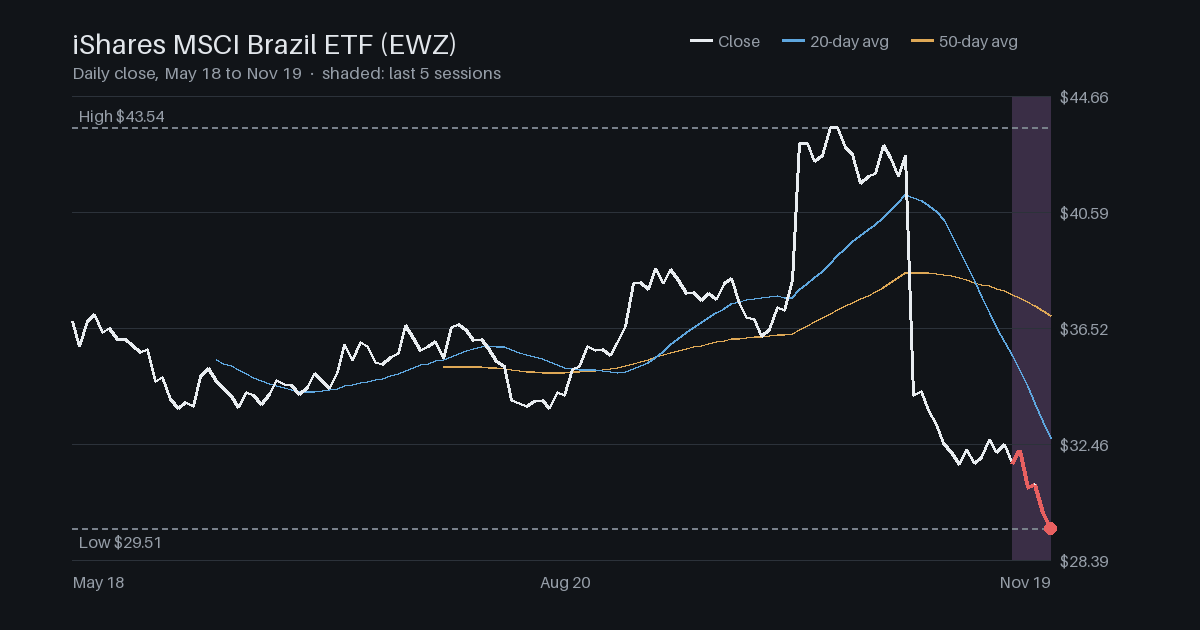
| Last close | $29.51 | Closing price on Nov 19, 2026. |
|---|---|---|
| 5-session move | -7.1% | Change in the closing price over the last five trading days. |
| 20-day average | $32.64 | The average closing price of the last 20 trading days. |
| 50-day average | $36.96 | The average closing price of the last 50 trading days. |
| Period high | $43.54 | Highest price since May 18, 2026. |
| Period low | $29.51 | Lowest price since May 18, 2026. |
Related coverage
 US Dollar Hits R$5.93, Prompting $1 Billion Brazil Central Bank SaleBrazil's central bank sold $1 billion in an emergency spot auction after the US dollar reached R$5.93 on fiscal fears and political delays.
 Spending Cap Cuts Head to Brazil's Lower House for Fast-Tracked VoteBrazil's Chamber of Deputies is set to vote Monday on PLP 299/2026, a fiscal bill lowering real spending growth to 2.0% to save up to R$56.1 billion in 2027.
 JBS Completes $150 Million Oman Halal Meat Joint VentureJBS has completed a $150 million joint venture in Oman to build a halal protein platform, a geographic hedge against North American beef margin pressures.