

US Dollar Hits R$5.93, Prompting $1 Billion Brazil Central Bank Sale
Brazil's central bank sold $1 billion in an emergency spot auction after the US dollar reached R$5.93 on fiscal fears and political delays.

Key takeaways
- Banco Central do Brasil executed an emergency $1 billion spot market sale, per official data on November 19, 2026
- The commercial US dollar hit a high of R$5.934, according to Gazeta do Povo on November 19, 2026
- President Lula stated he is in no rush to nominate cabinet ministers, according to Gazeta do Povo on November 19, 2026
- Former central bank open market chief Sérgio Goldenstein called the intervention a tactical error, according to UOL on November 19, 2026
The Brazilian central bank executed an emergency spot market sale of $1 billion on November 19, 2026, after the U.S. dollar surged to R$5.934 on the commercial market, according to official data from the Banco Central do Brasil. The dramatic volatility immediately reshaped the brazil dollar to usd rate, impacting U.S. retail investors holding exchange-traded funds and American Depositary Receipts (ADRs) that track South America's largest economy.
The central bank's extraordinary intervention on November 19, 2026, accepted five bids between 12:03 and 12:08 PM at a cut-off rate of R$5.860, as reported by Gazeta do Povo. This emergency spot sale followed another $1 billion in line auctions—dollar sales with repurchase agreements—conducted just one day prior on November 18, 2026, to inject much-needed liquidity into the foreign exchange market, per Gazeta do Povo.
The sudden drop in the Brazilian real was sparked by political commentary from President Luiz Inácio Lula da Silva on November 19, 2026. Speaking at an event in Brasília, Lula stated he was in "no rush" to nominate cabinet ministers for his upcoming fourth presidential term starting in 2027, according to Gazeta do Povo. The lack of definition, particularly regarding the next leader of the Ministry of Finance, spooked local dealers, causing dollar sellers to temporarily withdraw and drain liquidity from the spot market.
Critics, however, questioned the necessity and timing of the central bank's intervention. Sérgio Goldenstein, former head of the open market department at the central bank, argued in an interview published by UOL on November 19, 2026, that the institution made a tactical error by stepping in. Goldenstein stated that the surging dollar is a direct consequence of the government's delay in clarifying its fiscal direction, warning that using currency interventions to mask fiscal policy doubts could ultimately push domestic interest rates higher and increase the risk of stagflation in 2027, per UOL.
The broader currency sell-off highlights deep market concerns over Brazil's fiscal trajectory and rising public debt. Investors have repeatedly called for structural spending cuts from the Lula administration to ensure long-term fiscal sustainability. In the absence of a clear and comprehensive fiscal package, the market remains highly sensitive to political declarations, leaving the real exposed to further volatility as dealers await concrete details on how the government plans to meet its fiscal targets.
In your brokerage app
American investors holding the iShares MSCI Brazil ETF (EWZ), which is listed in New York, or American Depositary Receipts of major Brazilian companies such as state-run oil giant Petrobras (PBR) or private mining corporation Vale (VALE), will see their asset values directly reflect these currency fluctuations. When the Brazilian real weakens against the U.S. dollar, the underlying value of these holdings in U.S. brokerage accounts declines, even if local share prices on the São Paulo exchange (B3) remain unchanged. For those looking to invest in Brazil, currency volatility remains a primary risk factor as the USD BRL exchange rate heavily influences the performance of B3 stocks and the benchmark Ibovespa today. While the central bank's currency interventions provide temporary relief, the long-term outlook for New York-listed assets remains tied to both the upcoming fiscal definitions and future Copom decisions on the benchmark Selic interest rate.
Analysis · NWX analysis desk
Which Brazil assets this touches
- EWZ, IBOV, USDBRL — Named in this story.
Technical picture · iShares MSCI Brazil ETF (EWZ)
iShares MSCI Brazil ETF (EWZ) closed at $29.51 on Nov 19, 2026, down 7.1% from five sessions earlier. The last close is below its 20-day average of $32.64 and below its 50-day average of $36.96. Since May 18, 2026 it has traded between $29.51 (low, Nov 19, 2026) and $43.54 (high, Oct 9, 2026).
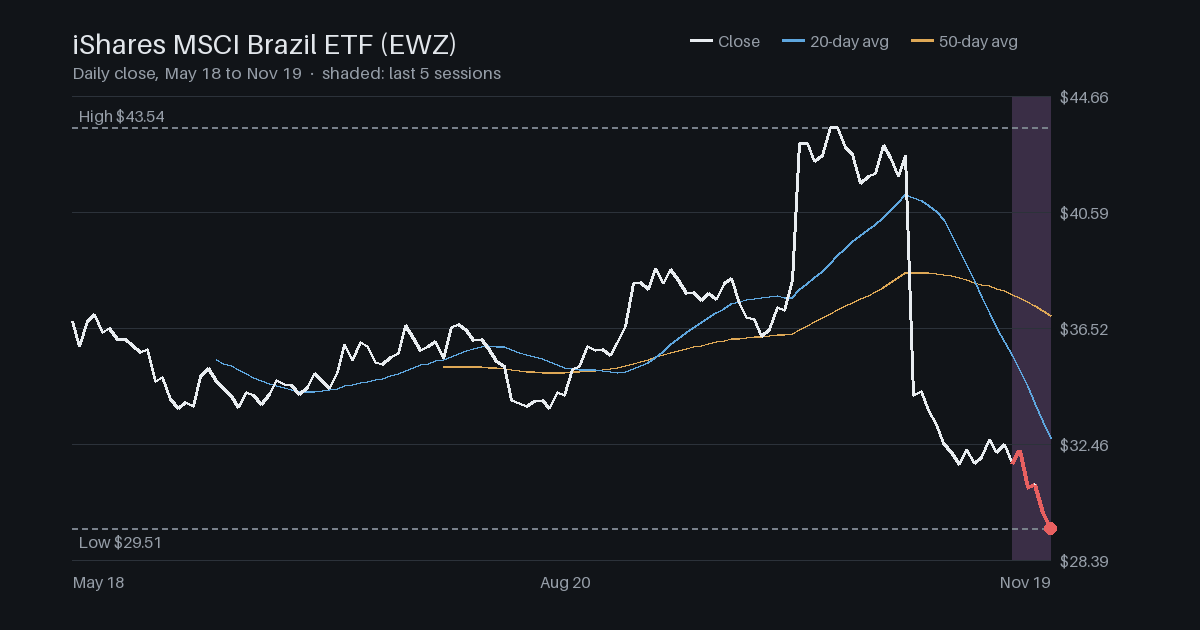
| Last close | $29.51 | Closing price on Nov 19, 2026. |
|---|---|---|
| 5-session move | -7.1% | Change in the closing price over the last five trading days. |
| 20-day average | $32.64 | The average closing price of the last 20 trading days. |
| 50-day average | $36.96 | The average closing price of the last 50 trading days. |
| Period high | $43.54 | Highest price since May 18, 2026. |
| Period low | $29.51 | Lowest price since May 18, 2026. |
Related coverage
 Congress Fast-Tracks $8.4B Fiscal Package to Steady Sovereign BondsBrazilian lawmakers are fast-tracking a major R$ 50 billion fiscal package to prevent a sovereign bond sell-off and anchor soaring interest rate expectations.
 Spending Cap Cuts Head to Brazil's Lower House for Fast-Tracked VoteBrazil's Chamber of Deputies is set to vote Monday on PLP 299/2026, a fiscal bill lowering real spending growth to 2.0% to save up to R$56.1 billion in 2027.
 JBS Completes $150 Million Oman Halal Meat Joint VentureJBS has completed a $150 million joint venture in Oman to build a halal protein platform, a geographic hedge against North American beef margin pressures.