

UBS BB Cuts Brazil Exchange Operator B3 Target to R$ 16
UBS BB downgraded Brazil stock exchange operator B3 to neutral and slashed its target price to R$ 16.00, citing headwinds from high interest rates.

Key takeaways
- UBS BB downgraded exchange operator B3 to neutral and cut its target price to R$ 16.00, per CNN Brasil on November 23, 2026
- Brazil's central bank kept its benchmark Selic rate at 13.75%, per G1 on November 4, 2026
- Foreign investors withdrew R$ 5 billion from Brazilian equities, per B3 data on November 12, 2026
American retail investors watching their global portfolios have grown accustomed to high interest rates at home, but the situation in Latin America's largest economy is proving far more stubborn. Brazil's benchmark interest rate is stuck deep in double-digit territory, creating a powerful headwind for the country's financial sector and choking off the flow of capital into public markets.
On November 23, 2026, investment bank UBS BB downgraded b3.com.br, the company that operates Brazil's sole stock exchange, from buy to neutral. Pointing to the prolonged high-interest-rate environment, analysts slashed their target price for the exchange operator by nearly 40%, dropping it from R$ 26.50 to R$ 16.00.
The downgrade reflects a fundamental shift in how domestic capital is moving in Brazil. On November 4, 2026, Brazil's central bank paused its benchmark Selic rate at a restrictive 13.75%. With risk-free government bonds offering highly attractive, low-risk yields, local institutional and retail investors have little incentive to rotate their capital into volatile equities, keeping stock market trading volumes severely depressed.
This domestic stagnation is compounded by a retreat of international capital. Foreign investors withdrew R$ 5 billion from Brazilian equities during the first half of November 2026 alone, according to market data compiled by b3.com.br. Without a meaningful drop in local interest rates to spark domestic interest or a return of foreign liquidity, analysts expect equity capital market volumes to remain muted well into 2027, directly squeezing B3's listing fees and transaction-based revenues.
In your brokerage app
For US retail investors holding the iShares MSCI Brazil ETF, which tracks the broader Brazilian market, the fortunes of the country's financial infrastructure are closely linked to overall fund performance. The exchange operator B3 is listed locally in São Paulo, and its prolonged transaction squeeze highlights the broader valuation pressure currently facing Brazilian equities within diversified emerging market funds.
Analysis · NWX analysis desk
Which Brazil assets this touches
- EWZ, IBOV, DI1, USDBRL — Named in this story.
Technical picture · iShares MSCI Brazil ETF (EWZ)
iShares MSCI Brazil ETF (EWZ) closed at $28.54 on Nov 20, 2026, down 11.4% from five sessions earlier. The last close is below its 20-day average of $31.94 and below its 50-day average of $36.77. Since May 20, 2026 it has traded between $28.54 (low, Nov 20, 2026) and $43.54 (high, Oct 9, 2026).
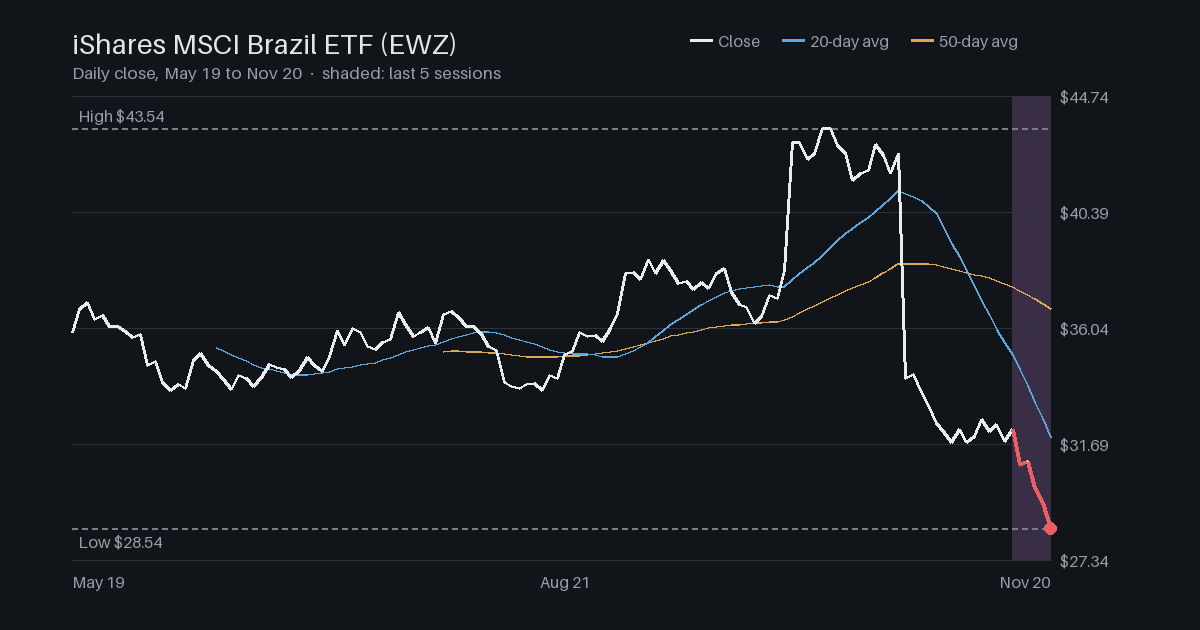
| Last close | $28.54 | Closing price on Nov 20, 2026. |
|---|---|---|
| 5-session move | -11.4% | Change in the closing price over the last five trading days. |
| 20-day average | $31.94 | The average closing price of the last 20 trading days. |
| 50-day average | $36.77 | The average closing price of the last 50 trading days. |
| Period high | $43.54 | Highest price since May 20, 2026. |
| Period low | $28.54 | Lowest price since May 20, 2026. |
Related coverage
 Dollar Breaches 6.00 Reais as Lula Pulls Minister for Fiscal VoteThe U.S. dollar briefly crossed 6.00 Brazilian reais as President Lula temporarily dismissed a minister to secure a vote on a 56 billion-real fiscal package.
 Vale Restarts Viga Iron Ore Mine After 10-Month ShutdownVale S.A. obtains judicial and federal approval to partially resume iron ore operations at its Viga mine in Minas Gerais, idle since January.
 US Soybean Speculators Hold Large Net-Long Position on CBOTWeekly CFTC data shows non-commercial traders held a net-long position of 145,816 soybean contracts as of November 17, 2026, amid strong Brazilian planting.