

Morgan Stanley Cuts Brazil Equity Rating as Fiscal Risks Mount
Morgan Stanley downgrades Brazilian equities to underweight, citing fiscal concerns and high interest rates that could pressure corporate earnings.

Key takeaways
- Morgan Stanley downgraded Brazilian equities to underweight, citing fiscal risks, per its strategy report on November 15, 2026
- The bank's analysts project corporate earnings could fall 10% to 20% due to high interest rates, per Morgan Stanley on November 16, 2026
- The Ibovespa index slid 1.83% and the Brazilian real fell 2.15% to 5.7767 per dollar, per market data on November 16, 2026
Global funds managing international stock portfolios are scaling back their exposure to South America after a major Wall Street investment bank warned of worsening local fiscal conditions. On November 15, 2026, Morgan Stanley slashed its regional equity rating to underweight from equal-weight, signaling to foreign retail investors and pension managers alike that the continent's largest economy is facing headwinds that could compromise stock returns.
The target of this major downgrade is Brazil, whose stock market has long been a key holding for emerging-market exchange-traded funds held by American retail investors. Morgan Stanley’s equity strategists, including Nikolaj Lippmann, Julia Nogueira, and Marcos Rios, warned in their November 15, 2026 report that the country's benchmark stock index, the Ibovespa, is expected to experience a downward trend by late 2027 compared to its prior levels. The bank's analysts argue that the lack of a clear, credible fiscal framework to control the nation's rising public debt, combined with double-digit local interest rates that drain corporate profits, has severely damaged the country's investment thesis.
In their client report, reported by Forbes Brasil on November 16, 2026, the strategists wrote that the economy is slowing down, while high interest rates continue to drain risk appetite and domestic investment. According to the bank's November 16, 2026 estimates, the forward price-to-earnings multiple of Brazilian stocks is projected to contract by late 2027. Under high domestic interest rates, local capital is fleeing the equity market for the safety of government bonds, leaving stocks without their traditional base of buyers. Additionally, Morgan Stanley’s team projects that corporate earnings could drop by as much as 20% if economic activity continues to slow under the weight of the central bank's tight monetary policy.
The Wall Street pivot triggered immediate selling pressure on November 16, 2026. Combined with weak global commodity prices, the downgrade caused the Ibovespa index to fall 1.83% in local trading, while the commercial exchange rate of the Brazilian real surged 2.15% to close at 5.7767 reals per U.S. dollar, according to market data from that session. The rapid depreciation of the real directly erodes the dollar-denominated returns of foreign investors holding these assets, highlighting how fiscal instability quickly translates into currency losses.
Looking forward, global asset managers will be watching for the government's response to these fiscal concerns. While other Latin American nations like Chile and Argentina were upgraded or favored by Morgan Stanley on November 16, 2026, for their strategic positions in copper, lithium, or energy, the Brazilian government faces growing pressure from both local and international financial institutions to deliver concrete spending cuts. Investors will closely monitor the next monetary policy decisions from the central bank to see if interest rates will remain elevated throughout 2027.
In your brokerage app
For retail investors holding diversified international funds, this shift is already reflecting in brokerage accounts. The downgrade puts negative pressure on major US-listed exchange-traded funds like the iShares MSCI Brazil ETF (EWZ), which tracks the country's largest firms, as well as New York-listed American Depositary Receipts (ADRs) of state-controlled oil producer Petrobras (PBR) and mining giant Vale (VALE). It also impacts major Brazilian banks traded in New York, including Itaú Unibanco (ITUB) and Banco Bradesco (BBD). A weaker Brazilian real (USDBRL) means the value of these US-listed shares can decline even if the underlying businesses remain profitable in local currency terms.
Analysis · NWX analysis desk
Which Brazil assets this touches
- EWZ, PBR, VALE, ITUB, BBD, USDBRL — Named in this story.
Fundamentals · Petrobras (PETR4)
Petrobras (PETR4) trades at 4.0x its yearly earnings and 1.1x its book value. Its return on equity is 27.8%. Its dividend yield is 8.3%. The market values the company at R$626.6 billion. Its financial health score is 81 out of 100 (strong), based on profitability, liquidity, debt and growth. Latest: Q3 2026 results, published Nov 10, 2026.
| Price / earnings (P/E) | 4.0x | How many years of the current yearly profit the share price adds up to. |
|---|---|---|
| Price / book (P/B) | 1.1x | The share price compared with the accounting value of what the company owns, per share. |
| Return on equity (ROE) | 27.8% | Yearly profit for every R$100 that shareholders have put into the company. |
| Net margin | 23.8% | The part of every R$100 in sales that is left as profit. |
| Dividend yield | 8.3% | Cash paid to shareholders over the past year, as a share of today's price. |
| Market value | R$626.6 billion | What the whole company is worth at today's share price. |
Technical picture · iShares MSCI Brazil ETF (EWZ)
iShares MSCI Brazil ETF (EWZ) closed at $30.92 on Nov 16, 2026, down 5.2% from five sessions earlier. The last close is below its 20-day average of $34.48 and below its 50-day average of $37.46. Since May 13, 2026 it has traded between $30.92 (low, Nov 16, 2026) and $43.54 (high, Oct 9, 2026).
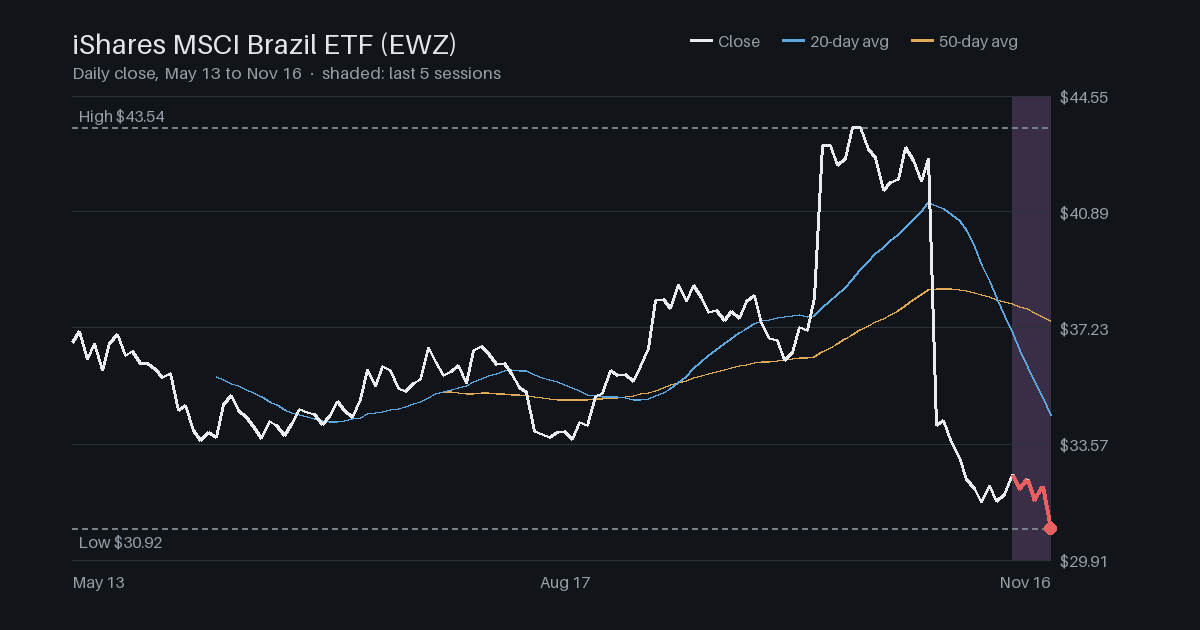
| Last close | $30.92 | Closing price on Nov 16, 2026. |
|---|---|---|
| 5-session move | -5.2% | Change in the closing price over the last five trading days. |
| 20-day average | $34.48 | The average closing price of the last 20 trading days. |
| 50-day average | $37.46 | The average closing price of the last 50 trading days. |
| Period high | $43.54 | Highest price since May 13, 2026. |
| Period low | $30.92 | Lowest price since May 13, 2026. |
Related coverage
 Telefonica Brasil Details ADR Dividend Payouts in SEC FilingTelefonica Brasil S.A. filed an SEC Form 6-K on November 17, 2026, detailing two cash distributions of R$0.172890 and R$0.239360 net per ADR.
 Petrobras Boosts 2026 Projections on Strong Offshore OutputPetrobras raised its 2026 cash flow forecast to $45B–$50B and oil production guidance to 3.3M–3.4M boed, while approving an interim dividend of $0.2161.