

Global Infrastructure Shares Face Risk as Cosan CEO Resigns
Cosan's sudden CEO transition and critical 0.3x interest coverage ratio overshadow its return to profitability, exposing global investors to governance risk.

Key takeaways
- Cosan announced CEO Marcelo Martins will step down on January 4, 2027, with Guilherme Penin taking over as interim chief, per company CVM filing on November 13, 2026
- Cosan reported Q3 2026 consolidated net income of BRL 190 million, reversing a BRL 1.185 billion loss, per financial disclosures on November 13, 2026
- Cosan maintained a critical debt service coverage ratio of 0.3x, keeping leverage at 8.54x net debt to EBITDA, per quarterly reports on November 13, 2026
Global energy and infrastructure portfolios face heightened governance and financial risk following a sudden leadership transition at the Brazilian conglomerate Cosan S.A. According to Cosan’s regulatory announcement reported by InfoMoney on November 13, 2026, Chief Executive Officer Marcelo Martins will step down on January 4, 2027, with Vice President of Strategy Guilherme Penin taking over on an interim basis. The sudden transition comes as the massive holding company grapples with an acute debt crisis, overshadowing its recent return to operational profitability.
Cosan is one of the largest infrastructure, biofuels, and energy players in South America, controlling major railway operator Rumo, natural gas distributor Compass, and lubricants manufacturer Moove. In its third-quarter earnings report released on November 13, 2026, the conglomerate posted a consolidated net income of BRL 190 million, a major turnaround that reversed a heavy BRL 1.185 billion net loss from the third quarter of 2025, per financial disclosures compiled by Money Times. However, this operational recovery was severely undermined by a critical debt service coverage ratio (DSCR) of just 0.3x, meaning holding-level cash flow covered only 30% of its immediate financial obligations during the period, according to Rico aos Poucos.
High local interest rates in Brazil have kept financial expenses elevated, absorbing a massive portion of the cash generated by Cosan's underlying business units. To manage its BRL 9.5 billion in expanded net debt and keep leverage at 8.54 times net debt to EBITDA, the holding company has had to resort to rapid divestments and restructuring, per Rico aos Poucos data from November 13, 2026. This includes the early November 2026 sale of its Radar agricultural land assets for BRL 808 million and ongoing negotiations to sell down its stake in railway operator Rumo.
Outgoing CEO Marcelo Martins, a 20-year veteran of the company, will not exit the group entirely. According to Cosan's filing with Brazil's securities regulator, the CVM, on November 13, 2026, Martins will retain his seats on the boards of Cosan, Rumo, Compass, and Moove to guide the transition and assist with ongoing mergers and acquisitions, per details published by InfoMoney. Guilherme Penin, who has ten years of experience at Cosan and over two decades in the infrastructure sector, is now tasked with executing this pivot from aggressive expansion to strict debt reduction.
Investors will closely monitor how the interim leadership navigates upcoming asset sales and the company's stated goal of raising its debt service coverage ratio to a range of 0.8x to 1.2x by the end of December 2026, according to corporate presentations sourced by Investing.com. The progress of subsidiary-level cash generation and regulatory approvals for divestments will determine whether Cosan can successfully stabilize its capital structure without further diluting its high-value holdings.
In your brokerage app
For retail investors, direct exposure to Cosan’s debt rehabilitation runs through its New York-listed American Depositary Receipts trading under the ticker CSAN, as well as through broader emerging market infrastructure exchange-traded funds. Additionally, the operational health of its key subsidiaries—such as railway operator Rumo and gas distributor Compass—directly impacts global infrastructure, biofuels, and energy sectors, making Cosan a crucial bellwether for South American utility and logistics risk.
Analysis · NWX analysis desk
Which Brazil assets this touches
- CSAN, CSAN3, USDBRL — Named in this story.
Technical picture · CSAN3 (CSAN3)
CSAN3 (CSAN3) closed at R$3.10 on Nov 13, 2026, up 11.9% from five sessions earlier. The last close is below its 20-day average of R$3.37 and below its 50-day average of R$3.83. Since May 20, 2026 it has traded between R$2.16 (low, Oct 30, 2026) and R$5.47 (high, Oct 9, 2026).
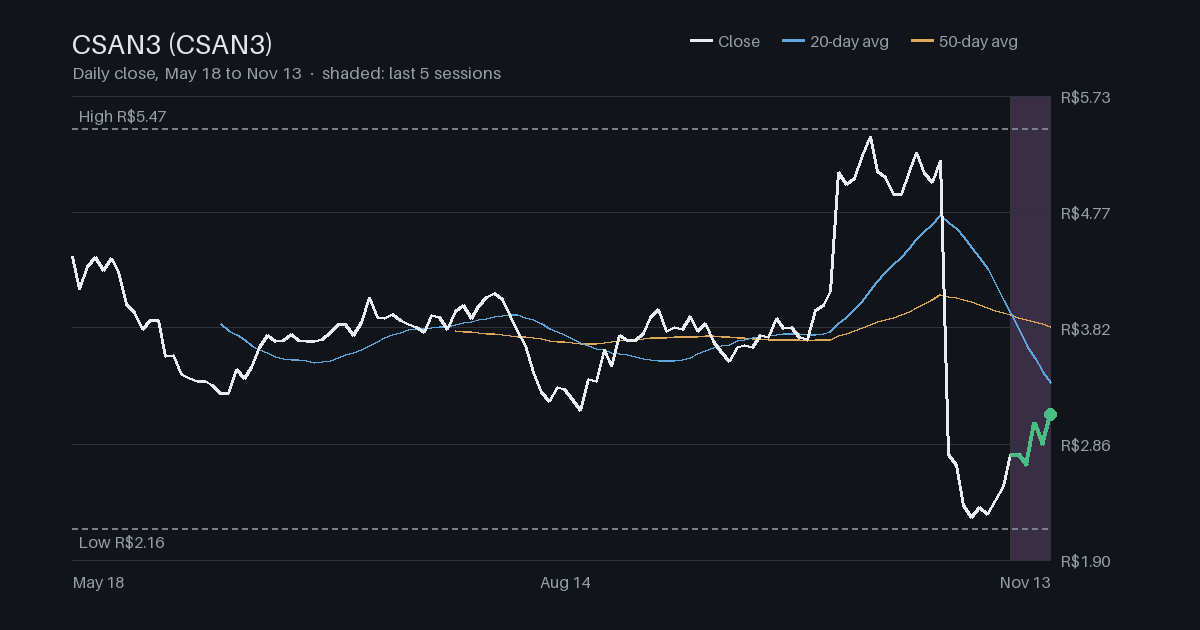
| Last close | R$3.10 | Closing price on Nov 13, 2026. |
|---|---|---|
| 5-session move | +11.9% | Change in the closing price over the last five trading days. |
| 20-day average | R$3.37 | The average closing price of the last 20 trading days. |
| 50-day average | R$3.83 | The average closing price of the last 50 trading days. |
| Period high | R$5.47 | Highest price since May 20, 2026. |
| Period low | R$2.16 | Lowest price since May 20, 2026. |
Related coverage
 Telefonica Brasil Details ADR Dividend Payouts in SEC FilingTelefonica Brasil S.A. filed an SEC Form 6-K on November 17, 2026, detailing two cash distributions of R$0.172890 and R$0.239360 net per ADR.
 Petrobras Boosts 2026 Projections on Strong Offshore OutputPetrobras raised its 2026 cash flow forecast to $45B–$50B and oil production guidance to 3.3M–3.4M boed, while approving an interim dividend of $0.2161.