

Global Crop Supply Cushion Narrows as Farm Land Expansion Slows
Bank of America forecasts Brazil's crop acreage expansion will slow to 1.5% in the 2026/27 season, tightening the global safety net for grains.
Key takeaways
- Bank of America projects Brazil’s grains and oilseeds acreage to expand by only 1.5% in the 2026/27 season, per BofA on November 14, 2026
- Brazil has supplied 35% of the growth in global planted area over the past 15 years, per BofA on November 14, 2026
- Government fiscal adjustments will dictate Brazil's ability to attract foreign capital, per Bank of America on November 19, 2026
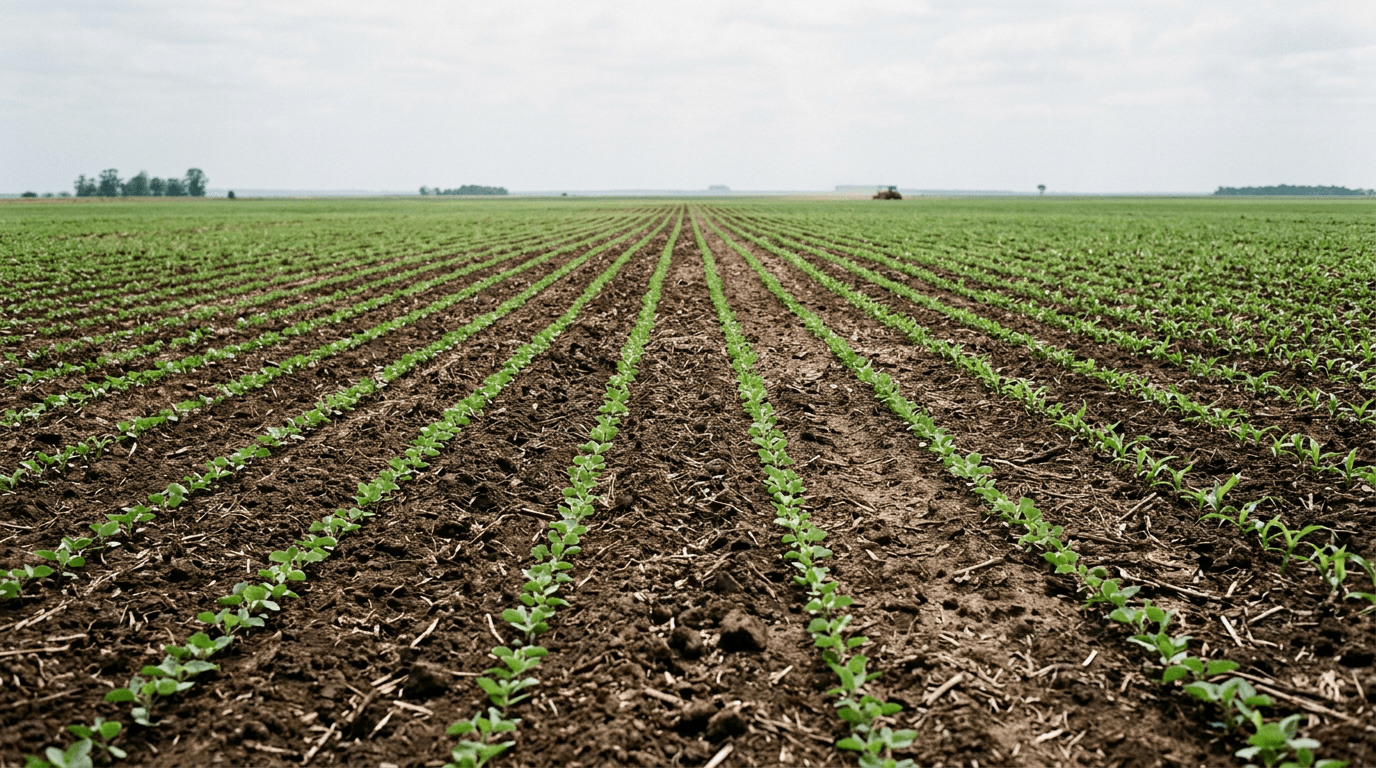
Global food buyers and biofuel manufacturers are facing a tighter cushion against supply shocks as the expansion of the world's most critical agricultural land bank begins to slow. Bank of America Global Research commodity strategists forecast that Brazil’s grains and oilseeds acreage will expand by only 1.5%—roughly 1 million hectares—in the 2026/27 season, according to a report published on November 14, 2026. This projected deceleration marks a significant departure from years of rapid land conversion that kept international commodity prices in check.
This 1.5% growth rate lands below the official estimates of 2.0% (representing 1.5 million hectares) published by the U.S. Department of Agriculture and Brazil's national supply agency, CONAB, on November 14, 2026. The gap matters because Brazil has supplied approximately 35% of the total increase in global planted area over the past 15 years, according to the BofA report. By adding fewer hectares to its fields, the world loses a primary shock absorber against bad weather in other major farming regions.
Behind the brazil soybean corn 2027 forecast, the projected deceleration in brazil soybeans corn acreage is driven by several economic headwinds. Even with a weaker local currency lifting local-currency revenues for exporters, high fertilizer costs and steep interest rates have squeezed margins. To sustain further massive agricultural development, Brazil must draw in fresh international capital.
Attracting that capital requires addressing domestic macroeconomic challenges. Executives from Bank of America noted on November 19, 2026, that the country has a relevant opportunity to capture foreign investments, but that government fiscal reform will make all the difference, according to reporting by Bloomberg Línea. Global funds are closely watching whether Brazil can successfully implement its spending cuts and anchor its public accounts.
Looking forward, agricultural buyers should monitor whether the slower planting pace forces a larger-than-expected drawdown of existing global inventories during the 2026/27 harvest cycle. The next crucial indicator will be CONAB's updated planting progress reports and revised global crop supply balances, which will determine if international prices must rise to incentivize the next wave of land expansion.
In your brokerage app
For retail investors tracking global grain supply balances and agricultural futures, this tightening safety net directly affects exchange-traded funds holding soybean and corn contracts. It also impacts large land-operating companies like Adecoagro S.A., listed in New York, whose margins track regional crop yields and land valuation. Additionally, swings in agricultural export revenues can impact the broader iShares MSCI Brazil ETF (EWZ) and the USD BRL exchange rate.
Analysis · NWX analysis desk
Which Brazil assets this touches
- EWZ, SOYBEAN, CORN, USDBRL — Named in this story.
Technical picture · iShares MSCI Brazil ETF (EWZ)
iShares MSCI Brazil ETF (EWZ) closed at $28.54 on Nov 20, 2026, down 11.4% from five sessions earlier. The last close is below its 20-day average of $31.94 and below its 50-day average of $36.77. Since May 19, 2026 it has traded between $28.54 (low, Nov 20, 2026) and $43.54 (high, Oct 9, 2026).
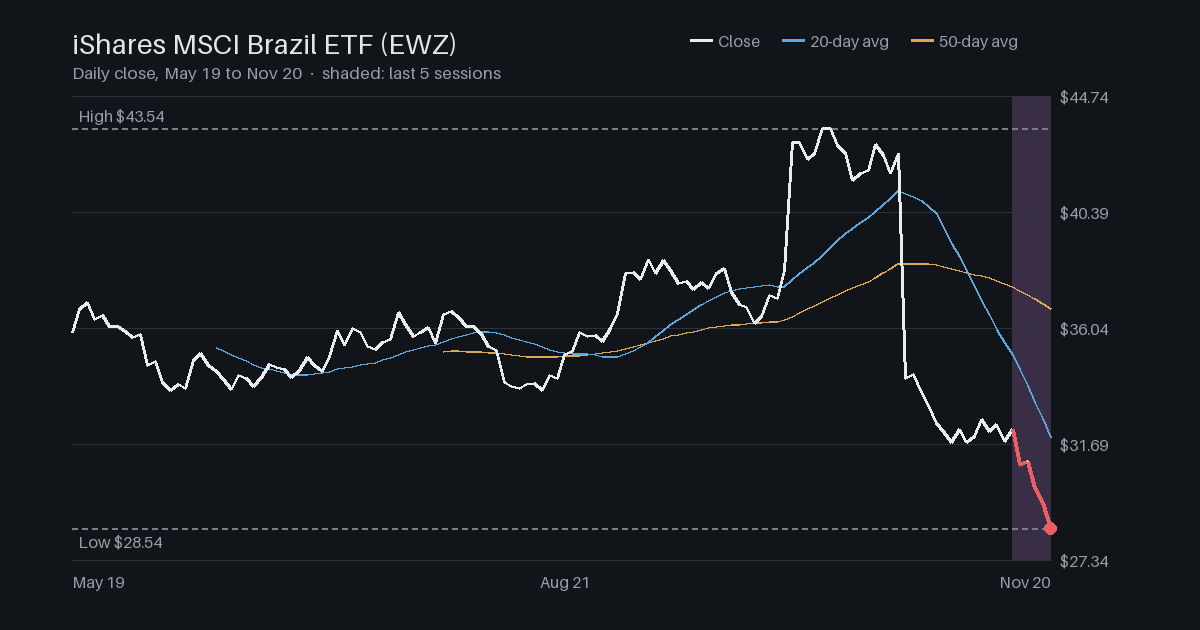
| Last close | $28.54 | Closing price on Nov 20, 2026. |
|---|---|---|
| 5-session move | -11.4% | Change in the closing price over the last five trading days. |
| 20-day average | $31.94 | The average closing price of the last 20 trading days. |
| 50-day average | $36.77 | The average closing price of the last 50 trading days. |
| Period high | $43.54 | Highest price since May 19, 2026. |
| Period low | $28.54 | Lowest price since May 19, 2026. |
Related coverage
 Bank of America Warns Brazil Must Pass Fiscal Cuts to Keep CapitalBank of America warns that foreign capital inflows to Brazil depend on its upcoming fiscal cuts, keeping its year-end 2027 exchange rate target at 5.85 reais.
 Petrobras Raises 2026 Investment to $22B and Approves DividendPetrobras approved a $2.786 billion dividend and boosted its 2026 cash investment target to up to $22 billion alongside higher production forecasts.
 Farm Debt Crisis Plunges Bank Profits, Squeezing iShares Brazil ETFA severe agribusiness default crisis at Banco do Brasil drove a 66.5% plunge in Q3 2026 profits, dragging down valuations in the iShares MSCI Brazil ETF.