

Morgan Stanley Cuts Its Brazil Equity Rating, a Headwind for Emerging Market ETFs
Morgan Stanley cuts its model allocation for Brazilian equities to underweight, citing persistent interest rate pressures and corporate earnings risks.

Key takeaways
- Morgan Stanley downgraded its model allocation for Brazilian equities to underweight, per InfoMoney on November 16, 2026
- Strategists forecast the Ibovespa could decline to 160,000 points by the end of 2027, per InfoMoney on November 16, 2026
- Analysts warn of a 10% to 20% risk of downward revisions to corporate earnings, per InfoMoney on November 16, 2026
Global diversified portfolios and emerging market exchange-traded funds face a shifting landscape after Morgan Stanley adjusted its Latin American equity allocations on November 15, 2026. In its latest strategy report, the investment bank's research team revised its stance on the region's largest market, lowering its model allocation for Brazilian equities to "underweight" relative to its benchmark. The bank's strategists cited elevated borrowing costs and expected economic deceleration as key factors behind their shift, emphasizing that their model suggests a potential 10% to 20% risk of downward revisions to corporate earnings.
The revision, detailed by InfoMoney on November 16, 2026, marks the second time within a month that Morgan Stanley has reduced its exposure models for Brazil. On October 26, 2026, immediately following the reelection of President Luiz Inácio Lula da Silva on October 25, 2026, the bank's research team had already adjusted its stance from overweight to equal-weight. In their latest assessment, the strategists argued that high interest rates in Brazil are creating a "crowding out" effect, which they believe could suppress corporate risk-taking and domestic equity demand.
Within the strategy report, Morgan Stanley's analysts outlined a scenario where the benchmark Ibovespa index could decline to 160,000 points by the end of 2027. This projection represents a 7.2% potential decrease from the index's close of 172,457.77 points on November 13, 2026. The bank's analysts presented this figure as a calculated target based on their macro models, rather than a guaranteed future return or a firm market prediction, noting that the outlook remains highly sensitive to public debt trajectories and domestic policy shifts.
This cautious assessment of Brazilian equities is part of a broader reassessment by international financial institutions. Just days prior to the Morgan Stanley report, Swiss banking group UBS also reduced its model exposure to the nation’s stock market, noting in its own reports that other emerging economies like Chile, South Korea, and India presented more competitive growth-to-return dynamics, as documented by InfoMoney on November 16, 2026.
Going forward, analysts and market participants are closely watching the Brazilian government's ongoing fiscal negotiations in Congress. If the administration does not implement a fiscal framework capable of stabilizing the growth trajectory of the country's public debt, Morgan Stanley’s report warns that domestic capital may continue to seek refuge in international assets, keeping local interest rates elevated and weighing heavily on local stock valuations.
In your brokerage app
For retail investors tracking exchange-traded products like the iShares MSCI Brazil ETF (EWZ), which holds the country's largest listed equities, these institutional allocation shifts highlight a period of increased domestic headwind. In its report, Morgan Stanley’s strategy team clarified that while they maintain a model preference for New York-listed commodity exporters with dollar-denominated earnings—citing companies like Petrobras, Suzano, and Embraer within their model portfolio selections—the broader Brazilian equity basket remains sensitive to local borrowing costs. These selections reflect the bank's internal institutional strategy and do not constitute direct investment recommendations for individual traders.
Analysis · NWX analysis desk
Which Brazil assets this touches
- EWZ, IBOV, USDBRL — Named in this story.
Technical picture · iShares MSCI Brazil ETF (EWZ)
iShares MSCI Brazil ETF (EWZ) closed at $32.22 on Nov 13, 2026, up 0.8% from five sessions earlier. The last close is below its 20-day average of $35.03 and below its 50-day average of $37.59. Since May 13, 2026 it has traded between $31.73 (low, Nov 3, 2026) and $43.54 (high, Oct 9, 2026).
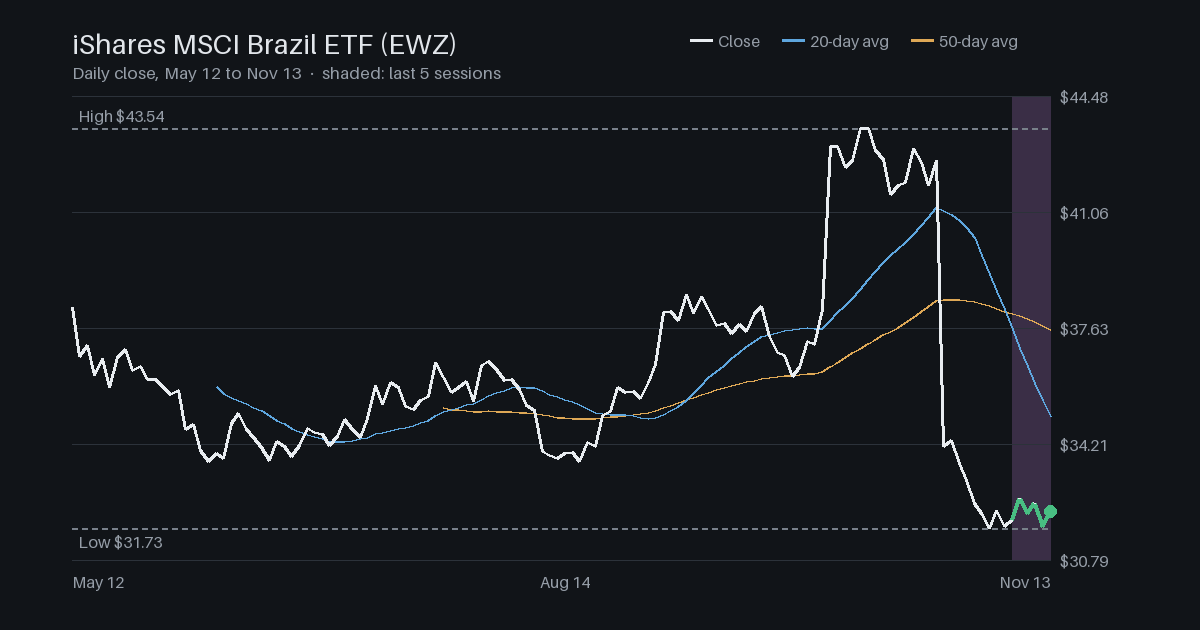
| Last close | $32.22 | Closing price on Nov 13, 2026. |
|---|---|---|
| 5-session move | +0.8% | Change in the closing price over the last five trading days. |
| 20-day average | $35.03 | The average closing price of the last 20 trading days. |
| 50-day average | $37.59 | The average closing price of the last 50 trading days. |
| Period high | $43.54 | Highest price since May 13, 2026. |
| Period low | $31.73 | Lowest price since May 13, 2026. |
Related coverage
 Telefonica Brasil Details ADR Dividend Payouts in SEC FilingTelefonica Brasil S.A. filed an SEC Form 6-K on November 17, 2026, detailing two cash distributions of R$0.172890 and R$0.239360 net per ADR.
 Petrobras Boosts 2026 Projections on Strong Offshore OutputPetrobras raised its 2026 cash flow forecast to $45B–$50B and oil production guidance to 3.3M–3.4M boed, while approving an interim dividend of $0.2161.