

Farm Debt Crisis Halves Lender's Profit Outlook, Shaking Key US ETF
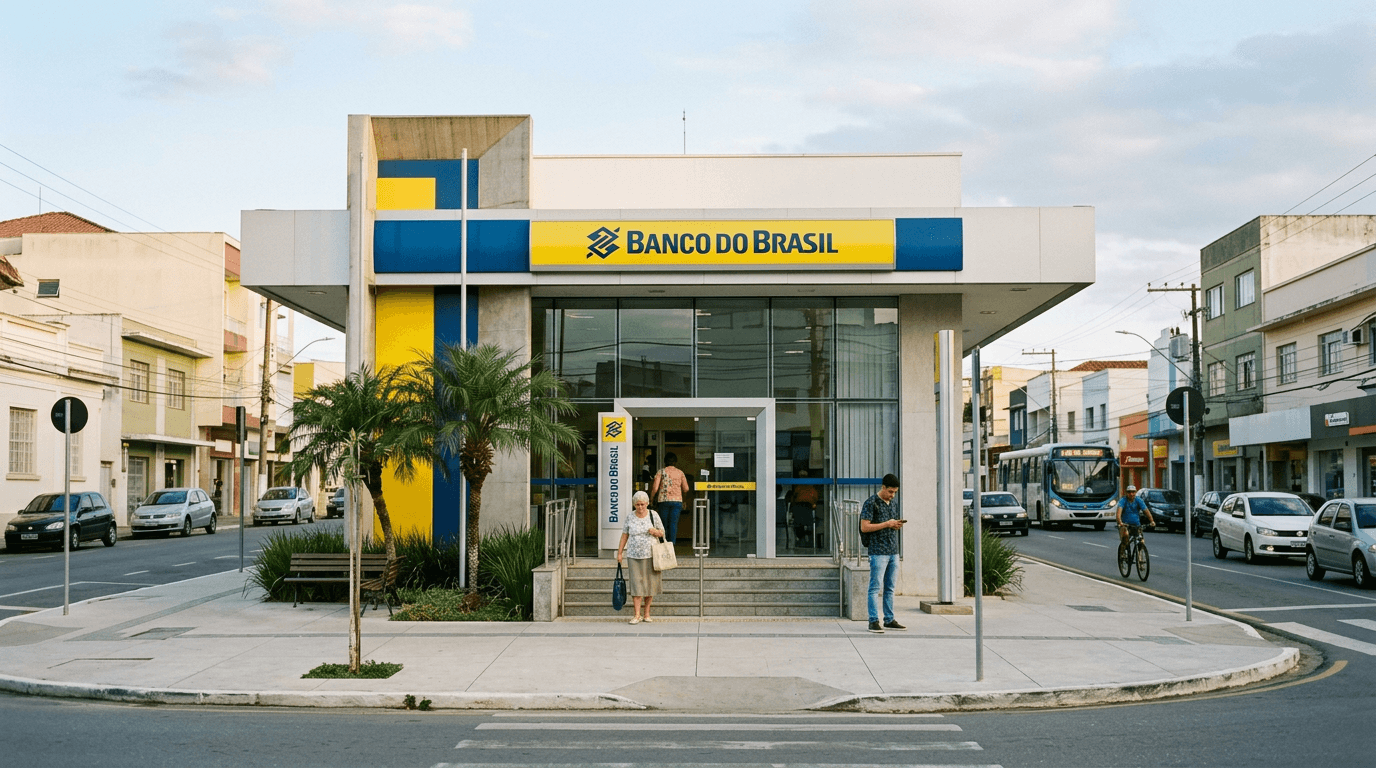
Banco do Brasil's Q3 2026 profit plummeted 66.5% due to agribusiness defaults, forcing a guidance cut and hitting the popular iShares MSCI Brazil ETF.
Key takeaways
- Banco do Brasil reported Q3 2026 adjusted net income of R$1.27 billion, down 66.5% year-over-year, per its earnings report on November 11, 2026
- The agribusiness over-90-day delinquency rate rose to 6.92% in September 2026 from 4.84% a year earlier, per bank data on November 11, 2026
- Management cut full-year 2026 net income guidance to R$9B–R$11B from R$18B–R$22B, per a regulatory filing on November 11, 2026
- The bank cut its dividend payout ratio to the statutory minimum of 25%, per a company announcement on November 11, 2026
A sudden and steep downturn in Brazil's farming heartland is threatening the performance of the most popular brazil etf Americans use to access Latin America's largest economy. On November 11, 2026, the country's largest agricultural lender, state-controlled Banco do Brasil, reported a massive 66.5% year-over-year drop in its third-quarter adjusted net income to R$1.27 billion ($220 million), according to the bank's official regulatory filing. This steep decline has forced the lender to slash its full-year profit projections in half, casting a shadow over the iShares MSCI brazil etf ewz, where the bank is a key component.
The shock earnings miss stems from a rapidly deteriorating credit environment across the Brazilian agricultural sector. Figures released by Banco do Brasil on November 11, 2026, show that the delinquency rate for agricultural loans over 90 days past due spiked to 6.92% in September 2026, up from 4.84% in September 2025. This rising default wave forced the lender to absorb R$21.23 billion in provisions for expected credit losses during the third quarter of 2026, an 18.4% increase compared to the same period in 2025, according to a financial analysis published on November 12, 2026.
Deliberate defaults create "moral hazard"
Unlike typical agricultural downturns caused by weather-related crop failures, this crisis involves a significant behavioral shift among borrowers. During a conference call with analysts on November 12, 2026, Banco do Brasil Chief Executive Tarciana Medeiros pointed out that defaults are heavily concentrated among medium and large soybean, corn, and cattle producers in the Center-West region, according to reporting by Brazil's state-owned news agency EBC. Medeiros characterized the situation as a "moral hazard," explaining that these wealthy farm owners are deliberately withholding payments and refusing to renegotiate their debts in the hope of forcing the federal government to approve subsidized state bailouts. Indeed, only 15% of delinquent borrowers joined the government's debt-restructuring program, Provisional Measure 1.376, according to her presentation on November 12, 2026.
To protect its balance sheet from further fallout, Banco do Brasil has shifted its strategy from aggressive lending to capital preservation. In a regulatory filing submitted to Brazil's CVM on November 11, 2026, the bank's board announced it is slashing its full-year 2026 adjusted net income guidance to between R$9 billion and R$11 billion, down from its previous target of R$18 billion to R$22 billion. To shore up its capital reserves, the bank also cut its 2026 dividend payout ratio to the statutory minimum of 25%, down from the previously planned 30%, and suspended interim shareholder distributions scheduled for November 11 and November 19, 2026, according to the same November 11, 2026, regulatory filing.
Whether this crisis stabilizes depends largely on how the federal government handles the demands of the agricultural lobby. Analysts at Genial Investimentos noted on November 12, 2026, that the bank expects elevated provisions to continue weighing on earnings through the fourth quarter of 2026 and into early 2027 as overdue loans migrate further into delinquency. Investors will be watching the next scheduled dividend announcement on February 17, 2027, which the bank announced in its November 11, 2026, regulatory filing, to see if the capital buffer has stabilized.
In your brokerage app
For retail investors holding the popular iShares MSCI Brazil ETF, the financial health of Banco do Brasil directly impacts their portfolio. The state-controlled giant represents 1.27% of the total fund holdings as of November 10, 2026, according to portfolio data from iShares. While private-sector rivals like Itaú Unibanco have managed to avoid similar farm-credit shocks, the widespread systemic nature of the agricultural debt crisis means that even diversified Brazil ETFs may face ongoing headwinds until agricultural loan defaults stabilize.
Analysis · NWX analysis desk
Which Brazil assets this touches
- EWZ, BBAS3, USDBRL — Named in this story.
Fundamentals · Banco do Brasil (BBAS3)
Banco do Brasil (BBAS3) trades at 7.7x its yearly earnings and 0.5x its book value. Its return on equity is 6.8%. Its dividend yield is 4.6%. The market values the company at R$86.4 billion. Its financial health score is 48 out of 100 (stable), based on profitability, liquidity, debt and growth. Latest: Q3 2026 results, published Nov 11, 2026.
| Price / earnings (P/E) | 7.7x | How many years of the current yearly profit the share price adds up to. |
|---|---|---|
| Price / book (P/B) | 0.5x | The share price compared with the accounting value of what the company owns, per share. |
| Return on equity (ROE) | 6.8% | Yearly profit for every R$100 that shareholders have put into the company. |
| Net margin | 4.3% | The part of every R$100 in sales that is left as profit. |
| Dividend yield | 4.6% | Cash paid to shareholders over the past year, as a share of today's price. |
| Market value | R$86.4 billion | What the whole company is worth at today's share price. |
Technical picture · iShares MSCI Brazil ETF (EWZ)
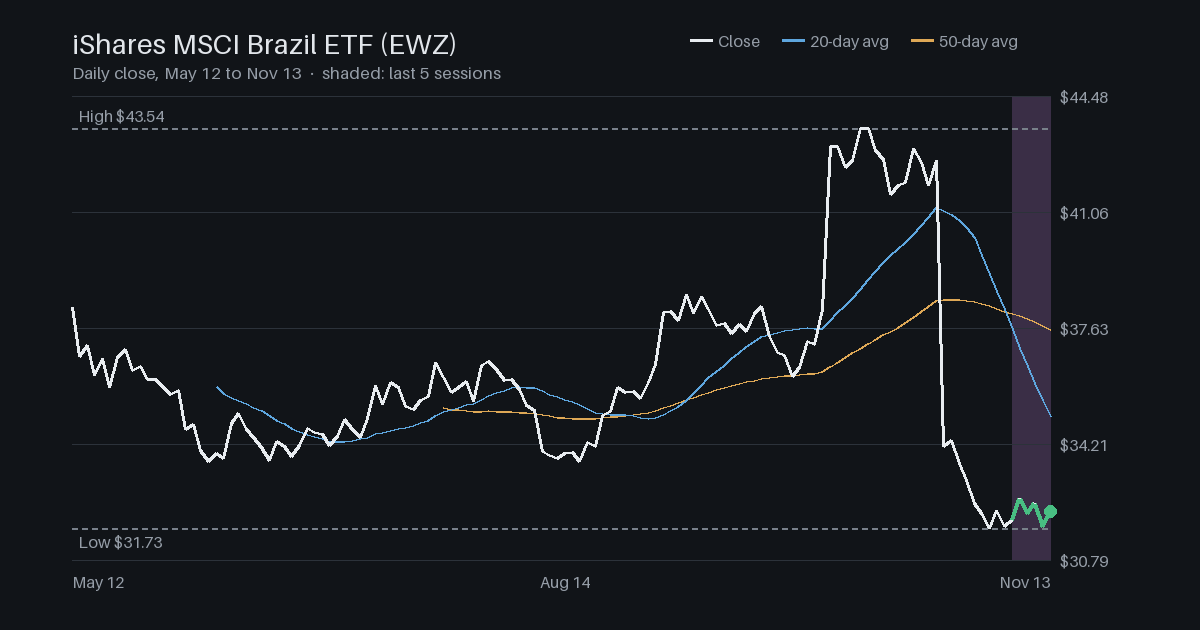
iShares MSCI Brazil ETF (EWZ) closed at $32.22 on Nov 13, 2026, up 0.8% from five sessions earlier. The last close is below its 20-day average of $35.03 and below its 50-day average of $37.59. Since May 13, 2026 it has traded between $31.73 (low, Nov 3, 2026) and $43.54 (high, Oct 9, 2026).
| Last close | $32.22 | Closing price on Nov 13, 2026. |
|---|---|---|
| 5-session move | +0.8% | Change in the closing price over the last five trading days. |
| 20-day average | $35.03 | The average closing price of the last 20 trading days. |
| 50-day average | $37.59 | The average closing price of the last 50 trading days. |
| Period high | $43.54 | Highest price since May 13, 2026. |
| Period low | $31.73 | Lowest price since May 13, 2026. |
Related coverage
 Telefonica Brasil Details ADR Dividend Payouts in SEC FilingTelefonica Brasil S.A. filed an SEC Form 6-K on November 17, 2026, detailing two cash distributions of R$0.172890 and R$0.239360 net per ADR.
 Petrobras Boosts 2026 Projections on Strong Offshore OutputPetrobras raised its 2026 cash flow forecast to $45B–$50B and oil production guidance to 3.3M–3.4M boed, while approving an interim dividend of $0.2161.