

Rate Gap of Ten Percent Fails to Stop Brazil Real Fall to R$ 5.93
Brazil’s 10% rate premium over the US Fed fails to boost the real as fiscal worries drive the iShares MSCI Brazil ETF toward its 52-week low.

Key takeaways
- The US Federal Reserve maintained its federal funds target range at 3.75% to 4.00%, per official FOMC statement on October 28, 2026
- Brazil's central bank held its benchmark Selic rate at 13.75%, per Copom disclosure on November 4, 2026
- The Brazilian real fell to a 19-month low of R$ 5.934 per dollar, per spot market close on November 19, 2026
- The iShares MSCI Brazil ETF tested a 52-week low of $30.05 per share, per fund disclosures on November 18, 2026
American investors who rely on the Federal Reserve’s steady interest rates to guide their global portfolios are watching a textbook finance theory fail in real time. Standard market logic dictates that when a foreign country offers a massive double-digit interest premium over the U.S. central bank's target rate—which the Federal Open Market Committee held at 3.75% to 4.00% on October 28, 2026—capital should flood in to capture the difference. Instead, the premium is being ignored, leaving dollar-denominated assets vulnerable to currency depreciation.
In Brazil, the Central Bank's Monetary Policy Committee, known as Copom, unanimously kept its benchmark Selic rate at 13.75% on November 4, 2026, per the official Banco Central do Brasil policy statement. This decision halted a cycle of consecutive rate cuts that began earlier in the year. Combined with the Fed's late October rate pause, this preserves a massive 10 percentage point interest rate gap between the two countries. Normally, such a wide spread triggers carry-trade inflows that strengthen the local currency, but fiscal anxieties are blocking that mechanism.
Rather than rising on this yield premium, the Brazil real fell to a 19-month low, closing at R$ 5.934 per dollar on November 19, 2026, amid public spending worries. This slide has direct consequences for foreign retail investors holding the ishares msci brazil etf stock. According to BlackRock fund disclosures, the ishares brazil msci etf has felt the squeeze of this currency depreciation, with the ishares brazil msci portfolio testing its 52-week low of $30.05 per share on November 18, 2026, and logging a year-to-date total return decrease of 6.29% as of November 19, 2026.
The carry-trade blockade stems from Wall Street’s skepticism over Brazil’s spending. Following the reelection of President Luiz Inácio Lula da Silva in late October 2026, concerns over fiscal expansion have intensified. Gross public debt is approaching 83% of gross domestic product, according to Treasury data, and because over half of this debt is indexed to the benchmark Selic rate, interest payments swallow nearly 9% of GDP annually.
To calm international markets, the Brazilian Senate passed a fiscal adjustment bill (PLP 299/2026) on November 18, 2026, reducing the real expense growth ceiling to 2.0% above inflation. The bill, which heads to the Chamber of Deputies for a final vote, aims to save up to R$ 56.1 billion in 2027, per a Senado Federal report. Investors are waiting to see if these measures can stabilize the debt before Copom's next meeting on December 9, 2026.
In the spot market, exchange rates reflect this tension. The USD/BRL is trading at 5.8883 (+0.04%), the EUR/BRL at 6.4659 (+0.54%), and the GBP/BRL at 7.7237 (+0.50%).
In your brokerage app
For retail investors holding the iShares MSCI Brazil ETF, which is listed in New York and tracks large and mid-sized Brazilian equities, the next few days are critical. While the fund’s underlying companies are backed by a 13.75% local interest rate, the value of those assets in U.S. dollars remains highly sensitive to the exchange rate. If the Chamber of Deputies passes the spending cap adjustments, it could help stabilize the local currency and ease pressure on the fund; if the fiscal package is delayed, the high yield premium will likely continue to be offset by currency losses.
Analysis · NWX analysis desk
Which Brazil assets this touches
- EWZ, IBOV, USDBRL, DI1 — Named in this story.
Technical picture · iShares MSCI Brazil ETF (EWZ)
iShares MSCI Brazil ETF (EWZ) closed at $28.54 on Nov 20, 2026, down 11.4% from five sessions earlier. The last close is below its 20-day average of $31.94 and below its 50-day average of $36.77. Since May 19, 2026 it has traded between $28.54 (low, Nov 20, 2026) and $43.54 (high, Oct 9, 2026).
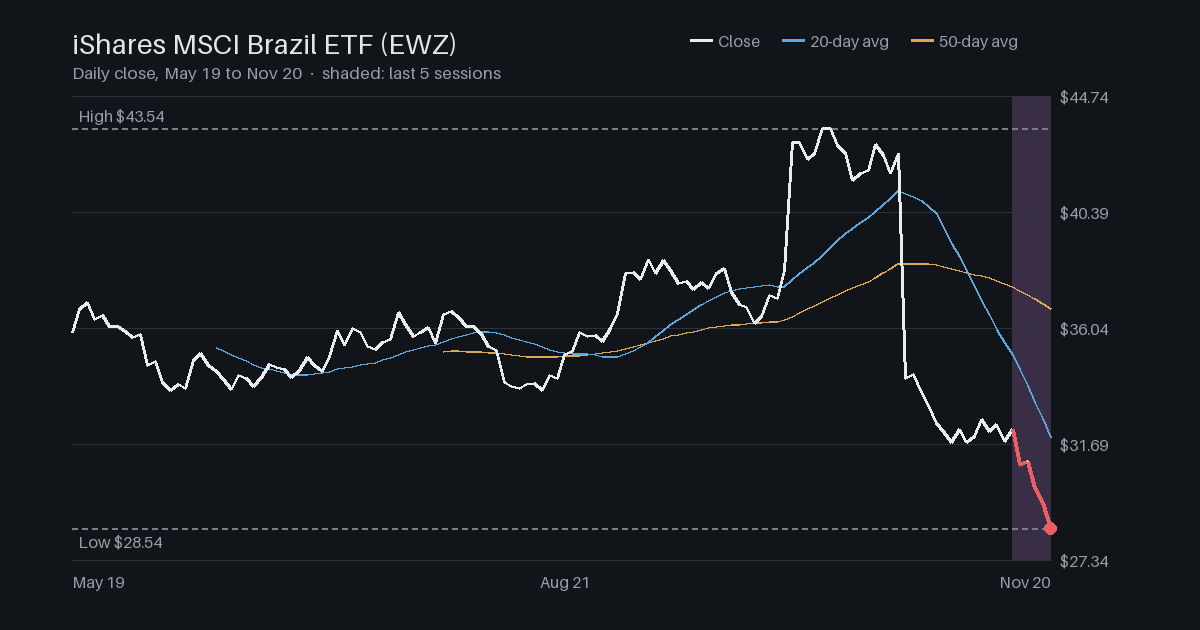
| Last close | $28.54 | Closing price on Nov 20, 2026. |
|---|---|---|
| 5-session move | -11.4% | Change in the closing price over the last five trading days. |
| 20-day average | $31.94 | The average closing price of the last 20 trading days. |
| 50-day average | $36.77 | The average closing price of the last 50 trading days. |
| Period high | $43.54 | Highest price since May 19, 2026. |
| Period low | $28.54 | Lowest price since May 19, 2026. |
Latest articles
 US Funds Keep 145,816 Net-Long Soybean Contracts, CFTC ReportsSpeculative funds held 145,816 net-long soybean contracts as of November 17, 2026, supporting Brazilian export expectations, according to the CFTC.
 PagSeguro Cuts 2026 Gross Profit Guidance as Brazil Rate Cuts StallBrazil's high interest rates forced New York-listed fintech PagSeguro to lower its 2026 profit outlook, though a December dividend cushions the blow.
 Petrobras Raises 2026 Investment to $22B and Approves DividendPetrobras approved a $2.786 billion dividend and boosted its 2026 cash investment target to up to $22 billion alongside higher production forecasts.