
Why Brazil's new labor rules and high rates hit US portfolios now
Brazil's Supreme Court has locked in a mandatory five-day workweek transition, while high interest rates force payment giant StoneCo to slash its profit outlook.

Global investors holding diversified emerging market funds are facing a sudden shift in the operating environment for Latin America's largest economy. A combination of sweeping labor reforms and stubbornly high interest rates is reshaping the profitability of major companies that US retail investors hold in their portfolios.
On November 12, 2026, Brazilian Supreme Court Justice Flávio Dino issued a preliminary injunction brznews.com confirming that the country's transition to a mandatory five-day (5x2) workweek will officially begin on December 16, 2026. The decision rejected petitions from major industrial and retail lobbying groups seeking to delay the rollout. The reform, enacted through Constitutional Amendment 141 on October 16, 2026, reduces maximum weekly working hours from 44 to 42 hours this year, and down to 40 hours by late 2027, while strictly prohibiting employers from reducing worker salaries.
At the same time, Brazil's high-interest-rate environment is squeezing corporate margins. On November 12, 2026, Brazilian financial technology firm StoneCo reported third-quarter results investing.com showing an 8% year-over-year decline in adjusted gross profit to 1.48 billion reais ($264 million). Citing persistent interest rate volatility and rising credit provisions, StoneCo slashed its full-year 2026 adjusted basic earnings per share guidance to a range of 9.1 to 9.5 reais, down from its previous projection of 10.8 to 11.4 reais, and completely withdrew its 2027 financial targets.
A Divergent Path for Digital Banking
While payments processors struggle with credit defaults, digital banking giant Nu Holdings continues to defy the macroeconomic drag. On November 12, 2026, the parent company of Nubank reported a record third-quarter net income of $1.09 billion securities.io, marking its second consecutive billion-dollar quarter.
Nu's customer base reached 142.6 million globally, helping the company achieve a 32% return on equity. However, even this high-flyer is showing signs of macro pressure, as its 90-plus-day non-performing loan ratio ticked up to 7.3% marketbeat.com from 6.9% in the previous quarter, indicating that rising consumer credit risk remains a key metric to monitor.
Legislative Relief on the Horizon
To address the fiscal deficits driving these high interest rates, Brazil's legislative leadership is pushing back. On November 12, 2026, the Brazilian Senate approved the base text of the PLP 299/2026 fiscal adjustment package brznews.com by a vote of 45 to 31.
The bill, sponsored by Senator Jaques Wagner, aims to generate up to 60 billion reais ($10.7 billion) in budget savings for the 2027 fiscal year by cutting corporate tax benefits by 10% and capping federal spending growth. The package is scheduled for a final vote on specific amendments on November 17, 2026, before heading to the Chamber of Deputies.
In your brokerage app
For retail investors, these regulatory and macroeconomic shifts directly impact the iShares MSCI Brazil ETF, an exchange-traded fund listed in New York that tracks large- and mid-sized Brazilian equities. This fund exposes holders to major retail and logistics employers facing rising labor compliance costs under the new workweek rules, as well as interest-rate-sensitive financial firms like StoneCo and Nu Holdings, which are both listed in New York.
Analysis · NWX analysis desk
Which Brazil assets this touches
- EWZ, NU, STNE, PAGS, IBOV — Big swings in U.S. tech stocks tend to spill into Brazil's fintechs listed in New York and into the broad Brazil fund, as global investors change how much risk they hold.
Technical picture · iShares MSCI Brazil ETF (EWZ)
iShares MSCI Brazil ETF (EWZ) closed at $32.22 on Nov 13, 2026, up 0.8% from five sessions earlier. The last close is below its 20-day average of $35.03 and below its 50-day average of $37.59. Since May 12, 2026 it has traded between $31.73 (low, Nov 3, 2026) and $43.54 (high, Oct 9, 2026).
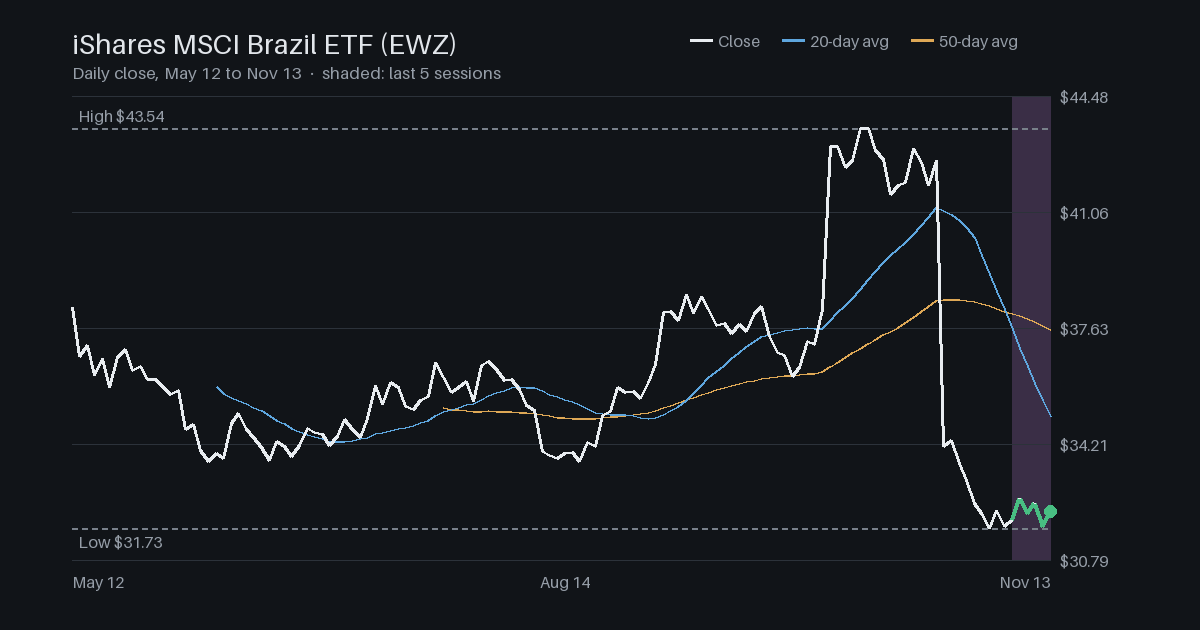
| Last close | $32.22 | Closing price on Nov 13, 2026. |
|---|---|---|
| 5-session move | +0.8% | Change in the closing price over the last five trading days. |
| 20-day average | $35.03 | The average closing price of the last 20 trading days. |
| 50-day average | $37.59 | The average closing price of the last 50 trading days. |
| Period high | $43.54 | Highest price since May 12, 2026. |
| Period low | $31.73 | Lowest price since May 12, 2026. |
Related coverage
 Why Speculators Are Sticking to Big Bets on Soybean FuturesSpeculative traders maintain significant long positions in soybean futures as they weigh massive global supply projections against South American weather risks.
 Brazil Largest Retailers Settle Long-Standing Billion-Real DisputeCasas Bahia and GPA resolve a legal battle stemming from their failed 2009 merger, removing major balance sheet liabilities for both debt-laden companies.
 Nubank Secures Official Banking License in BrazilBrazil's Central Bank approved Nubank's acquisition of Banco Porto Real, officially granting the New York-listed fintech a full banking license.