
Brazil Largest Retailers Settle Long-Standing Billion-Real Dispute
Casas Bahia and GPA resolve a legal battle stemming from their failed 2009 merger, removing major balance sheet liabilities for both debt-laden companies.

Global investors holding emerging-market retail funds or tracking Latin American consumer stocks saw a massive legal cloud lift from two of the region's most recognized corporate names. On November 13, 2026, two of the top retailers in Brazil announced a comprehensive settlement that permanently ends all legal disputes stemming from their failed, high-profile merger nearly two decades ago.
Under the terms of the agreement, home-appliance giant Casas Bahia and supermarket operator Companhia Brasileira de Distribuição, widely known as GPA, resolved outstanding liabilities totaling over R$ 1.1 billion ($190 million). The settlement brings much-needed balance sheet predictability to two debt-laden companies currently undergoing complex financial reorganizations.
The legal battle dates back to a 2009 association agreement between the two retail giants that subsequently dissolved. Under the newly signed deal, GPA will waive its claim to approximately R$ 700 million in tax credits previously owed by Casas Bahia. In return, Casas Bahia will assume R$ 424 million in outstanding tax liabilities and contingencies related to the original joint venture.
For GPA, the immediate benefit will show up on its upcoming financial statements. The supermarket operator announced it will reverse R$ 174 million in provisions in its fourth-quarter 2026 balance sheet, as it is now freed from reimbursing Casas Bahia for those historical fiscal contingencies. GPA's management stated in a regulatory filing that the deal successfully resolves a major "structural liability" from its corporate history.
Meanwhile, Casas Bahia, which is operating under a court-supervised debt restructuring (recuperação judicial), will be allowed to utilize the R$ 700 million in tax credits to optimize its own capital structure. In its own market announcement, the retailer emphasized that the settlement dramatically reduces future litigation costs and provides greater financial predictability moving forward.
Analysis · NWX analysis desk
Which Brazil assets this touches
- EWZ, USDBRL — Named in this story.
Technical picture · iShares MSCI Brazil ETF (EWZ)
iShares MSCI Brazil ETF (EWZ) closed at $32.22 on Nov 13, 2026, up 0.8% from five sessions earlier. The last close is below its 20-day average of $35.03 and below its 50-day average of $37.59. Since May 12, 2026 it has traded between $31.73 (low, Nov 3, 2026) and $43.54 (high, Oct 9, 2026).
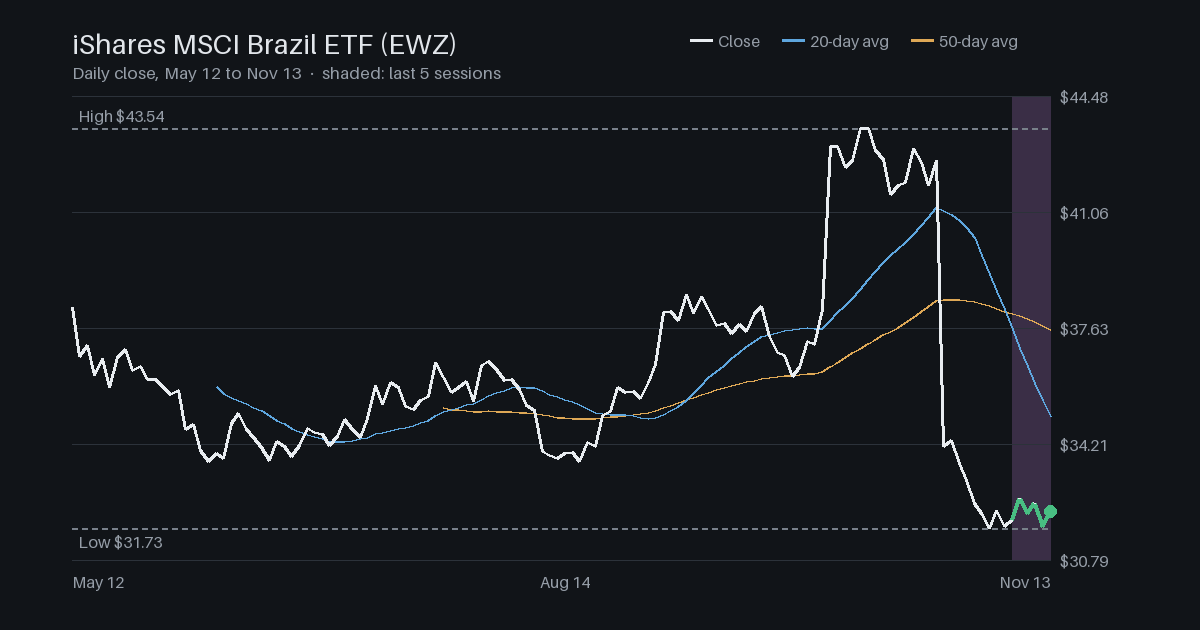
| Last close | $32.22 | Closing price on Nov 13, 2026. |
|---|---|---|
| 5-session move | +0.8% | Change in the closing price over the last five trading days. |
| 20-day average | $35.03 | The average closing price of the last 20 trading days. |
| 50-day average | $37.59 | The average closing price of the last 50 trading days. |
| Period high | $43.54 | Highest price since May 12, 2026. |
| Period low | $31.73 | Lowest price since May 12, 2026. |
Related coverage
 Why Speculators Are Sticking to Big Bets on Soybean FuturesSpeculative traders maintain significant long positions in soybean futures as they weigh massive global supply projections against South American weather risks.
 Why Brazil's new labor rules and high rates hit US portfolios nowBrazil's Supreme Court has locked in a mandatory five-day workweek transition, while high interest rates force payment giant StoneCo to slash its profit outlook.
 Nubank Secures Official Banking License in BrazilBrazil's Central Bank approved Nubank's acquisition of Banco Porto Real, officially granting the New York-listed fintech a full banking license.