

Structural Business Costs in Brazil Hit 27.5% of GDP
A study by Movimento Brasil Competitivo and Monitor Deloitte shows structural business costs in Brazil reached R$ 3.5 trillion, or 27.5% of GDP.

Key takeaways
- Structural business costs in Brazil reached R$ 3.5 trillion in 2025, representing 27.5% of GDP, per a study by MBC and Monitor Deloitte on November 18, 2026
- High financing costs alone added R$ 363 billion to the annual corporate bill, per the MBC and Monitor Deloitte study on November 18, 2026
- Brazil's real interest rate stood at 10.74% at the end of 2025 compared to an OECD average of 0.90%, per the MBC and Monitor Deloitte study on November 18, 2026
Structural business costs in Brazil reached R$ 3.5 trillion ($588 billion) in 2025, equivalent to 27.5% of the country’s gross domestic product, according to a landmark study released on November 18, 2026, by the business-backed advocacy group Movimento Brasil Competitivo (MBC) and consultancy Monitor Deloitte. This operational premium, historically known as the Custo Brasil (Brazil Cost), represents a severe competitive drag for multinational corporations and foreign investors looking to invest in Brazil. The calculation shows how structural bottlenecks from the door outward eat into corporate margins and depress capital returns compared to global peers.
The updated 2026 edition of the Brazil business costs study 2026 represents a major methodological shift by incorporating the direct impacts of high real interest rates into the benchmark comparison against the Organisation for Economic Co-operation and Development (OECD). According to the November 18, 2026 study, high financing costs alone added R$ 363 billion to the annual corporate bill in the Brazil economy. This financing friction is driven by a stark macroeconomic divergence: Brazil’s real interest rate stood at 10.74% at the end of 2025, whereas the average real rate across OECD member nations was just 0.90%, according to the same November 18, 2026 report.
The study, which analyzes competitive indicators across seven operational axes, was designed to trace the structural disadvantages of producing, hiring, and investing locally. By comparing domestic conditions against OECD benchmarks, MBC and Monitor Deloitte highlighted that even as Brazil has made progress in public sector digitalization and business registration, systemic overheads continue to restrict local industry from competing effectively on a global stage. The newly expanded research aims to provide policymakers with a comprehensive roadmap of where operational bottlenecks are most concentrated.
What to watch next is how the federal government and Congress utilize this diagnostic data as they design and debate the regulatory framework for Brazil’s historic consumption tax reform. While the transition to a simplified value-added tax system is expected to streamline compliance over the coming decade, the immediate focus remains on whether policymakers can successfully dismantle administrative and logistical hurdles to lower the structural premium of the domestic market.
In your brokerage app
For retail investors holding the MSCI Brazil ETF (NYSE Arca: EWZ) or financial giants like Itaú Unibanco (NYSE: ITUB) and Banco Bradesco (NYSE: BBD), these structural costs directly depress corporate margins. High real interest rates squeeze credit expansion, while logistical bottlenecks and security expenses erode the profitability of physical exporters. When evaluating Brazilian equities, investors must discount expected earnings to account for this persistent 27.5% GDP operational drag, as measured in the November 18, 2026 study by MBC and Monitor Deloitte.
Analysis · NWX analysis desk
Which Brazil assets this touches
- EWZ, ITUB, BBD, VALE, PBR, USDBRL — Named in this story.
Fundamentals · Itaú Unibanco (ITUB4)
Itaú Unibanco (ITUB4) trades at 9.7x its yearly earnings and 1.9x its book value. Its return on equity is 20.8%. Its dividend yield is 7.7%. The market values the company at R$465.3 billion. Its financial health score is 61 out of 100 (stable), based on profitability, liquidity, debt and growth. Latest: Q3 2026 results, published Nov 3, 2026. Next: FY 2026 results expected Feb 3, 2027 (confirmed date).
| Price / earnings (P/E) | 9.7x | How many years of the current yearly profit the share price adds up to. |
|---|---|---|
| Price / book (P/B) | 1.9x | The share price compared with the accounting value of what the company owns, per share. |
| Return on equity (ROE) | 20.8% | Yearly profit for every R$100 that shareholders have put into the company. |
| Net margin | 12.2% | The part of every R$100 in sales that is left as profit. |
| Dividend yield | 7.7% | Cash paid to shareholders over the past year, as a share of today's price. |
| Market value | R$465.3 billion | What the whole company is worth at today's share price. |
Technical picture · iShares MSCI Brazil ETF (EWZ)
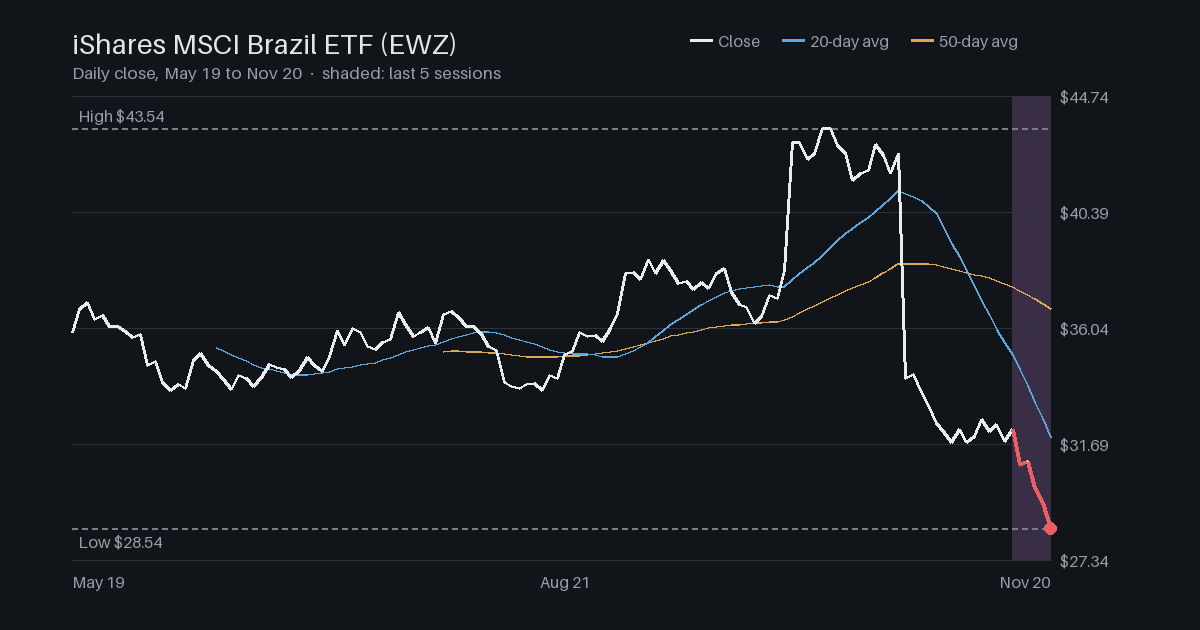
iShares MSCI Brazil ETF (EWZ) closed at $28.54 on Nov 20, 2026, down 11.4% from five sessions earlier. The last close is below its 20-day average of $31.94 and below its 50-day average of $36.77. Since May 19, 2026 it has traded between $28.54 (low, Nov 20, 2026) and $43.54 (high, Oct 9, 2026).
| Last close | $28.54 | Closing price on Nov 20, 2026. |
|---|---|---|
| 5-session move | -11.4% | Change in the closing price over the last five trading days. |
| 20-day average | $31.94 | The average closing price of the last 20 trading days. |
| 50-day average | $36.77 | The average closing price of the last 50 trading days. |
| Period high | $43.54 | Highest price since May 19, 2026. |
| Period low | $28.54 | Lowest price since May 19, 2026. |
Related coverage
 Main US-Listed Brazil ETF Drops to 15-Month Low on Local HolidayThe iShares MSCI Brazil ETF (EWZ) fell 3.25% to its lowest close since August 2025 as a Wall Street tech rout hit emerging markets during a Brazilian holiday.
 Screwworm Surge Squeezes Cattle Supply, Pressuring JBS Packer MarginsA sharp rise in flesh-eating New World screwworm cases in the US Southwest threatens tight cattle supplies, raising processing costs for meatpacker JBS.
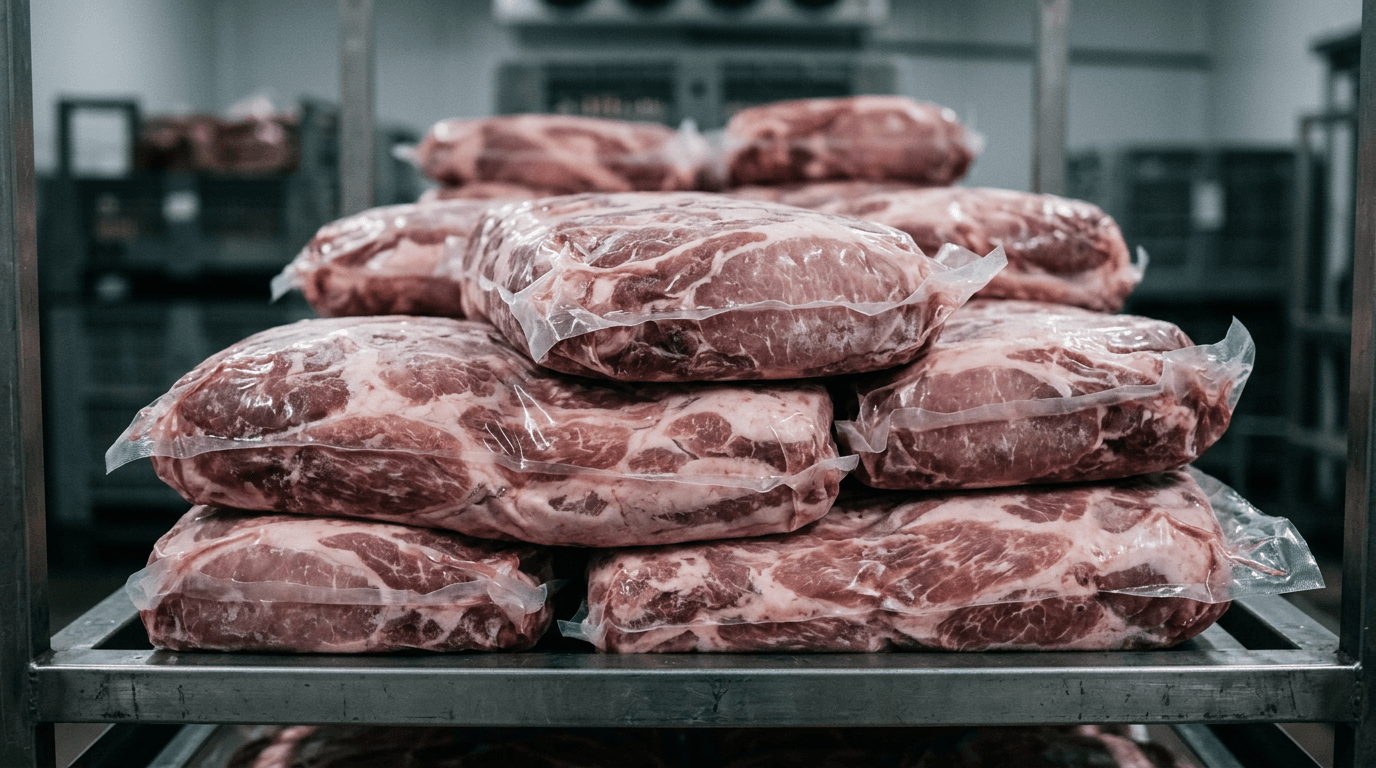 Trump Philippines Deal Threatens $1.2B in Brazil Meat ExportsDonald Trump announced that the Philippines will buy 100% of agricultural imports from the US starting January 1, 2027, bypassing competitive Brazilian pork.