

Hidden Corporate Overhead in Brazil Reaches R$3.5 Trillion, Study Finds
A new study by Movimento Brasil Competitivo and Monitor Deloitte pegs Brazil's systemic business overhead at 27.5% of GDP, driven by massive logistics deficits.
Key takeaways
- Systemic corporate overhead in Brazil reaches R$3.5 trillion per year or 27.5% of GDP, per a Movimento Brasil Competitivo study on November 18, 2026
- Infrastructure and logistics represent the largest bottleneck at R$805 billion annually, with logistics costs at 15.5% of GDP, per study data
- High real interest rates of 10.7% drive R$648 billion in corporate financing friction, compared to the OECD average of 0.9%
American investors who track global markets often face a frustrating puzzle: why do dominant corporations in Latin America's largest economy struggle to convert massive top-line revenues into competitive shareholder returns? A landmark study released on Wednesday, November 18, 2026, by the business advocacy group Movimento Brasil Competitivo (MBC) and consultancy Monitor Deloitte provides a stark answer. The systemic overhead known as the "Custo Brasil" (Brazil Cost) has climbed to an estimated R$3.5 trillion ($605 billion) per year, consuming 27.5% of the country’s 2025 gross domestic product, as reported by Poder360. This massive drag acts as an invisible tax, directly eroding corporate margins and penalizing those who want to invest in Brazil.
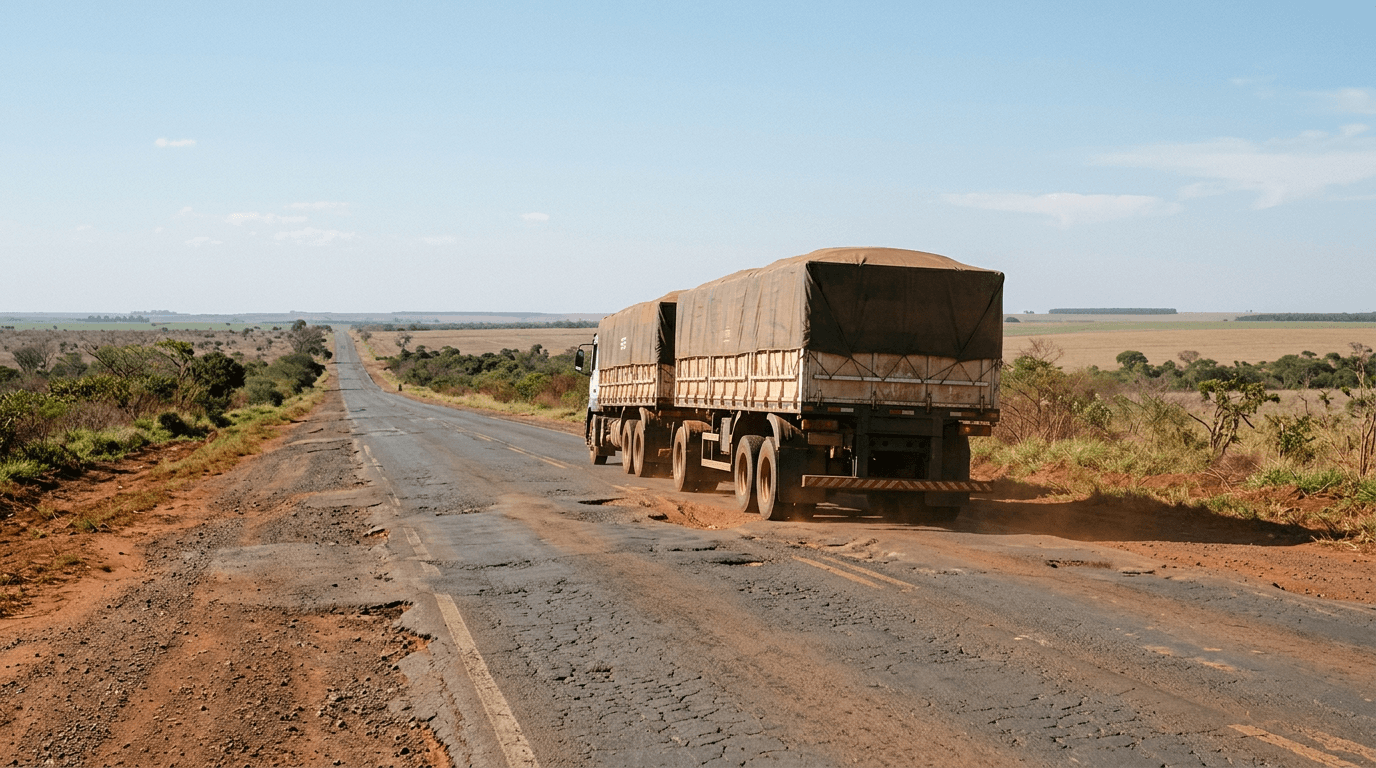
To understand how these costs accumulate, a foreigner must look beyond individual company balance sheets and into the country's physical constraints. The largest single driver of this overhead is the country's severely deficient infrastructure and logistics, which imposes an annual burden of R$805 billion on the productive sector. High transport costs, poorly maintained roads, and congested port terminals mean that internal logistical operations alone consume 15.5% of Brazil's economic output. In contrast, the average logistics cost among member nations of the Organisation for Economic Co-operation and Development (OECD) is just 9.8%. For heavy industrial players and agricultural exporters, this gap means their products become uncompetitively expensive the moment they leave the factory gates, limiting their overall performance on the Brazil stock market today.
Beyond physical bottlenecks, the study highlights how financial friction starves corporate growth. High interest rates and domestic credit spreads represent a R$648 billion annual burden on Brazilian companies. Brazil interest rates Selic, which sit at high nominal levels, translate to an eye-watering domestic real interest rate of 10.7% per year, as measured in the study. This stands in stark contrast to the OECD real interest rate average of just 0.9%, severely punishing companies that rely on debt to expand. Consequently, even highly profitable businesses must allocate substantial capital simply to service their local debts, putting downward pressure on the Brazil real.
The study, which updated its methodology in 2026 to incorporate security costs and real interest rates for the first time, also flagged R$457 billion in tax compliance costs and R$451 billion from judicial and regulatory instability. While Brazil has made strides in digital public services and corporate registration, the sheer complexity of the tax system and long-running court cases continue to weigh down corporate margins. The overall cost has ballooned from 19.5% of GDP in 2021 to the current 27.5% under the revised methodology, proving that local corporate efficiency gains are routinely wiped out by external systemic drag.
Looking ahead, global markets are closely watching the implementation of the country's sweeping consumption tax reform and upcoming infrastructure concessions to see if they can begin to chip away at these structural hurdles. The government's ability to maintain public investment without triggering fiscal instability will determine if the Custo Brasil has finally peaked. For investors holding a major Brazil ETF or tracking the country's primary stock index, these structural reforms are not merely political talking points; they are the absolute prerequisites for unlocking real corporate profitability.
In your brokerage app
For retail investors, this structural overhead directly impacts the profit margins of major Brazilian companies traded on U.S. exchanges. Major US-listed equities, such as beverage giant Ambev (listed in New York as ABEV) and agricultural exporter JBS N.V. (listed in New York as JBS), must constantly dedicate capital to bypass domestic logistical and tax bottlenecks. Investors seeking broad exposure to the country's economy through the iShares MSCI Brazil ETF (listed in New York as EWZ) should monitor these overhead figures, as they act as a persistent headwind against the underlying valuations of the country's largest industrial and consumer stocks.
Analysis · NWX analysis desk
Which Brazil assets this touches
- EWZ, IBOV, USDBRL, DI1 — Named in this story.
Technical picture · iShares MSCI Brazil ETF (EWZ)
iShares MSCI Brazil ETF (EWZ) closed at $29.51 on Nov 19, 2026, down 7.1% from five sessions earlier. The last close is below its 20-day average of $32.64 and below its 50-day average of $36.96. Since May 19, 2026 it has traded between $29.51 (low, Nov 19, 2026) and $43.54 (high, Oct 9, 2026).
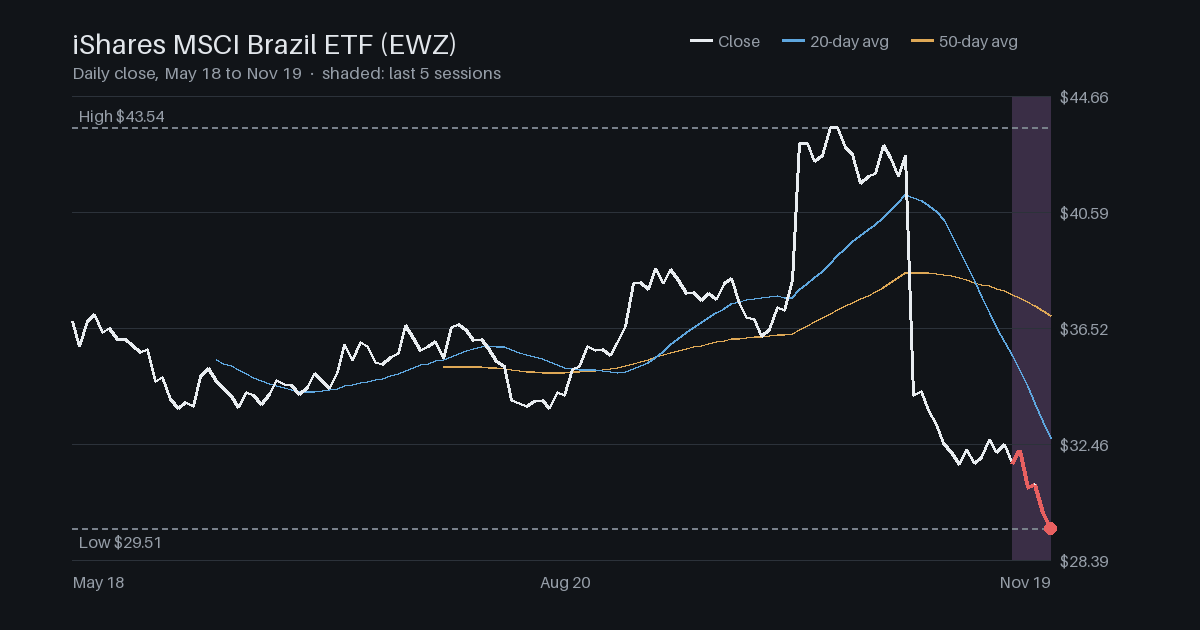
| Last close | $29.51 | Closing price on Nov 19, 2026. |
|---|---|---|
| 5-session move | -7.1% | Change in the closing price over the last five trading days. |
| 20-day average | $32.64 | The average closing price of the last 20 trading days. |
| 50-day average | $36.96 | The average closing price of the last 50 trading days. |
| Period high | $43.54 | Highest price since May 19, 2026. |
| Period low | $29.51 | Lowest price since May 19, 2026. |
Related coverage
 Bradesco Flags 2027 Economic Slowdown, Vows Strict Loan PrudenceBanco Bradesco CEO Marcelo Noronha has warned of credit prudence over riskier expansion due to high consumer debt and a projected 0.4% GDP growth rate for Brazil in 2027.
 XP Slashes Banco do Brasil Target to R$ 15 on Crop DefaultsXP Investimentos has cut Banco do Brasil's price target to R$ 15 following a crop-credit crisis that forced a massive dividend reduction and profit guidance cut.
 Agi Founder Marciano Testa Reassumes CEO Role to Lead Mexico PushAgi founder Marciano Testa will reassume the CEO role of its Brazilian operations on Dec. 31, 2026, to drive expansion into Mexico.