

Brazil soybean planting lags as slow expansion signals end of easy land
Brazil's 2026/27 soybean planting is off to a slow start due to uneven rain, while Conab projects record output despite the slowest land expansion in 20 years.
Speculative financial players maintained a heavily bullish stance on global soybean markets in late September, providing a crucial backdrop for South American farmers as they begin their yearly planting cycle. According to the U.S. Commodity Futures Trading Commission (CFTC), non-commercial traders held a substantial net-long position of 256,872 contracts in Chicago Board of Trade soybean futures as of the weekly observation on September 29, 2026.
This net-long position was built on 345,383 long contracts compared to 88,511 short contracts, set against a total market open interest of 1,090,227 contracts. These weekly figures from the CFTC reflect the aggregate positioning of investment funds, offering a snapshot of financial sentiment rather than a direct forecast of future prices. For Brazil, the world’s largest exporter of soybeans, these international financial dynamics help shape the pricing environment just as local tractors roll into the fields.
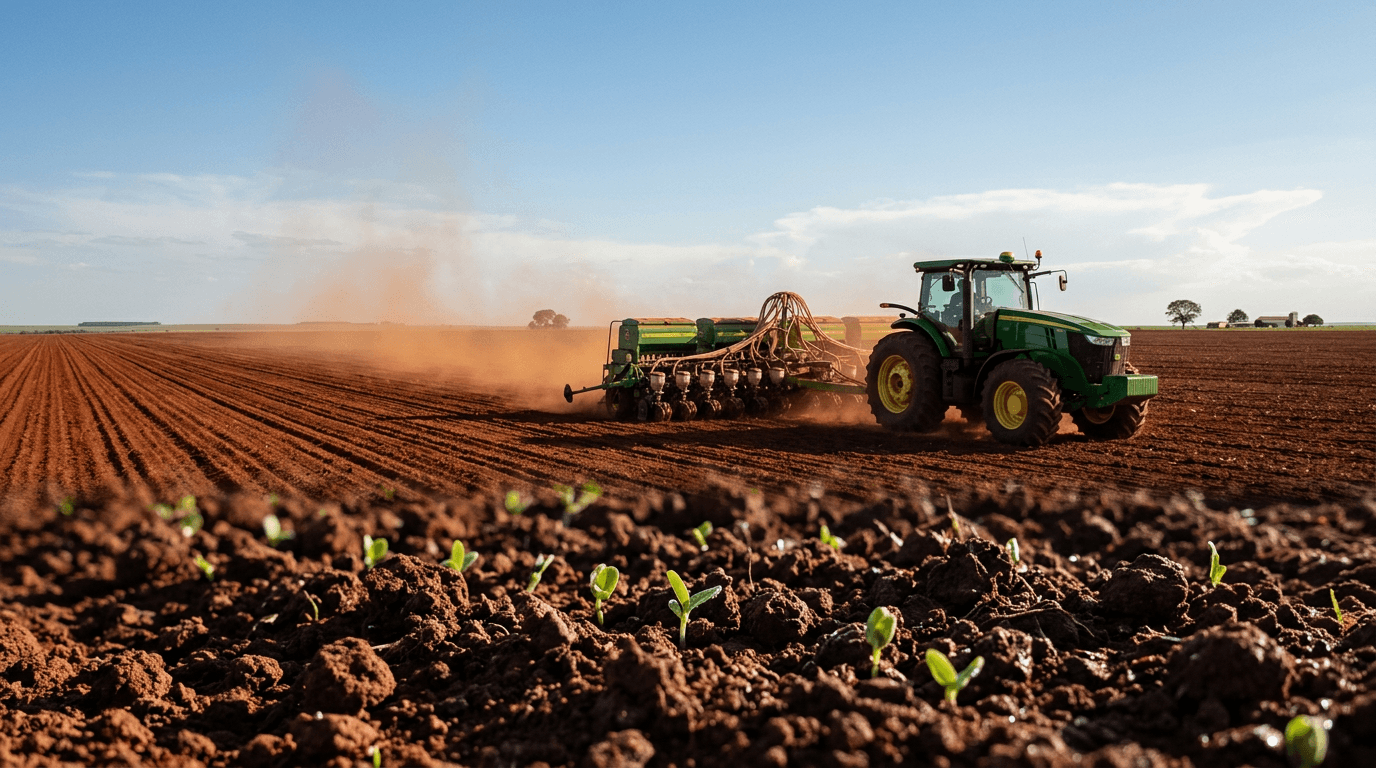
The speculative optimism in Chicago coincided with the highly anticipated launch of the 2026/27 South American crop season. In Brazil, planting operations are underway but off to a slightly slower start than in previous years due to highly uneven early-season rainfall across key agricultural states. According to data from private agribusiness consultancy AgRural, Brazilian farmers had seeded 7.3% of the projected soybean area by early October, lagging behind the 9.0% pace recorded at the same point last year.
Despite the sluggish start to fieldwork, official projections point to another massive harvest. Conab, Brazil's national supply agency, has projected a record 2026/27 soybean crop of approximately 181.6 million tonnes, representing a modest 1.4% expansion in planted area. This marks the slowest rate of land expansion for Brazilian soybeans in two decades, signaling that the era of easy agricultural expansion via land conversion is drawing to a close, leaving future growth heavily dependent on per-hectare yield improvements.
While the CFTC data shows that financial markets remain net-long on the oilseed, local agricultural margins in Brazil remain tightly compressed by high input costs. Any prolonged weather disruptions in key growing states like Mato Grosso or Paraná could quickly trigger volatility, forcing international funds to rapidly adjust their heavy long positions.
What it touches
The intersection of international futures positioning and Brazilian crop progress directly impacts major agribusiness players traded on global exchanges. Companies with significant exposure to South American farmland and grain logistics, such as Adecoagro S.A. (NYSE: AGRO) and global protein giant JBS N.V. (NYSE: JBS), are highly sensitive to these shifting supply dynamics and the resulting export price fluctuations.
Related coverage
 Structural Business Costs in Brazil Hit 27.5% of GDPA study by Movimento Brasil Competitivo and Monitor Deloitte shows structural business costs in Brazil reached R$ 3.5 trillion, or 27.5% of GDP.
 Main US-Listed Brazil ETF Drops to 15-Month Low on Local HolidayThe iShares MSCI Brazil ETF (EWZ) fell 3.25% to its lowest close since August 2025 as a Wall Street tech rout hit emerging markets during a Brazilian holiday.
 Screwworm Surge Squeezes Cattle Supply, Pressuring JBS Packer MarginsA sharp rise in flesh-eating New World screwworm cases in the US Southwest threatens tight cattle supplies, raising processing costs for meatpacker JBS.