

Sabesp Approves $450 Million Payout Under Hiked 17.5% Tax Rule
New York ADR holders of Sabesp face a 17.5% withholding tax rate on its massive R$ 2.64 billion interest on equity distribution approved on November 5, 2026.
Key takeaways
- Sabesp's board approved a gross R$ 2.64 billion (~$450 million) payout on November 5, 2026, per UOL.
- The distribution represents 50% of the newly privatized water utility's net income for the first nine months of 2026.
- Under Complementary Law 224/2025, a tax rate hike from 15% to 17.5% will be withheld directly from the payout.
- The ex-dividend date on the B3 was November 11, 2026, with the New York ADR ex-date on November 16, 2026.
American retail investors holding shares of New York-listed Brazilian water utility Sabesp (NYSE: SBS) are about to feel the direct impact of Brazil’s newly tightened tax regime on their investment returns. On November 5, 2026, the company’s board of directors approved a massive gross interest on equity (JCP) distribution of R$ 2.64 billion (approximately $450 million USD), as reported by UOL on November 6, 2026. However, because of recent legislative changes in Brazil, US-based American Depositary Receipt (ADR) holders will face a higher-than-historical withholding tax on this windfall.
The R$ 2.64 billion payout represents exactly 50% of Sabesp's net income for the first nine months of 2026, after setting aside the mandatory 5% legal reserve, according to the company's regulatory filing on November 5, 2026. Under the company's approved distribution schedule, the payout is set at R$ 0.7498 per share. On the local Brazilian exchange (B3), the cutoff date to receive the distribution was November 10, 2026, making the stock trade ex-dividend on November 11, 2026. For New York ADR holders, the ex-dividend date was set for November 16, 2026, as outlined on the company's official investor relations platform, sabesp.com.br.
What makes this distribution different from previous payouts is the tax rate applied. Starting in 2026, Brazil's Complementary Law 224/2025 went into effect, raising the standard withholding income tax rate on interest on equity (JCP) distributions from 15% to 17.5%. This legal change, enacted on December 26, 2025, is designed to curb federal tax incentives and raise revenues from corporate payouts. For foreign and retail investors alike, this 2.5 percentage point tax hike is withheld directly at the source, effectively clipping the final net cash that lands in brokerage accounts.
Sabesp, which was privatized by the state of São Paulo in July 2024, has been transitioning its corporate governance and capital allocation toward higher shareholder returns. The company stated in its November 5, 2026 announcement that the final payment of this JCP will be executed by the date of the annual general meeting that approves the 2026 financial statements, which typically takes place in April 2027. Investors should note that the payout is fixed and will not be adjusted for inflation or interest despite the months-long waiting period before the funds actually arrive in accounts.
In your brokerage app
For retail investors holding Sabesp ADRs (NYSE: SBS) in US accounts, the gross dividend of R$ 0.7498 per share will be translated to US dollars and distributed by the depository bank, minus local taxes. Because of the 17.5% withholding tax mandated by Complementary Law 224/2025, the net local payout per share drops to approximately R$ 0.6186. The iShares MSCI Brazil ETF (NYSE Arca: EWZ) also holds a significant position in Sabesp, meaning the tax change will marginalize distributions up to the fund level as well.
Analysis · NWX analysis desk
Which Brazil assets this touches
- SBS, EWZ, SBSP3 — Named in this story.
Fundamentals · SBSP3 (SBSP3)
SBSP3 (SBSP3) trades at 13.1x its yearly earnings and 2.1x its book value. Its return on equity is 15.6%. Its dividend yield is 5.2%. The market values the company at R$98.1 billion. Its financial health score is 70 out of 100 (strong), based on profitability, liquidity, debt and growth. Latest: Q3 2026 results, published Nov 5, 2026.
| Price / earnings (P/E) | 13.1x | How many years of the current yearly profit the share price adds up to. |
|---|---|---|
| Price / book (P/B) | 2.1x | The share price compared with the accounting value of what the company owns, per share. |
| Return on equity (ROE) | 15.6% | Yearly profit for every R$100 that shareholders have put into the company. |
| Net margin | 17.5% | The part of every R$100 in sales that is left as profit. |
| Dividend yield | 5.2% | Cash paid to shareholders over the past year, as a share of today's price. |
| Market value | R$98.1 billion | What the whole company is worth at today's share price. |
Technical picture · SBSP3 (SBSP3)
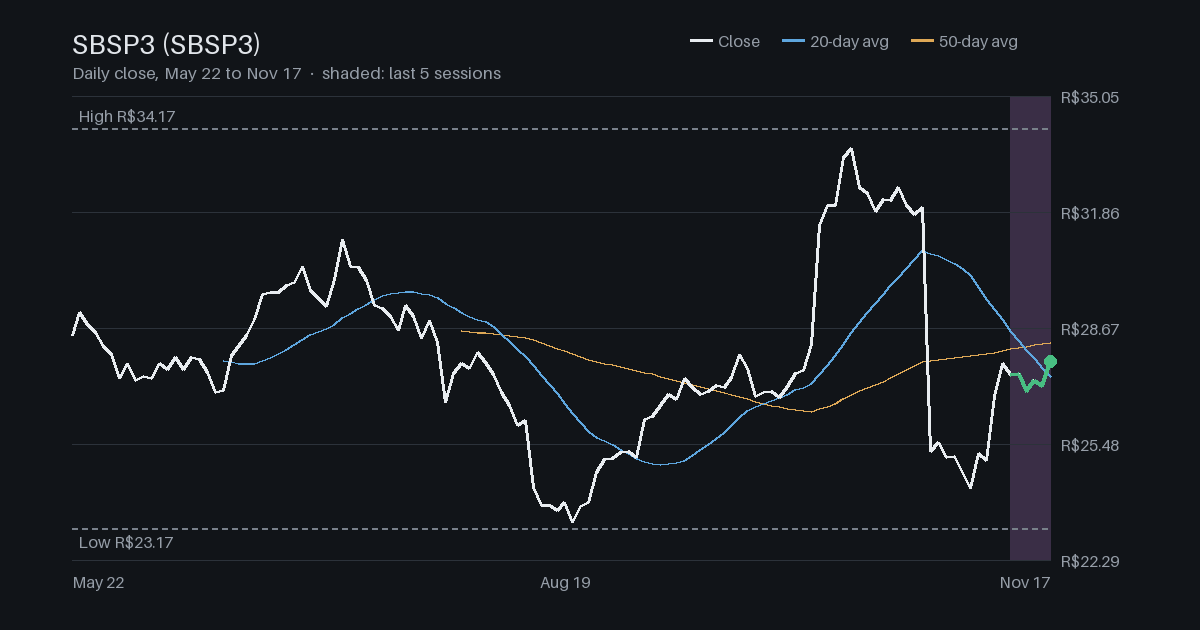
SBSP3 (SBSP3) closed at R$27.76 on Nov 17, 2026, up 1.4% from five sessions earlier. The last close is above its 20-day average of R$27.35 and below its 50-day average of R$28.27. Since May 22, 2026 it has traded between R$23.17 (low, Aug 20, 2026) and R$34.17 (high, Oct 9, 2026).
| Last close | R$27.76 | Closing price on Nov 17, 2026. |
|---|---|---|
| 5-session move | +1.4% | Change in the closing price over the last five trading days. |
| 20-day average | R$27.35 | The average closing price of the last 20 trading days. |
| 50-day average | R$28.27 | The average closing price of the last 50 trading days. |
| Period high | R$34.17 | Highest price since May 22, 2026. |
| Period low | R$23.17 | Lowest price since May 22, 2026. |
Related coverage
 Telefônica Brasil Confirms December Payout to New York InvestorsTelefônica Brasil confirmed the December payment date for a previously approved interest-on-capital distribution. Here is what ADS holders can expect.
 Fed, Fiscal Fears Push US Dollar to 19-Month High Against Brazil RealA hawkish Fed and weakened Brazilian fiscal savings push the US dollar to its highest level since April 2025, devaluing American investor returns.
 Banco do Brasil Halves 2026 Profit Forecast on Farm DefaultsState-controlled Banco do Brasil slashed its 2026 profit guidance by 50% after rising defaults among soy, corn, and cattle producers drove a Q3 profit drop.