

Banco do Brasil Halves 2026 Profit Forecast on Farm Defaults
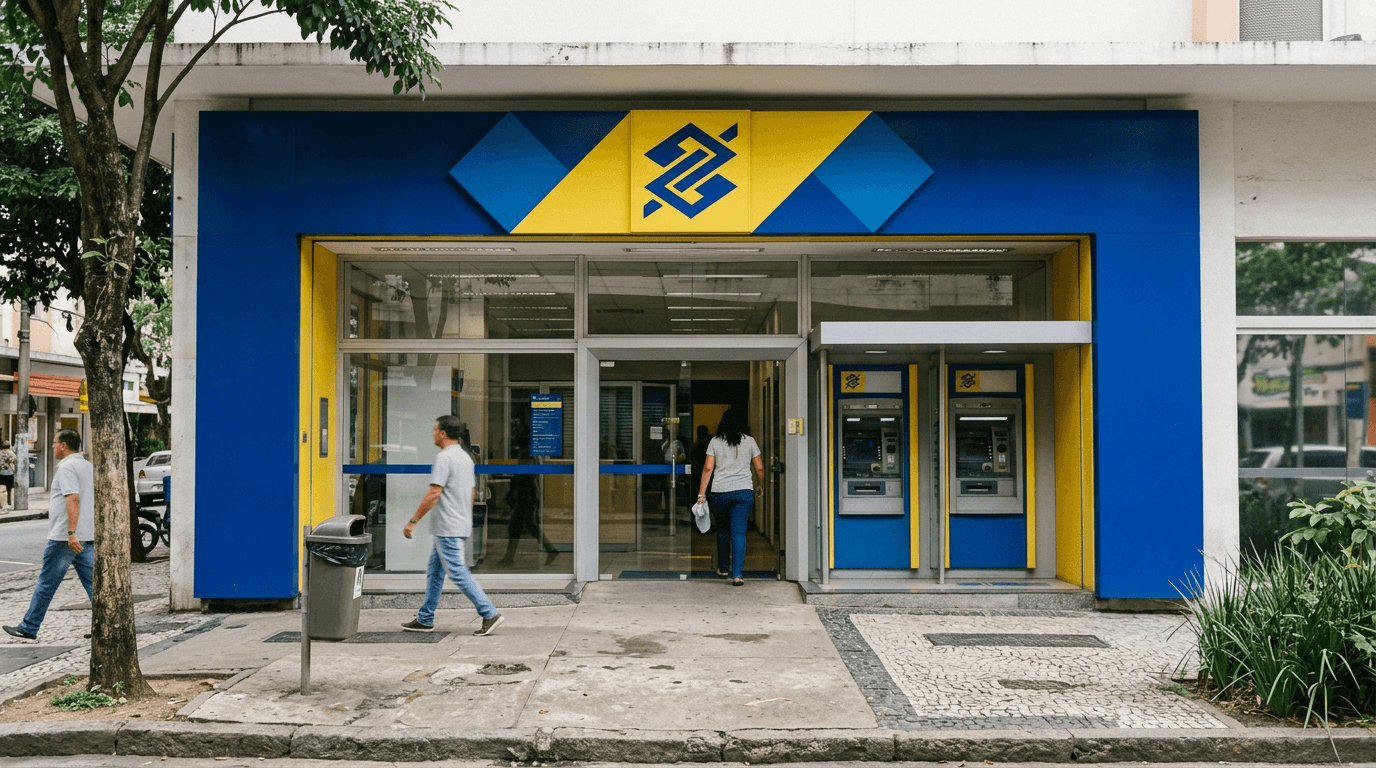
State-controlled Banco do Brasil slashed its 2026 profit guidance by 50% after rising defaults among soy, corn, and cattle producers drove a Q3 profit drop.
Key takeaways
- Banco do Brasil reported Q3 2026 adjusted net income plummeted 66.5% year-over-year to 1.27 billion reals, per the bank's earnings report on November 12, 2026
- The lender halved its 2026 adjusted net profit guidance to a range of 9 billion to 11 billion reals, per its financial disclosures on November 12, 2026
- Agribusiness delinquencies over 90 days jumped to 6.92% in September 2026 from 4.84% a year earlier, per the bank's presentation on November 12, 2026
American retail investors holding emerging-market portfolios are seeing a major core holding hit hard, as a sudden 50% profit-forecast cut from South America's largest agricultural lender triggers an immediate dividend reduction. For US investors scanning emerging markets, the state-run brazil banco is traditionally seen as a safe, high-yielding bet, but this agricultural standoff has upended that thesis. State-controlled financial giant Banco do Brasil announced in its third-quarter earnings release on November 12, 2026, that its adjusted net profit plummeted 66.5% year-over-year to 1.27 billion reals, down from 3.79 billion reals in the same period of 2025. The drastic earnings decline was primarily driven by an 18.4% increase in the quarterly cost of credit, which reached 21.2 billion reals, according to financial disclosures released by the bank on November 12, 2026.
This massive credit hit directly relates to Brazil's dominant agricultural output exposure, specifically in the soybean, corn, and cattle sectors of the Center-West region. The lender, which holds a massive 403.6 billion real crop portfolio representing roughly half of the country's rural credit, according to bank disclosures on November 12, 2026, is facing what management describes as a deliberate payment standoff. Medium and large soybean, corn, and cattle producers are intentionally withholding payments, choosing to reject debt-restructuring offers in hopes of extracting more lenient bailout terms or a broader debt pardon from the government, according to a report published by Agência Brasil on November 13, 2026.
Deliberate Defaults and Moral Hazard
During an analyst call on November 12, 2026, Banco do Brasil CEO Tarciana Medeiros stated that the bank did not anticipate the persistence and intentional nature of this moral hazard, pointing out that many of these producers recorded record harvests in 2025 and 2026 but still chose not to honor their financial commitments. The bank's 90-day agricultural delinquency rate jumped to 6.92% in September 2026 from 4.84% a year prior, while the on-time payment rate collapsed from 83% in July to just 66% in October 2026, according to presentation slides published by the bank on November 12, 2026. Only 15% of delinquent borrowers participated in the bank's special debt renegotiation program under Provisional Measure 1,376/2026, which expired on November 12, 2026, according to the bank's presentation.
The resulting financial damage has forced the lender to dramatically lower its near-term expectations. The bank's board of directors voted on November 12, 2026, to cut its 2026 dividend payout ratio to the statutory minimum of 25%, down from the previously targeted 30%, and suspended scheduled interim dividend announcements for 2027, as reported by El Fondo on November 16, 2026. Furthermore, Banco do Brasil slashed its full-year 2026 adjusted net income forecast from an earlier range of 18 billion to 22 billion reals down to between 9 billion and 11 billion reals, according to regulatory filings on November 12, 2026. CFO Geovanne Tobias on November 12, 2026, described the sudden surge in agricultural defaults as an extraordinary outlier with no equivalent in the bank's modern history since the 1994 Plano Real.
To recover the missing cash, Banco do Brasil is preparing to shift from soft negotiations to aggressive collateral enforcement and legal actions. The bank also plans to sell off its non-performing agricultural loan portfolio to third-party market participants, according to statements made by executives during the November 12, 2026, analyst call. Investors will be watching whether these enforcement actions can stabilize the Brazilian banking sector credit quality, or if the ongoing political debate over agricultural bailouts in Congress will continue to fuel payment delays into the first half of 2027.
In your brokerage app
For US retail investors, Banco do Brasil does not trade directly on major American exchanges but is listed in Sao Paulo under the ticker BBAS3. However, the bank represents a major financial holding in the iShares MSCI Brazil ETF (EWZ), the most popular US exchange-traded fund tracking Brazilian equities. The sudden earnings plunge and dividend reduction are expected to put downward pressure on the fund's overall yield, highlighting how agricultural output exposure can quickly affect broader emerging-market portfolios.
Analysis · NWX analysis desk
Which Brazil assets this touches
- EWZ, BBAS3, SOYBEAN, CORN, CATTLE — Named in this story.
Fundamentals · Banco do Brasil (BBAS3)
Banco do Brasil (BBAS3) trades at 7.3x its yearly earnings and 0.4x its book value. Its return on equity is 6.8%. Its dividend yield is 4.9%. The market values the company at R$83.6 billion. Its financial health score is 48 out of 100 (stable), based on profitability, liquidity, debt and growth. Latest: Q3 2026 results, published Nov 11, 2026.
| Price / earnings (P/E) | 7.3x | How many years of the current yearly profit the share price adds up to. |
|---|---|---|
| Price / book (P/B) | 0.4x | The share price compared with the accounting value of what the company owns, per share. |
| Return on equity (ROE) | 6.8% | Yearly profit for every R$100 that shareholders have put into the company. |
| Net margin | 4.3% | The part of every R$100 in sales that is left as profit. |
| Dividend yield | 4.9% | Cash paid to shareholders over the past year, as a share of today's price. |
| Market value | R$83.6 billion | What the whole company is worth at today's share price. |
Technical picture · iShares MSCI Brazil ETF (EWZ)
iShares MSCI Brazil ETF (EWZ) closed at $30.07 on Nov 18, 2026, down 7.3% from five sessions earlier. The last close is below its 20-day average of $33.26 and below its 50-day average of $37.14. Since May 15, 2026 it has traded between $30.07 (low, Nov 18, 2026) and $43.54 (high, Oct 9, 2026).
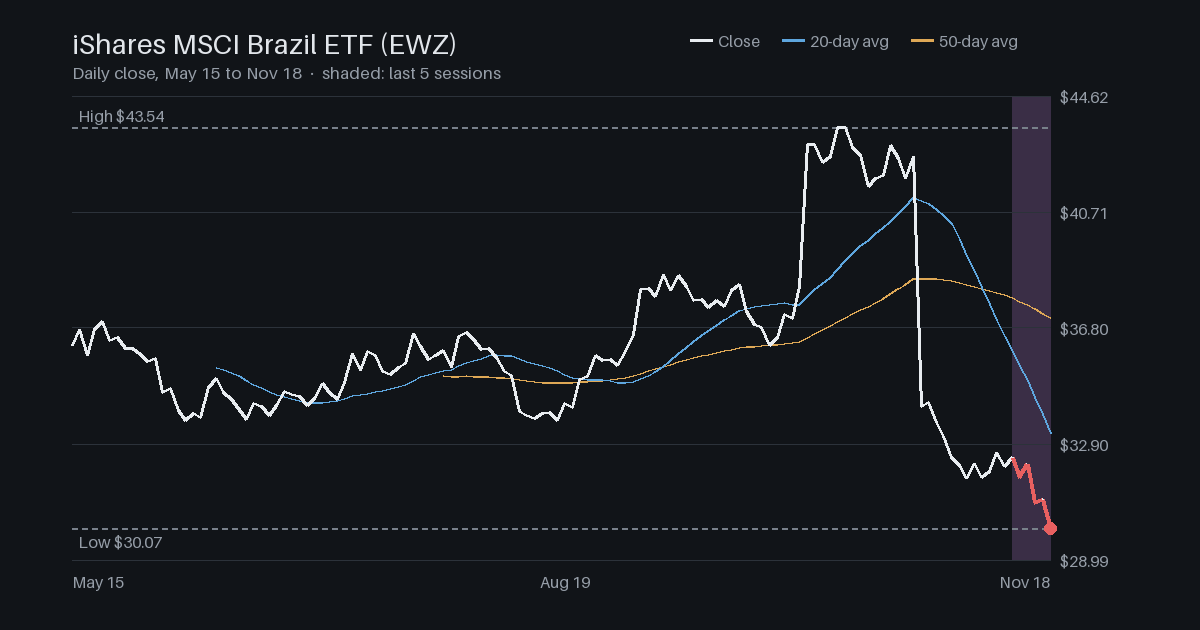
| Last close | $30.07 | Closing price on Nov 18, 2026. |
|---|---|---|
| 5-session move | -7.3% | Change in the closing price over the last five trading days. |
| 20-day average | $33.26 | The average closing price of the last 20 trading days. |
| 50-day average | $37.14 | The average closing price of the last 50 trading days. |
| Period high | $43.54 | Highest price since May 15, 2026. |
| Period low | $30.07 | Lowest price since May 15, 2026. |
Related coverage
 Telefônica Brasil Confirms December Payout to New York InvestorsTelefônica Brasil confirmed the December payment date for a previously approved interest-on-capital distribution. Here is what ADS holders can expect.
 Fed, Fiscal Fears Push US Dollar to 19-Month High Against Brazil RealA hawkish Fed and weakened Brazilian fiscal savings push the US dollar to its highest level since April 2025, devaluing American investor returns.
 Gerdau Cancels December Investor Day, Delaying Competitiveness PlanGlobal steel investors face delays in hearing Gerdau's response to Chinese import pressures after the company canceled its December 4 meeting.