

US-Listed Brazil ETF Braced for New 25% Dividend Tax Proposal
Left-wing lawmakers in Brasília proposed progressive dividend taxes up to 25% as US-listed Brazilian equities navigate fiscal reforms and corporate shocks.

Key takeaways
- Left-wing lawmakers proposed a progressive dividend tax of up to 25% on corporate payouts, per legislative records on November 17, 2026
- Brazil’s Senate approved a base fiscal bill aiming for up to 56.1 billion reais in savings, per official records on November 12, 2026
- Pulp producer Klabin suspended southern Brazil operations following a boiler explosion, per a company filing on November 18, 2026
- Steelmaker Gerdau S.A. canceled its planned December investor day to restructure competitiveness plans, per a market announcement on November 18, 2026
American retail investors holding high-yielding Brazilian stocks or the benchmark iShares MSCI Brazil ETF face a sharp drop in future payouts under a new proposal by left-wing lawmakers in Brasília to tax corporate dividends at progressive rates of up to 25%, according to legislative records. Filed on November 17, 2026, by the leader of the ruling Workers' Party (PT) in the Chamber of Deputies, Pedro Uczai, along with 78 other left-wing legislators, the draft bill threatens to upend the decades-long tax-exempt status of corporate distributions and directly cut net yields for foreign brokerage accounts. This political move introduces fresh volatility for international portfolios, highlighting the regulatory risks of allocating capital to emerging markets.
The proposed tax, registered as PL 5889/2026, represents a dramatic escalation from a flat 15% rate proposal introduced by the same group just days earlier, on November 13, 2026. Under the new draft, monthly corporate payouts would be taxed at 15% for distributed amounts up to 50,000 reais (about $8,550), rising to 20% for payouts up to 150,000 reais, and peaking at 25% for any distributed amounts exceeding 150,000 reais, according to the text of the bill. This political push comes as President Luiz Inácio Lula da Silva’s administration and Congress negotiate a highly anticipated fiscal consolidation package. Historically, Brazil has exempted corporate dividends from income tax since 1995, save for a modest 10% withholding tax on high-value monthly domestic payouts and all foreign remittances that was implemented in January 2026 under Law 15,270/2025. Under the new proposal, the taxes would be withheld directly at the source by the distributing companies before reaching investors.
These tax proposals run parallel to, and threaten to complicate, negotiations over the government's official fiscal adjustment plan, PLP 299/2026. On November 12, 2026, the Brazilian Senate approved the base text of that bill by a 45-to-31 vote, aiming to improve the 2027 primary budget balance by between 45.1 billion reais and 56.1 billion reais by limiting tax breaks and tightening spending rules, according to Senate legislative records. The package has now headed to the Chamber of Deputies, the lower house of Congress, where centrist and conservative parties hold substantial leverage to modify or block the ruling party's proposals. Foreign investors are closely watching whether Congress can deliver a credible spending-cut package to stabilize the country's public debt, which has climbed to over 82% of GDP, according to International Monetary Fund estimates.
In addition to the legislative battles, several US-listed Brazilian giants reported operational and corporate disruptions this week. On November 18, 2026, pulp and paper producer Klabin suspended operations at its Otacílio Costa packaging paper plant in southern Brazil after a recovery boiler exploded, injuring ten employees, according to a securities filing. The mill has an annual production capacity of 350,000 metric tons, according to Klabin's records. Meanwhile, steelmaking giant Gerdau S.A. announced on November 18, 2026, that it has canceled its planned December 4 Investor Day, delaying the presentation of its much-anticipated competitiveness and investment plans for Brazil. Elsewhere, lithium producer Sigma Lithium saw its shares touch a 52-week low of $4.25 on November 17, 2026, amid weak global lithium prices, according to NASDAQ market data.
Investors must watch the Chamber of Deputies in the coming weeks as it debates both the official fiscal package and the ruling party's tax proposals. For these draft measures to become law, they must navigate committee reviews and secure majority votes in both houses of a highly divided Congress. Any dilution of the official spending cuts or progress on the aggressive dividend tax could spark currency volatility and keep upward pressure on interest rates, as the Brazilian Central Bank struggles to bring 4.6% inflation back to its 3% target, according to official central bank data.
In your brokerage app
American investors holding the iShares MSCI Brazil ETF or individual New York-listed shares should closely track these developments. Heavyweight holdings in the fund—such as state-controlled oil producer Petrobras, commercial bank Itaú Unibanco, and private steelmaker Gerdau S.A.—would see direct pressure on net dividend payouts if the proposed 25% tax rate passes. Meanwhile, digital payments firm PagSeguro Digital Ltd., which announced a $0.26 cash dividend on November 16, 2026, illustrates that cash returns remain active but are increasingly subject to local fiscal crosswinds, according to its SEC filing.
Analysis · NWX analysis desk
Which Brazil assets this touches
- EWZ, NU, STNE, PAGS, IBOV — Big swings in U.S. tech stocks tend to spill into Brazil's fintechs listed in New York and into the broad Brazil fund, as global investors change how much risk they hold.
Technical picture · iShares MSCI Brazil ETF (EWZ)
iShares MSCI Brazil ETF (EWZ) closed at $30.07 on Nov 18, 2026, down 7.3% from five sessions earlier. The last close is below its 20-day average of $33.26 and below its 50-day average of $37.14. Since May 15, 2026 it has traded between $30.07 (low, Nov 18, 2026) and $43.54 (high, Oct 9, 2026).
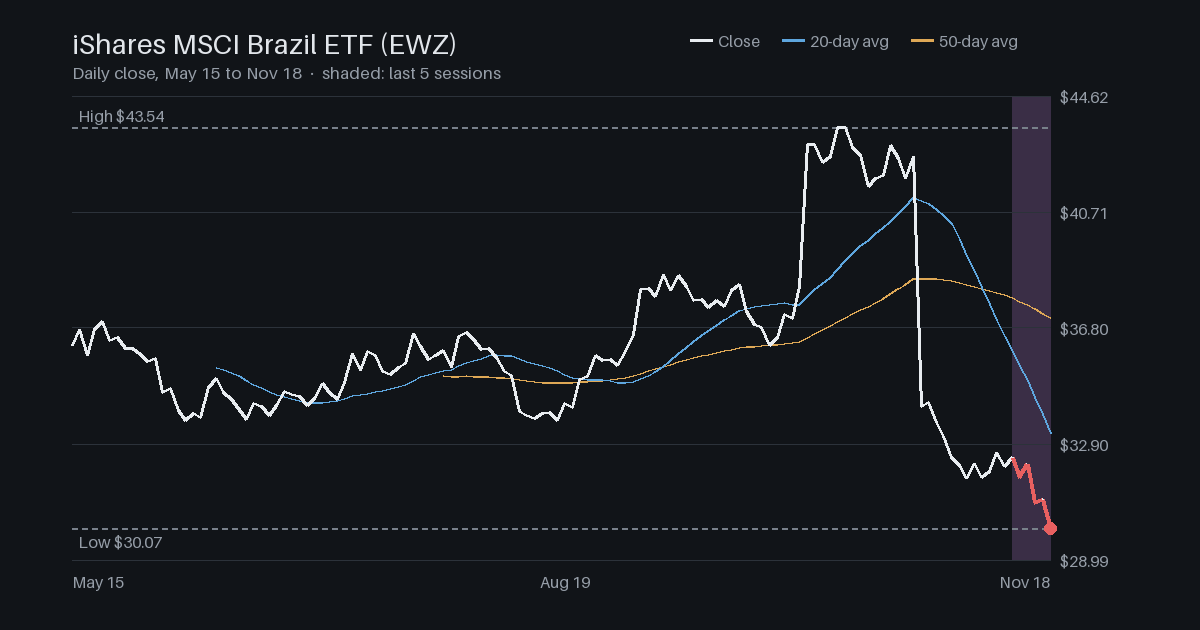
| Last close | $30.07 | Closing price on Nov 18, 2026. |
|---|---|---|
| 5-session move | -7.3% | Change in the closing price over the last five trading days. |
| 20-day average | $33.26 | The average closing price of the last 20 trading days. |
| 50-day average | $37.14 | The average closing price of the last 50 trading days. |
| Period high | $43.54 | Highest price since May 15, 2026. |
| Period low | $30.07 | Lowest price since May 15, 2026. |
Related coverage
 Petrobras Prepares to Raise Capital Spending Up to $120 BillionAmerican investors holding Petrobras certificates face a potential dividend squeeze as the energy giant prepares to unveil a capital-heavy business plan.
 Klabin Boiler Explosion Threatens Dividends for US ADR HoldersA suspension at Klabin's Otacílio Costa mill following a boiler explosion could cut annual EBITDA by 7%, posing a risk to ADR holder dividends.
 DIDIY ADR Faces Threat as Brazil Demands $17 Million App-Fee PenaltyDiDi Global's ADR faces regulatory pressure in Brazil as labor prosecutors demand $17 million and a halt to 99's upfront 'Taxa Zero' subscription pass.