

Fed, Fiscal Fears Push US Dollar to 19-Month High Against Brazil Real
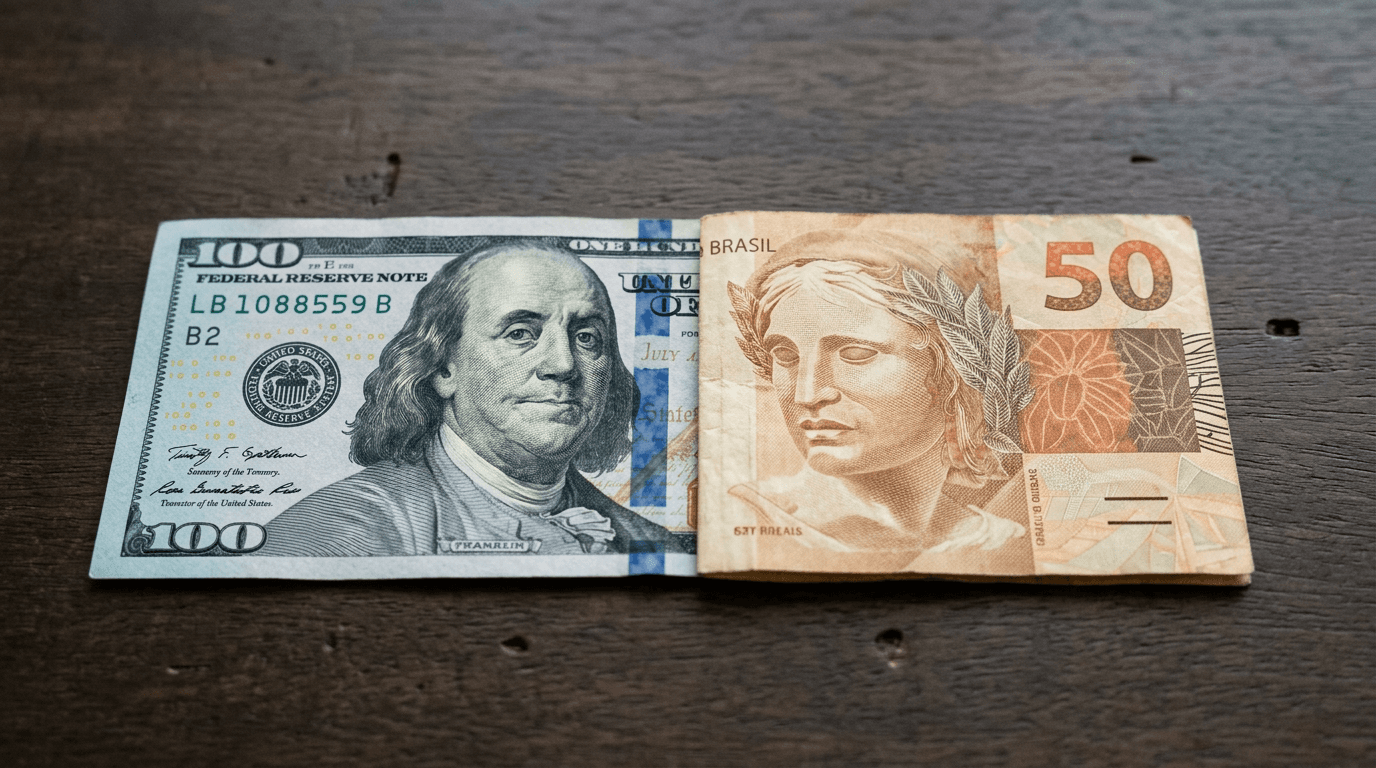
A hawkish Fed and weakened Brazilian fiscal savings push the US dollar to its highest level since April 2025, devaluing American investor returns.
Key takeaways
- The US dollar rose 1.46% to close at R$ 5.8667 on November 18, 2026, marking a 19-month high, per Exame
- The Brazilian Real lost 8% of its value in November 2026 alone due to domestic fiscal delays and hawkish Fed signals, per Exame
- Brazil's Central Bank unsuccessfully intervened on November 18, 2026, by auctioning $1 billion in liquidity, per BCB
- The Brazilian Senate passed the diluted R$ 50 billion fiscal adjustment bill 69 to 2 on November 18, 2026, per Poder360
Global stock portfolios and US-listed emerging market funds felt the sting of a strengthening greenback on November 18, 2026, as hawkish signs from the Federal Reserve sent shockwaves through overseas assets. The prospects of prolonged high interest rates in the United States have renewed pressure on foreign currencies, directly impacting dollar-denominated returns for international retail investors.
In South America's largest economy, the Brazil real plummeted to its lowest level in 19 months. On November 18, 2026, the US dollar surged 1.46% to close at R$ 5.8667, marking its highest nominal closing since April 15, 2025, according to trading data reported by Exame. The rapid slide means the Brazilian currency has depreciated by 8% in November 2026 alone, as shown by historical tracking on Exame, eroding the value of holdings in American depositary receipts and funds focused on the country.
The sell-off was triggered by a double whammy of global and domestic factors. In Washington, the release of hawkish Federal Reserve minutes—accentuated by comments from Fed Governor Christopher Waller on November 18, 2026, signaling that further rate adjustments might be necessary, as reported by Exame—stoked fears of a persistent interest-rate gap between the US and developing countries. Simultaneously, investors in São Paulo grew anxious over delayed and diluted negotiations in Congress regarding the Luiz Inácio Lula da Silva administration’s fiscal savings package.
While the Brazilian Senate ultimately concluded its vote on the landmark fiscal adjustment bill on November 18, 2026, passing it 69 to 2 as reported by Poder360, late concessions to the opposition watered down the target. Senator Eduardo Braga stated on November 18, 2026, that the concessions would reduce the projected 2027 budget savings from R$ 56 billion to R$ 50 billion, according to Poder360. This dilution of austerity measures failed to reassure nervous currency markets.
In an effort to stabilize the free-falling currency, the Central Bank of Brazil stepped in during morning trading on November 18, 2026. The central bank, whose monetary policy actions are updated at bcb.gov.br, sold the full offer of $1 billion across two morning line auctions to inject liquidity, as detailed in transaction results on November 18, 2026, by bcb.gov.br. Despite this direct intervention, the massive demand for dollars overwhelmed the central bank's efforts, failing to arrest the real’s downward trajectory.
The next major hurdle for the fiscal package is the Chamber of Deputies. The lower house plans to hold an extraordinary session on Monday, November 23, 2026, to deliberate on the bill, as announced by Chamber President Hugo Motta on November 18, 2026, and reported by Poder360. Global investors will be watching closely to see if the proposed spending caps suffer further dilutions, which could trigger another wave of USDBRL exchange rate volatility and emerging market ETF flows.
In your brokerage app
For retail investors holding the iShares MSCI Brazil ETF (EWZ), which tracks large and mid-sized Brazilian equities, the slide in the real acts as a direct drag on performance. Even when local share prices rise on the B3 exchange in São Paulo, the conversion back to US dollars at a weaker exchange rate diminishes the net asset value of the fund. The same currency headwind applies to US-listed Brazilian heavyweights like state-run oil firm Petrobras (PBR) and mining giant Vale (VALE), whose dollar-denominated ADR payouts and valuations are highly sensitive to wild swings in the USDBRL exchange rate.
Analysis · NWX analysis desk
Which Brazil assets this touches
- EWZ, PBR, VALE, IBOV, USDBRL, DI1 — Named in this story.
Fundamentals · Petrobras (PETR4)
Petrobras (PETR4) trades at 4.0x its yearly earnings and 1.1x its book value. Its return on equity is 27.8%. Its dividend yield is 8.5%. The market values the company at R$607.4 billion. Its financial health score is 81 out of 100 (strong), based on profitability, liquidity, debt and growth. Latest: Q3 2026 results, published Nov 10, 2026.
| Price / earnings (P/E) | 4.0x | How many years of the current yearly profit the share price adds up to. |
|---|---|---|
| Price / book (P/B) | 1.1x | The share price compared with the accounting value of what the company owns, per share. |
| Return on equity (ROE) | 27.8% | Yearly profit for every R$100 that shareholders have put into the company. |
| Net margin | 23.8% | The part of every R$100 in sales that is left as profit. |
| Dividend yield | 8.5% | Cash paid to shareholders over the past year, as a share of today's price. |
| Market value | R$607.4 billion | What the whole company is worth at today's share price. |
Technical picture · iShares MSCI Brazil ETF (EWZ)
iShares MSCI Brazil ETF (EWZ) closed at $30.07 on Nov 18, 2026, down 7.3% from five sessions earlier. The last close is below its 20-day average of $33.26 and below its 50-day average of $37.14. Since May 15, 2026 it has traded between $30.07 (low, Nov 18, 2026) and $43.54 (high, Oct 9, 2026).
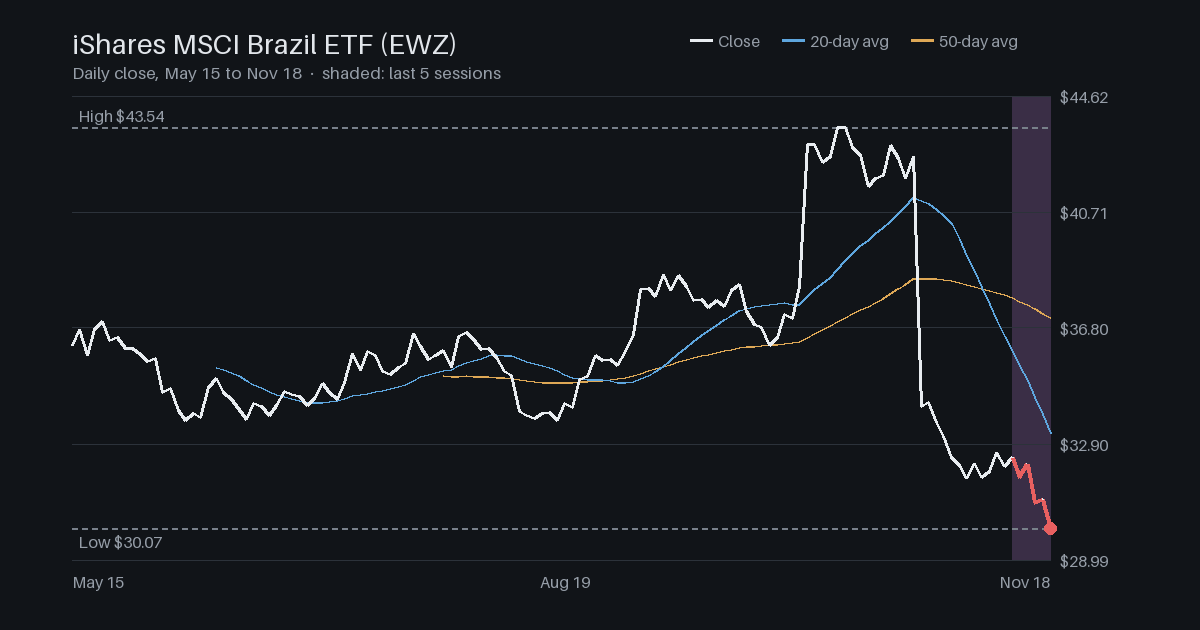
| Last close | $30.07 | Closing price on Nov 18, 2026. |
|---|---|---|
| 5-session move | -7.3% | Change in the closing price over the last five trading days. |
| 20-day average | $33.26 | The average closing price of the last 20 trading days. |
| 50-day average | $37.14 | The average closing price of the last 50 trading days. |
| Period high | $43.54 | Highest price since May 15, 2026. |
| Period low | $30.07 | Lowest price since May 15, 2026. |
Related coverage
 Telefônica Brasil Confirms December Payout to New York InvestorsTelefônica Brasil confirmed the December payment date for a previously approved interest-on-capital distribution. Here is what ADS holders can expect.
 Banco do Brasil Halves 2026 Profit Forecast on Farm DefaultsState-controlled Banco do Brasil slashed its 2026 profit guidance by 50% after rising defaults among soy, corn, and cattle producers drove a Q3 profit drop.
 Gerdau Cancels December Investor Day, Delaying Competitiveness PlanGlobal steel investors face delays in hearing Gerdau's response to Chinese import pressures after the company canceled its December 4 meeting.