

Dollar Passes R$ 6.00 and Shakes Brazil ETFs Ahead of Fiscal Vote
American retail portfolios face erosion as the US dollar hits R$ 6.0010 and the iShares MSCI Brazil ETF reaches a 15-month low of $28.56 ahead of a fiscal vote.
Key takeaways
- The US Dollar reached an intraday peak of R$ 6.0010, marking its first breach of the R$ 6.00 line since April 2025, per Times Brasil on November 23, 2026
- The iShares MSCI Brazil ETF fell 3.29% to a 15-month low of $28.56, per iShares on November 20, 2026
- Brazil's Chamber of Deputies votes on a controversial R$ 50 billion fiscal package, per Guaíba on November 23, 2026
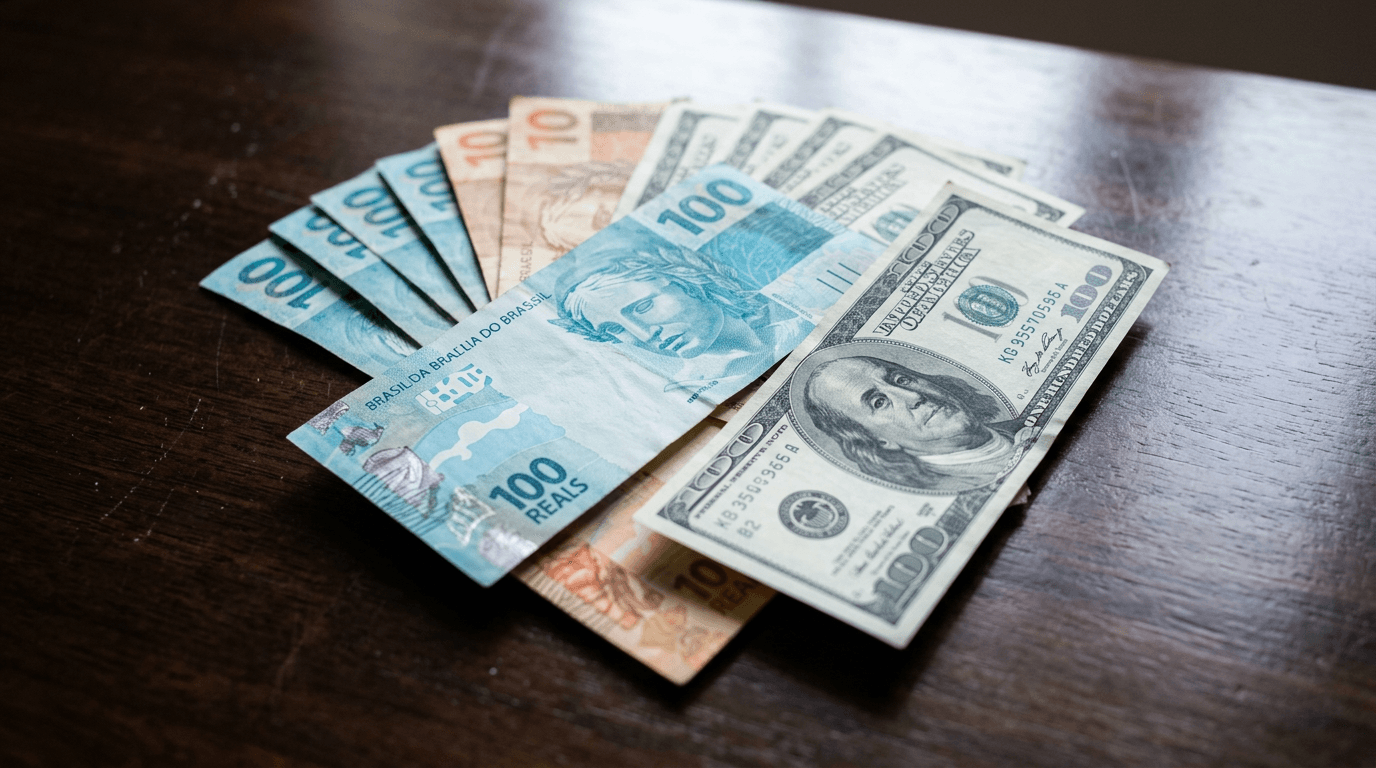
American retail investors holding diversified emerging market assets are seeing their returns eroded as South America’s largest economy experiences a sharp currency sell-off. On Monday, November 23, 2026, the US dollar crossed a critical psychological barrier against the Brazilian real, directly impacting the value of US-listed funds [Times Brasil]. This rapid depreciation occurs as international markets closely track a critical legislative vote in Brazil's capital, which many fear may not go far enough to stabilize the country's growing public debt [Guaíba].
The greenback reached an intraday peak of R$ 6.0010 on Monday, November 23, 2026, marking the first time the exchange rate crossed the R$ 6.00 threshold since April 2025, according to trading data compiled by Times Brasil. This currency depreciation, tracked under the USD BRL pair, has immediate consequences for foreign equity holders [Times Brasil]. Because US-listed funds buy and hold assets denominated in local Brazilian currency, any decline in the real's purchasing power automatically reduces the dollar-denominated net asset value of those portfolios.
This exchange rate pressure is highly visible in the ishares msci brazil etf stock, which serves as the main vehicle for US retail investors targeting Brazilian equities [iShares]. Ahead of the local market's weekly reopening, the ishares msci brazil etf (known as EWZ) dropped 3.29% on Friday, November 20, 2026, hitting a 15-month low of $28.56, according to official fund data from iShares. To put this in perspective for American portfolios, while major US stock indices have hovered near record highs throughout late 2026, the Brazilian benchmark fund has faced persistent downward pressure, driven almost entirely by the deteriorating foreign exchange rate [Times Brasil].
The immediate trigger for the real’s downward spiral is domestic fiscal policy uncertainty in Brasília [Times Brasil]. On Monday, November 23, 2026, Brazil's Chamber of Deputies (the lower house of Congress) prepared to vote on a highly contested R$ 50 billion fiscal adjustment package designed to curb government spending, as reported by Guaíba. However, international analysts have criticized the proposal as mathematically insufficient to halt the growth of the country's long-term sovereign debt, prompting a rapid exit of foreign capital. In the first half of November 2026 alone, international investors pulled R$ 5.5 billion out of the Brazilian stock exchange (B3), according to data cited by Times Brasil.
Investors are now watching whether Brazil's policymakers will introduce more aggressive structural spending cuts to restore market confidence, or if the central bank will step in with further direct market interventions. On Thursday, November 19, 2026, the Banco Central do Brasil conducted an extraordinary spot market auction of $1 billion to defend the currency, its first such intervention since December 2024, per Times Brasil. Despite this large dollar injection, the real's downward trend highlights how structural fiscal doubts continue to override short-term central bank operations [Times Brasil].
In your brokerage app
For retail investors holding international assets, the most direct exposure to this currency volatility is through the ishares msci brazil etf (EWZ), a US-listed exchange-traded fund that tracks major Brazilian giants like mining firm Vale and state oil company Petrobras [iShares]. Broad emerging market funds and diversified Latin American ETFs also maintain large allocations in Brazilian assets, meaning that a sustained move above R$ 6.00 will continue to dilute dollar returns for unsuspecting foreign portfolios.
Analysis · NWX analysis desk
Which Brazil assets this touches
- EWZ, IBOV, USDBRL — Named in this story.
Technical picture · iShares MSCI Brazil ETF (EWZ)
iShares MSCI Brazil ETF (EWZ) closed at $28.54 on Nov 20, 2026, down 11.4% from five sessions earlier. The last close is below its 20-day average of $31.94 and below its 50-day average of $36.77. Since May 20, 2026 it has traded between $28.54 (low, Nov 20, 2026) and $43.54 (high, Oct 9, 2026).
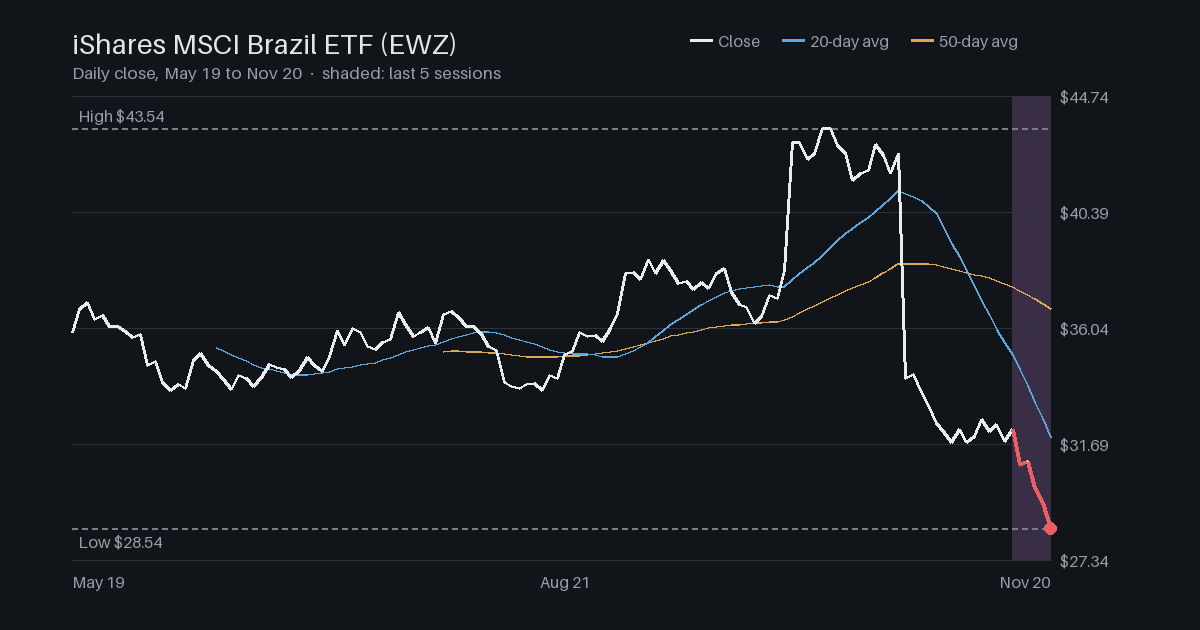
| Last close | $28.54 | Closing price on Nov 20, 2026. |
|---|---|---|
| 5-session move | -11.4% | Change in the closing price over the last five trading days. |
| 20-day average | $31.94 | The average closing price of the last 20 trading days. |
| 50-day average | $36.77 | The average closing price of the last 50 trading days. |
| Period high | $43.54 | Highest price since May 20, 2026. |
| Period low | $28.54 | Lowest price since May 20, 2026. |
Related coverage
 Dollar Hits R$ 6.00 on Brazil Budget Woes, Hurting US Retail ETFsA historic spike in the US dollar to R$ 6.00 on domestic budget concerns directly erodes returns for American retail investors holding Brazil-focused ETFs.
 Banco do Brasil Cuts Dividend as Bad Farm Loans Hit 21 Billion RealAmerican investors face a steep dividend haircut as Banco do Brasil slashes payouts following a massive agricultural loan default wave in the third quarter.
 Braskem Secures $4.9 Billion Out-of-Court Debt DealBraskem has secured an out-of-court restructuring agreement with major creditors to swap debt for equity and inject $1.3 billion in cash, avoiding bankruptcy.