

Banco do Brasil Halves Annual Profit Forecast as Farm Defaults Surge
The state-backed agribusiness lender cut its 2026 adjusted net income guidance to R$ 9 billion to R$ 11 billion after third-quarter profit plunged 66.5%.
Key takeaways
- Banco do Brasil reported third-quarter adjusted net income of R$ 1.27 billion, representing a 66.5% drop year-over-year, per ebc.com.br on November 13, 2026
- The state-backed lender cut its full-year profit guidance in half to a range of R$ 9 billion to R$ 11 billion, per ebc.com.br on November 13, 2026
- Over-90-day agricultural credit delinquency jumped to 6.92% in September 2026, up from 4.84% a year prior, per ebc.com.br on November 13, 2026
- The lender is seeking more flexible loan-loss accounting rules from the Central Bank of Brazil, per uol.com.br on November 16, 2026
American retail investors holding emerging market financial equities are facing sharply reduced dividend payouts after Banco do Brasil, the nation's largest state-backed agribusiness lender, slashed its annual profit forecast in half due to surging agricultural loan defaults. On November 11, 2026, the company filed a material fact cutting its 2026 adjusted net income guidance to between R$ 9 billion and R$ 11 billion—down from its prior estimate of R$ 18 billion to R$ 22 billion—while reducing its target dividend payout ratio to the regulatory minimum of 25%, according to filings cited by ebc.com.br on November 13, 2026.
The lender reported an adjusted net income of R$ 1.27 billion for the third quarter of 2026, representing a 66.5% drop year-over-year, per ebc.com.br on November 13, 2026. This sudden earnings collapse highlights the scale of financial distress rippling through the Brazilian interior, where the bank holds a massive R$ 403.6 billion agricultural credit portfolio, per ebc.com.br on November 13, 2026.
Surging Farm Defaults and 'Moral Hazard'
The root of the lender's third-quarter distress is a rapid deterioration in its agricultural loan book. Over-90-day agricultural credit delinquency jumped to 6.92% in September 2026, up from 4.84% in September 2025, according to data published by ebc.com.br on November 13, 2026. These defaults are concentrated heavily among medium and large soybean, corn, and cattle operations in the Center-West, the agricultural heartland of Brazil. To absorb these credit risks, the bank recorded R$ 21.2 billion in credit costs during the third quarter of 2026, per ebc.com.br on November 13, 2026.
Banco do Brasil President Tarciana Medeiros pointed directly to "moral hazard" to explain why defaults are rising even after years of record harvests. Medeiros asserted that solvent, large-scale producers are deliberately utilizing legal and governmental delay mechanisms to avoid loan restructuring, hoping to secure more favorable renegotiation terms later, per ebc.com.br on November 13, 2026. In response to the crisis, the bank is attempting to negotiate with the Central Bank of Brazil and the Ministry of Finance for a more flexible accounting rule to calculate expected losses from agricultural defaults, as reported by uol.com.br on November 16, 2026.
Looking ahead, global investors will need to watch whether the Central Bank of Brazil accepts the bank's regulatory appeal to adjust these provisioning rules. If delinquency rates do not stabilize in the coming months, further provisions could continue to weigh on the lender's profitability, keeping its dividend distributions locked at the 25% statutory minimum through 2027, as established in the bank's revised forecast reported by ebc.com.br on November 13, 2026.
In your brokerage app
For retail investors who invest in Brazil through broad-market funds, Banco do Brasil’s dividend cuts and guidance downgrade directly impact index-tracking vehicles. The lender is a significant component of the iShares MSCI Brazil ETF, which exposes holders to the financial health of Brazil’s state-backed banking sector. Banco do Brasil is also listed on the over-the-counter market in New York as American Depositary Receipts, meaning direct shareholders will see their interim dividend payments for the remainder of 2026 canceled.
Analysis · NWX analysis desk
Which Brazil assets this touches
- BBAS3, SOYBEAN, CORN, CATTLE — Named in this story.
Fundamentals · Banco do Brasil (BBAS3)
Banco do Brasil (BBAS3) trades at 7.4x its yearly earnings and 0.4x its book value. Its return on equity is 6.8%. Its dividend yield is 4.9%. The market values the company at R$81.8 billion. Its financial health score is 48 out of 100 (stable), based on profitability, liquidity, debt and growth. Latest: Q3 2026 results, published Nov 11, 2026.
| Price / earnings (P/E) | 7.4x | How many years of the current yearly profit the share price adds up to. |
|---|---|---|
| Price / book (P/B) | 0.4x | The share price compared with the accounting value of what the company owns, per share. |
| Return on equity (ROE) | 6.8% | Yearly profit for every R$100 that shareholders have put into the company. |
| Net margin | 4.3% | The part of every R$100 in sales that is left as profit. |
| Dividend yield | 4.9% | Cash paid to shareholders over the past year, as a share of today's price. |
| Market value | R$81.8 billion | What the whole company is worth at today's share price. |
Technical picture · Banco do Brasil (BBAS3)
Banco do Brasil (BBAS3) closed at R$14.30 on Nov 19, 2026, down 7.6% from five sessions earlier. The last close is below its 20-day average of R$16.95 and below its 50-day average of R$20.72. Since May 27, 2026 it has traded between R$14.02 (low, Nov 19, 2026) and R$27.19 (high, Oct 5, 2026).
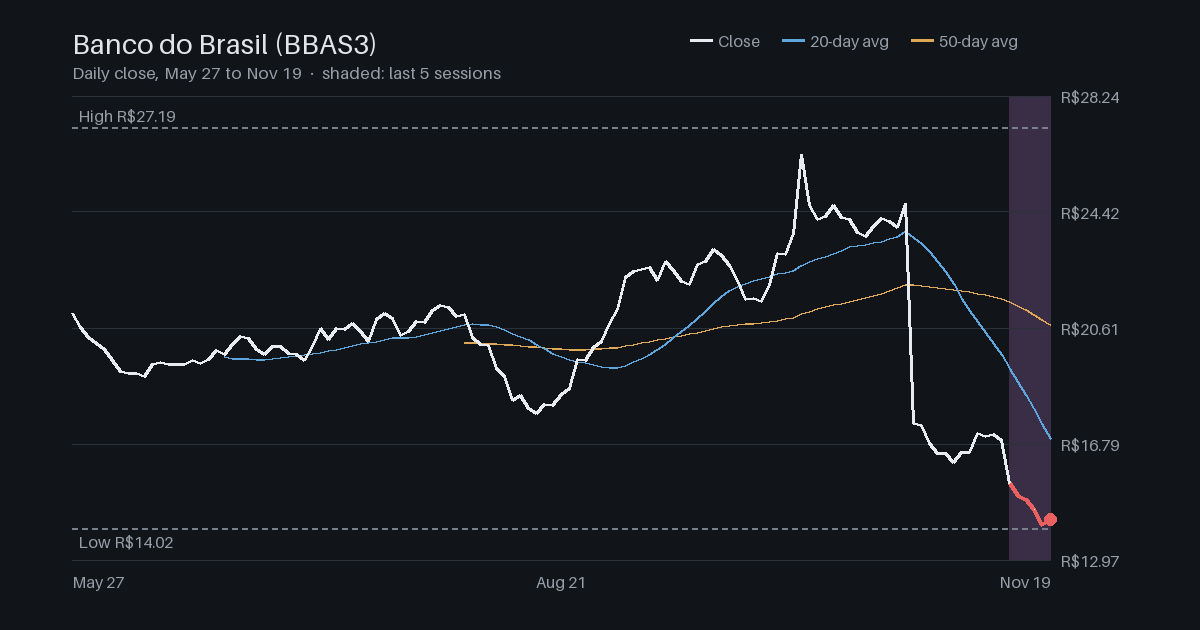
| Last close | R$14.30 | Closing price on Nov 19, 2026. |
|---|---|---|
| 5-session move | -7.6% | Change in the closing price over the last five trading days. |
| 20-day average | R$16.95 | The average closing price of the last 20 trading days. |
| 50-day average | R$20.72 | The average closing price of the last 50 trading days. |
| Period high | R$27.19 | Highest price since May 27, 2026. |
| Period low | R$14.02 | Lowest price since May 27, 2026. |
Related coverage
 Dollar Hits R$ 6.00 on Brazil Budget Woes, Hurting US Retail ETFsA historic spike in the US dollar to R$ 6.00 on domestic budget concerns directly erodes returns for American retail investors holding Brazil-focused ETFs.
 Banco do Brasil Cuts Dividend as Bad Farm Loans Hit 21 Billion RealAmerican investors face a steep dividend haircut as Banco do Brasil slashes payouts following a massive agricultural loan default wave in the third quarter.
 Braskem Secures $4.9 Billion Out-of-Court Debt DealBraskem has secured an out-of-court restructuring agreement with major creditors to swap debt for equity and inject $1.3 billion in cash, avoiding bankruptcy.