

Suzano Beats Q3 Earnings Estimates, Raises Pulp Prices by $50
Brazilian pulp giant Suzano beat third-quarter earnings estimates and raised pulp prices by $50 per tonne, driven by its Arbex joint venture consolidation.

Key takeaways
- Suzano announced a US$50 per tonne pulp price hike for Europe and the Americas, bringing European list prices to US$1,410, per Tissue World Magazine on November 4, 2026
- Suzano posted Q3 2026 EPS of $0.33, beating the consensus estimate of $0.17, per MarketBeat on November 5, 2026
- Suzano reported Q3 net revenue of R$16.5 billion and EBITDA of R$5.7 billion, per company reports on November 4, 2026
For American retail investors tracking global supply chains and consumer goods portfolios, the price of everyday paper products is headed higher. Suzano, the New York-listed Brazilian giant that dominates the global supply of raw paper inputs, announced a US$50 per tonne price increase for eucalyptus hardwood pulp order intakes in Europe and the Americas starting in November 2026, as reported by Tissue World Magazine on November 4, 2026. This adjustment brings the European list price to a benchmark US$1,410 per tonne, according to the same Tissue World Magazine report from November 4, 2026, signaling strong pricing power in soft commodity markets and pulp prices.
Understanding the scale of Suzano is critical for anyone tracking multinational consumer stocks. Headquartered in São Paulo, the Brazilian entity operates as the world's largest producer of hardwood pulp, meaning its pricing decisions directly impact the margins of consumer packaged goods giants like Procter & Gamble and Kimberly-Clark. While local dynamics in Brazil often involve complex tax and currency fluctuations, Suzano's dominance allows it to dictate global terms, translating physical forest assets in South America into dollar-denominated revenue.
This pricing leverage is already reflecting in the company's financial performance. According to earnings data published by MarketBeat, Suzano posted a third-quarter earnings per share (EPS) of $0.33, which beat the analyst consensus estimate of $0.17, on quarterly revenue of $3.19 billion.
Diversification via the Arbex Joint Venture
According to the company's official third-quarter results published on November 4, 2026, adjusted EBITDA rose 9% year-over-year to R$5.7 billion. This was supported by a new record net revenue of R$16.5 billion, which was significantly boosted by the first-time consolidation of Arbex, a tissue and consumer goods joint venture with Kimberly-Clark in which Suzano holds a 51% stake, according to the company's third-quarter statement. This integration has fundamentally altered the company's revenue profile, scaling up its direct consumer goods segment and helping it capture more margin along the value chain.
Going forward, the key factor for investors to watch is whether the Suzano pulp price hikes can be sustained in the face of varying regional demand. While European and North American buyers are absorbing the US$50 hike, weaker margins and cheaper local wood chips in Asian markets prevented the company from implementing similar increases there. The success of this pricing strategy will determine if Suzano can offset rising production expenses and continue to outpace consensus expectations.
In your brokerage app
Investors can track this pulp price momentum through Suzano's American Depositary Receipts (ADRs), which trade on the New York Stock Exchange under the ticker SUZ. Because Suzano is a heavy weight in broader emerging market funds, its financial health also directly influences the performance of the iShares MSCI Brazil ETF (EWZ), the primary exchange-traded fund used by retail accounts to gain exposure to Brazilian equities.
Analysis · NWX analysis desk
Which Brazil assets this touches
- SUZ, SUZB3 — Named in this story.
Fundamentals · Suzano (SUZB3)
Suzano (SUZB3) trades at 7.7x its yearly earnings and 1.3x its book value. Its return on equity is 16.1%. Its dividend yield is 2.2%. The market values the company at R$68.7 billion. Its financial health score is 85 out of 100 (strong), based on profitability, liquidity, debt and growth. Latest: Q3 2026 results, published Nov 5, 2026.
| Price / earnings (P/E) | 7.7x | How many years of the current yearly profit the share price adds up to. |
|---|---|---|
| Price / book (P/B) | 1.3x | The share price compared with the accounting value of what the company owns, per share. |
| Return on equity (ROE) | 16.1% | Yearly profit for every R$100 that shareholders have put into the company. |
| Net margin | 15.9% | The part of every R$100 in sales that is left as profit. |
| Dividend yield | 2.2% | Cash paid to shareholders over the past year, as a share of today's price. |
| Market value | R$68.7 billion | What the whole company is worth at today's share price. |
Technical picture · Suzano (SUZB3)
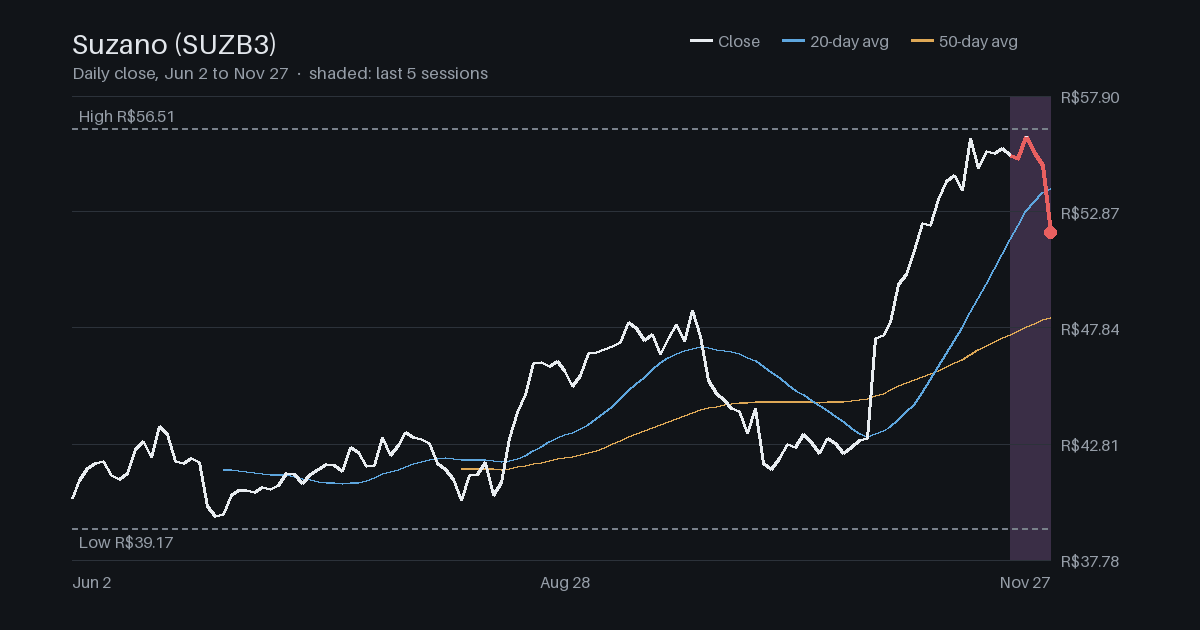
Suzano (SUZB3) closed at R$51.98 on Nov 27, 2026, down 6.0% from five sessions earlier. The last close is below its 20-day average of R$53.89 and above its 50-day average of R$48.29. Since Jun 2, 2026 it has traded between R$39.17 (low, Jun 30, 2026) and R$56.51 (high, Nov 17, 2026).
| Last close | R$51.98 | Closing price on Nov 27, 2026. |
|---|---|---|
| 5-session move | -6.0% | Change in the closing price over the last five trading days. |
| 20-day average | R$53.89 | The average closing price of the last 20 trading days. |
| 50-day average | R$48.29 | The average closing price of the last 50 trading days. |
| Period high | R$56.51 | Highest price since Jun 2, 2026. |
| Period low | R$39.17 | Lowest price since Jun 2, 2026. |
Latest articles
 Vinci Compass Surges 6.5%, Bypassing ADR Fees for US InvestorsVinci Compass shares jumped 6.54% on November 27, 2026, offering US investors a direct-listing route into Brazil without the hassle and fees of traditional ADRs.
 Nu Holdings Co-Founder Files Notice to Sell $3.24 Million in SharesNu Holdings co-founder Cristina Junqueira filed a Form 144 notice with the SEC to sell 250,000 common shares valued at $3.24 million.
 Speculators Maintain Strong Net-Long Position in Soybean FuturesCFTC data as of November 17, 2026, shows large speculators holding 145,816 net-long contracts in Chicago Board of Trade soybeans.