

US Sugar Futures Surge 14.65% on Proposed Tariff Targeting Brazil
The Trump administration proposed a new $440 per ton tariff on out-of-quota sugar imports on November 25, 2026, sending domestic futures up 14.65%.

Key takeaways
- The Trump administration proposed a $440 per metric ton tariff on out-of-quota raw sugar on November 25, 2026, per USTR draft guidelines
- US ICE March sugar futures surged 14.65% to 45 cents per pound on November 25, 2026, per market data on Kitco on November 26, 2026
- StoneX estimated that the total out-of-quota sugar import tariff could rise to an equivalent rate of 193% on November 25, 2026, per Kitco on November 26, 2026
Household grocery bills and the profit margins of major American packaged food companies face a new squeeze as Washington moves to heavily tax foreign agricultural imports. On November 25, 2026, the Trump administration proposed a massive new tariff of $440 per metric ton ($0.44 per kilogram) on out-of-quota raw sugar imports, alongside a $600 per metric ton ($0.60 per kilogram) duty on beet and refined sugar, according to a report by Kitco on November 26, 2026. This aggressive trade barrier is intended to restrict foreign supplies and shield domestic producers by raising procurement costs for businesses relying on sweetener ingredients.
Brazil, the world's largest sugar exporter and a primary target of the administration's trade policy, will see its access to the lucrative U.S. market heavily penalized. The proposed action by the Office of the United States Trade Representative (USTR) on November 25, 2026, swaps an existing 25% percentage-based tariff for these high flat-rate duties, as reported by Kitco on November 26, 2026. This trade escalation follows rising tensions; just one day prior, on November 24, 2026, Brazil asked the World Trade Organization (WTO) to establish a dispute panel over existing tariffs, a request the U.S. immediately blocked, according to WTO records from November 24, 2026.
The financial toll of the proposal was felt instantly across commodity markets, where U.S. sugar futures surged 14.65% to 45 cents per pound on November 25, 2026, while the global benchmark price rose just 3.9% to 18.34 cents per pound, according to market data published by Kitco on November 26, 2026. Crucially, the new duties apply to out-of-quota sugar from all origins to prevent other nations from backfilling the market, meaning American food companies cannot easily bypass the tax by sourcing from other global suppliers.
On November 25, 2026, commodity brokerage StoneX estimated that the total combined tariff on out-of-quota sugar imports from non-preferential suppliers will rise to an equivalent rate of 193%, as noted by Kitco on November 26, 2026. This creates a stark division where American buyers must pay more than double the price paid by international competitors for the exact same raw input. In a statement on November 25, 2026, the Sweetener Users Association warned that adding another heavy duty on top of existing tariffs will sharply increase the cost of securing the sugar needed to meet U.S. consumer demand, according to Kitco on November 26, 2026.
The proposed trade rules are now open to public comments and formal objections until a deadline of December 30, 2026, according to USTR draft guidelines published on November 25, 2026. A public hearing is also scheduled for January 14, 2027, as outlined in the USTR draft. Investors and corporate procurement officers will be watching this period closely, as the final implementation of these duties will dictate the cost structure of packaged goods and grocery staples well into the coming fiscal year.
In your brokerage app
For public equity markets, these rising domestic raw material costs are particularly relevant for major U.S. food and beverage giants listed in New York, such as The Hershey Company (NYSE: HSY) and Mondelez International (NASDAQ: MDLZ). Analysts monitor these large-cap consumer staple stocks to assess how raw material price changes influence corporate operating margins. When key input costs rise, the financial impact on these equities depends on each company's long-term supply-chain hedges and its capacity to pass higher pricing along to retail consumers.
Analysis · NWX analysis desk
Which Brazil assets this touches
- SUGAR — Named in this story.
- EWZ, NU, STNE, PAGS, IBOV — Big swings in U.S. tech stocks tend to spill into Brazil's fintechs listed in New York and into the broad Brazil fund, as global investors change how much risk they hold.
Technical picture · iShares MSCI Brazil ETF (EWZ)
iShares MSCI Brazil ETF (EWZ) closed at $33.12 on Nov 27, 2026, up 12.2% from five sessions earlier. The last close is above its 20-day average of $31.27 and below its 50-day average of $36.19. Since May 26, 2026 it has traded between $28.54 (low, Nov 20, 2026) and $43.54 (high, Oct 9, 2026).
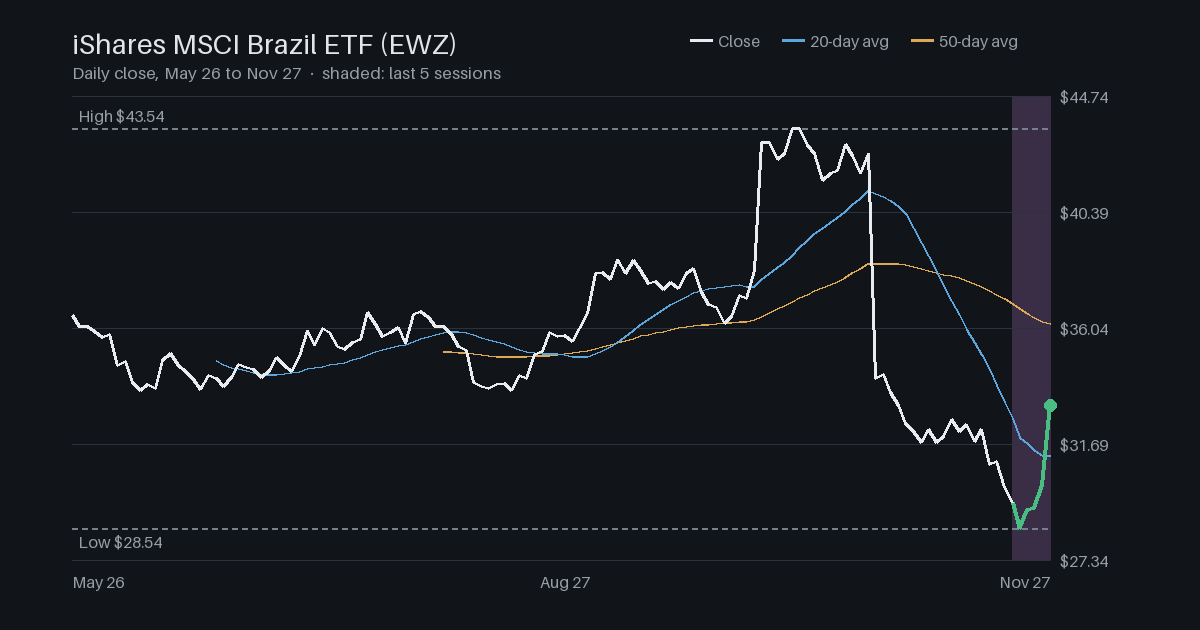
| Last close | $33.12 | Closing price on Nov 27, 2026. |
|---|---|---|
| 5-session move | +12.2% | Change in the closing price over the last five trading days. |
| 20-day average | $31.27 | The average closing price of the last 20 trading days. |
| 50-day average | $36.19 | The average closing price of the last 50 trading days. |
| Period high | $43.54 | Highest price since May 26, 2026. |
| Period low | $28.54 | Lowest price since May 26, 2026. |
Related coverage
 Trump Sugar Tariff Proposal Sends Domestic Futures Soaring 14.65%A proposed U.S. tariff of $440 per metric ton on raw sugar imports outside the WTO quota has driven domestic futures to 45 cents per pound.
 JPMorgan Upgrades Adecoagro on NYSE While Slashing São MartinhoJPMorgan reshuffled its South American sugar and ethanol exposure on November 26, 2026, upgrading NYSE-listed Adecoagro and downgrading Brazil's São Martinho.
 Speculators Maintain Strong Net-Long Position in Soybean FuturesCFTC data as of November 17, 2026, shows large speculators holding 145,816 net-long contracts in Chicago Board of Trade soybeans.