BlackRock’s Brazil Fund Surges on Trabuco Finance Minister Pick
BlackRock’s EWZ ETF rallied as Wall Street banks Goldman Sachs and JPMorgan reacted to the appointment of Luiz Carlos Trabuco as Brazil’s next finance minister.

Key takeaways
- BlackRock’s EWZ ETF surged up to 11% in pre-market trading and closed up 9.81% on November 27, 2026, following the Trabuco appointment, per iShares data
- Goldman Sachs labeled the choice 'the strongest signal of credibility' to limit risk premiums on November 27, 2026
- JPMorgan called the nomination a positive disruptor that raises the probability of a fiscal pivot on November 26, 2026
- UBS GWM stated on November 27, 2026, that the pick acts as an institutional shield for the Central Bank
BlackRock’s flagship exchange-traded fund tracking South American equities surged as much as 11% in pre-market trading on November 27, 2026, as Wall Street's largest investment banks welcomed the surprise appointment of a veteran private banker to lead the region's largest economy out of a fiscal impasse.
The sudden rally in the iShares MSCI Brazil ETF (EWZ)—which eventually closed up 9.81% on November 27, 2026, at $33.12—followed the official announcement in Brasilia that Bradesco Chairman Luiz Carlos Trabuco Cappi had accepted President Luiz Inácio Lula da Silva's invitation to head the Finance Ministry starting in 2027. Trabuco, a 75-year-old banking executive who has spent over five decades at one of Brazil's largest private lenders, is widely regarded as a market-friendly figure capable of bridging the gap between the government's social spending goals and Faria Lima’s fiscal demands. The appointment marks a significant shift in market sentiment following a period of post-election volatility that had previously pushed the Brazilian currency above the threshold of six reais per dollar.
Wall Street Views Trabuco as a 'Credibility Shield'
Wall Street’s major financial institutions reacted to the nomination with cautious optimism, framing the transition as a potential turning point for Brazil’s public finances. Goldman Sachs labeled the choice "the strongest signal of credibility" the government could send in a note on November 27, 2026, predicting that Trabuco's leadership will limit risk premiums and support the real. Meanwhile, JPMorgan called the nomination a "positive disruptor" on November 26, 2026, that raises the probability of a structural fiscal pivot, though the bank remained cautious about whether the transition can achieve long-term debt stabilization with public debt currently hovering near 83% of gross domestic product.
In a report published on November 27, 2026, UBS GWM argued that the appointment acts as an "institutional shield" for Brazil's Central Bank by reducing the space for unorthodox economic policies or alterations to the official inflation target. However, UBS analysts led by Solange Srour warned that Trabuco's ultimate success will depend on securing unwavering political support from President Lula when implementing unpopular fiscal adjustments. The Swiss bank drew parallels to former Finance Minister Joaquim Levy, who enjoyed strong market backing in 2015 but was ultimately forced out after less than a year due to a lack of political delegation and resistance from within the ruling party.
Domestic Funds Anticipate Asset Repricing
Domestic fund managers are also recalibrating their expectations for a major asset repricing. Rogério Xavier, a senior partner at SPX Capital, noted on November 29, 2026, in an article cited by Money Times that investors may have been underestimating President Lula's capacity to react to deteriorating financial conditions. According to Xavier, even a short three-month window of fiscal progress under Trabuco could trigger a "strong repricing" of Brazilian assets as global funds re-evaluate risk premiums.
Investors will now closely monitor the composition of Trabuco's incoming economic team, the specific details of any proposed expenditure reforms, and the administration's ability to shepherd those measures through Congress. The official transition is set to begin ahead of the new ministerial term in January 2027, which will serve as the first major test of whether this market-backed appointment can translate into concrete structural reform.
In your brokerage app
For retail investors holding emerging market ETFs in their brokerage accounts, the policy shift directly exposes the iShares MSCI Brazil ETF (EWZ), the primary US-listed fund tracking Brazilian equities. In addition to the broader index fund, the news heavily influenced US-listed Brazilian bank shares, including Banco Bradesco's American Depositary Receipts, which rose over the holiday-shortened trading session on November 27, 2026, as the market adjusted to the departure of its long-time chairman to public service.
Analysis · NWX analysis desk
Which Brazil assets this touches
- EWZ — Named in this story.
Technical picture · iShares MSCI Brazil ETF (EWZ)
iShares MSCI Brazil ETF (EWZ) closed at $33.12 on Nov 27, 2026, up 12.2% from five sessions earlier. The last close is above its 20-day average of $31.27 and below its 50-day average of $36.19. Since May 26, 2026 it has traded between $28.54 (low, Nov 20, 2026) and $43.54 (high, Oct 9, 2026).
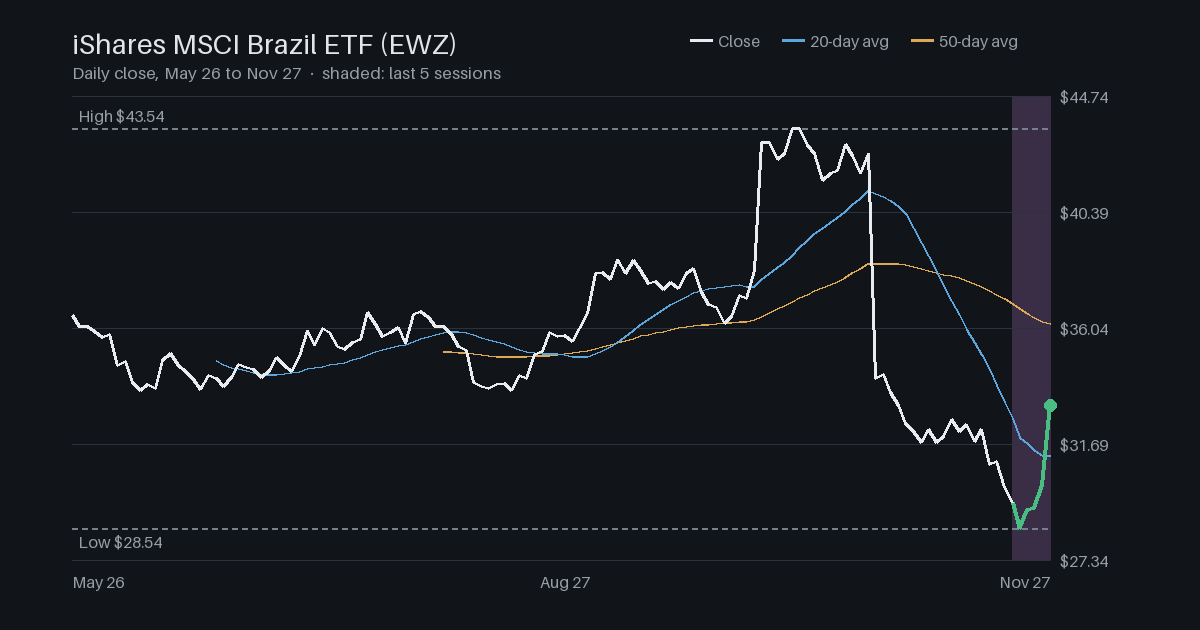
| Last close | $33.12 | Closing price on Nov 27, 2026. |
|---|---|---|
| 5-session move | +12.2% | Change in the closing price over the last five trading days. |
| 20-day average | $31.27 | The average closing price of the last 20 trading days. |
| 50-day average | $36.19 | The average closing price of the last 50 trading days. |
| Period high | $43.54 | Highest price since May 26, 2026. |
| Period low | $28.54 | Lowest price since May 26, 2026. |