

Wall Street Downgrades Brazilian Equities on High Rates, Fiscal Fears
Major investment banks downgrade Brazilian equities, advising retail investors to shift exposure toward more stable emerging markets.
Key takeaways
- Goldman Sachs downgraded Brazilian equities to neutral, citing a slowing GDP, per Money Times on November 17, 2026
- Morgan Stanley downgraded Brazil to underweight and cut its 2027 Ibovespa target to 160,000 points, per Istoé Dinheiro on November 16, 2026
- UBS downgraded Brazil's equities to underweight, warning of public debt rising to 102% of GDP, per UBS report on November 13, 2026
Mainstream retail investors holding broad emerging-market ETFs are seeing a major shift in how international fund managers view South America's largest economy. A coordinated shift in sentiment is sweeping across the brazil wall street corridor, as a wave of downgrades from major investment banks warns global portfolio holders that high interest rates and unresolved government spending issues will likely cap the upside of their holdings. This means that diversified retail portfolios may face an unexpected drag, as Wall Street giants advise cutting exposure to the country's stocks.
On November 17, 2026, Goldman Sachs downgraded Brazilian equities from 'overweight' to 'marketweight' (neutral), as reported by Money Times. According to the Money Times report, the bank's strategists cited a cooling gross domestic product (GDP) outlook and very limited room for the country's central bank to cut interest rates. A parallel report by Poder360 on November 17, 2026, confirmed that the firm adopted a defensive stance because of the persistent risk of downward corporate earnings revisions.
This move followed a sharper action by Morgan Stanley, which on November 16, 2026, downgraded Brazil's stock market to 'underweight' (equivalent to sell), as published by Istoé Dinheiro. The bank slashed its 2027 target for the benchmark Ibovespa stock index to 160,000 points—down from its previous target of 172,457 points on November 13, 2026, per Istoé Dinheiro. Morgan Stanley warned of a potential 10% to 20% drop in corporate earnings as high interest rates suppress private investments.
Earlier, on November 13, 2026, Swiss banking giant UBS also downgraded Brazilian equities to underweight, stating that the discount on local stock prices is no longer enough to compensate for fiscal uncertainty. UBS recommended that global investors seeking emerging-market exposure look elsewhere, favoring alternative emerging markets like Chile, India, and South Korea, which they argue present stronger corporate profit growth and more predictable macroeconomic policies.
Squeezed by High Selic Rates
For an American investor, the mechanism behind this brazilian wall street retreat is tied directly to local borrowing costs. Brazil's central bank has been forced to keep interest rates high to curb inflation, which makes local fixed-income assets highly attractive. This migration of domestic capital out of equities and into government bonds leaves local stocks starved for liquidity. At the same time, the government of President Luiz Inácio Lula da Silva has struggled to reassure global markets with a convincing fiscal plan to stabilize public debt, which UBS warns could approach 102% of GDP by the end of the decade.
Going forward, international asset managers will be closely watching whether the Brazilian government can pass meaningful spending cuts to ease the fiscal strain. Until a clear fiscal plan is enacted, foreign capital is expected to continue its cautious stance, leaving local stocks sensitive to further downward revisions.
In your brokerage app
For retail investors, these Wall Street shifts directly affect exposure through the iShares MSCI Brazil ETF, which fell 2.16% to 30.35 USD, and the Franklin FTSE Brazil ETF, which slid 2.08% to 18.8 USD. It also affects ADRs of heavyweights listed in New York like Itaú Unibanco, which fell 1.56% to 6.92 USD, and Banco Santander Brasil, which dropped 2.13% to 4.82 USD.
Analysis · NWX analysis desk
Which Brazil assets this touches
- EWZ, IBOV, USDBRL, DI1 — Named in this story.
Technical picture · iShares MSCI Brazil ETF (EWZ)
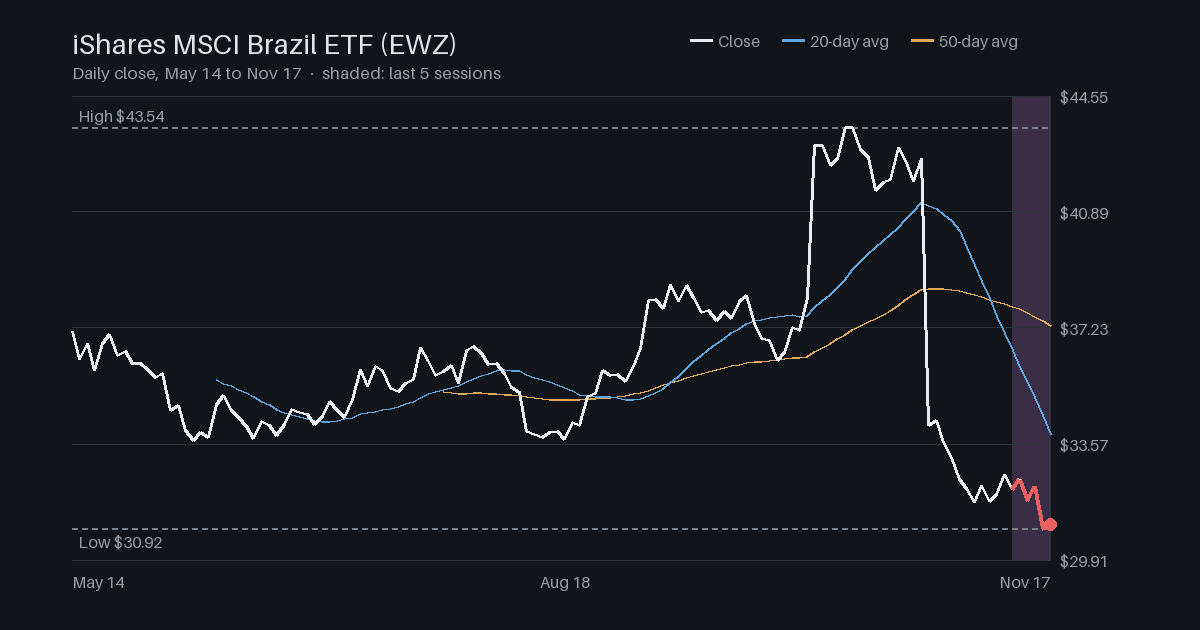
iShares MSCI Brazil ETF (EWZ) closed at $31.02 on Nov 17, 2026, down 3.5% from five sessions earlier. The last close is below its 20-day average of $33.88 and below its 50-day average of $37.30. Since May 15, 2026 it has traded between $30.92 (low, Nov 16, 2026) and $43.54 (high, Oct 9, 2026).
| Last close | $31.02 | Closing price on Nov 17, 2026. |
|---|---|---|
| 5-session move | -3.5% | Change in the closing price over the last five trading days. |
| 20-day average | $33.88 | The average closing price of the last 20 trading days. |
| 50-day average | $37.30 | The average closing price of the last 50 trading days. |
| Period high | $43.54 | Highest price since May 15, 2026. |
| Period low | $30.92 | Lowest price since May 15, 2026. |
Related coverage
 US-Listed Brazil ETF Braced for New 25% Dividend Tax ProposalLeft-wing lawmakers in Brasília proposed progressive dividend taxes up to 25% as US-listed Brazilian equities navigate fiscal reforms and corporate shocks.
 Petrobras Prepares to Raise Capital Spending Up to $120 BillionAmerican investors holding Petrobras certificates face a potential dividend squeeze as the energy giant prepares to unveil a capital-heavy business plan.
 Klabin Boiler Explosion Threatens Dividends for US ADR HoldersA suspension at Klabin's Otacílio Costa mill following a boiler explosion could cut annual EBITDA by 7%, posing a risk to ADR holder dividends.