

Wall Street Reassesses Brazil ETF Holdings as EWZ Surges 11%
Wall Street brokerages caution that the market rally following the naming of Luiz Carlos Trabuco as Brazil’s economic chief is driven by sentiment.

Key takeaways
- J.P. Morgan stated that while the new appointment increases long-term fiscal reform chances, the base case remains incremental measures that will not stabilize debt, per J.P. Morgan on November 27, 20
- Citigroup strategists warned that the 11% pre-market surge of the EWZ ETF was driven by sentiment and positioning rather than macro fundamentals, per Citigroup on November 27, 2026
- Bradesco BBI upgraded Brazilian equities to overweight, predicting up to 30% potential upside in dollar terms, per Bradesco BBI on November 27, 2026
U.S. retail investors holding diversified emerging-market assets found themselves reassessing their portfolios on November 27, 2026, as major global investment houses clashed over the long-term prospects of Latin America's largest economy. This portfolio reevaluation comes amid warnings that a dramatic, sentiment-driven market rally may soon run headfirst into deeply rooted structural challenges. The debate was triggered by an 11% pre-market surge of the New York-listed iShares MSCI Brazil ETF (EWZ) on November 27, 2026, per market trading reports.
The sudden market movement followed the official confirmation late on November 26, 2026, by Brazil's presidential palace that Luiz Carlos Trabuco Cappi, the 75-year-old chairman of Banco Bradesco S.A., has accepted an invitation to become the country's next finance minister starting in 2027. The appointment of a highly respected private-sector banker to lead the economic team immediately ignited a wave of optimism, prompting international funds to reevaluate their exposure to the country.
However, major Wall Street analysts quickly urged caution, warning that the initial rally was a product of investor positioning rather than improved economic fundamentals. In a research report released on November 27, 2026, Citigroup equity strategists led by André Mazini noted that while Trabuco’s corporate background could help rebuild trust and reduce the country’s risk premium, any initial market reaction would likely be driven by sentiment rather than a structural shift in macroeconomic fundamentals, according to Bloomberg Línea. Citigroup emphasized that the long-term sustainability of the rally hinges on Trabuco’s ability to present concrete spending cuts and secure political backing in Congress.
Similarly, J.P. Morgan released an analysis on November 27, 2026, stating that although bringing in an external name increases the likelihood of a significant fiscal change over time, the base case remains far more conservative, per CNN Brasil. In its report, J.P. Morgan outlined that Brazil's fiscal policy will likely continue to rely on incremental, short-term improvements that are insufficient to stabilize the country's rising public debt, which currently sits near 83% of gross domestic product, per the bank's analysis on November 27, 2026. The bank flagged tight global credit conditions, a slowing domestic economy, and historical political resistance in the legislature as critical obstacles that the incoming minister must navigate.
In contrast to the cautious stance of the American giants, local investment house Bradesco BBI—the investment banking arm of the very institution Trabuco chairs—upgraded its rating on Brazilian equities to overweight on November 26, 2026, according to a report published by the bank. BBI strategists Pedro Grimaldi and Ben Laidler argued that the country presents an attractive "tactical opportunity" with up to 30% potential upside in U.S. dollar terms for the MSCI Brazil index, per their report on November 26, 2026. They noted that the index trades at 7.5 times projected earnings, representing a 25% discount to its historical average, per the Bradesco BBI report on November 26, 2026.
This sharp divergence in outlook has sparked a lively debate on the brazilian wall street—the financial hub of São Paulo's Faria Lima—where local traders are exhibiting far more tactical optimism than their counterparts in New York. While the local cohort expects the banker's appointment to avert a potential value trap, global funds aligned with the broader brazil wall street perspective remain wary of the underlying structural deficits.
In your brokerage app
For retail investors with positions in a standard U.S. brokerage account, the primary vehicle tracking these developments is the iShares MSCI Brazil ETF, an exchange-traded fund listed in New York that directly mirrors the MSCI Brazil Index. While local investment bank Bradesco BBI sees substantial tactical upside in this basket of equities, the warnings from Citigroup and J.P. Morgan suggest that retail holders should prepare for ongoing volatility as the new minister attempts to navigate the country's fiscal hurdles in the coming year.
Analysis · NWX analysis desk
Which Brazil assets this touches
- EWZ — Named in this story.
Technical picture · iShares MSCI Brazil ETF (EWZ)
iShares MSCI Brazil ETF (EWZ) closed at $33.12 on Nov 27, 2026, up 12.2% from five sessions earlier. The last close is above its 20-day average of $31.27 and below its 50-day average of $36.19. Since May 26, 2026 it has traded between $28.54 (low, Nov 20, 2026) and $43.54 (high, Oct 9, 2026).
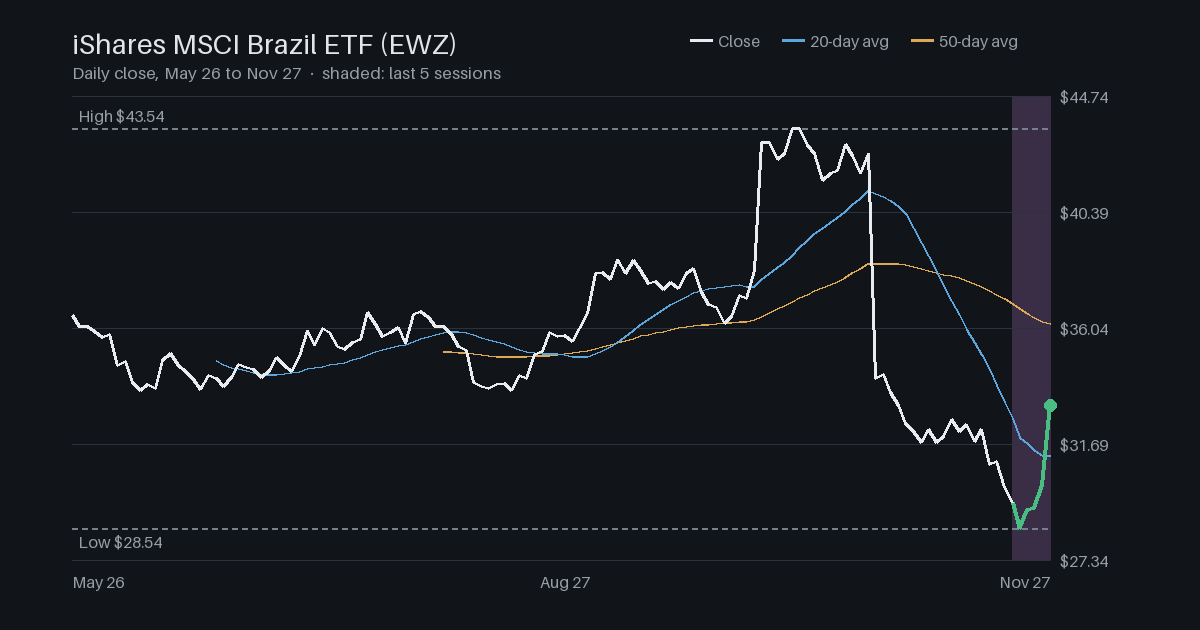
| Last close | $33.12 | Closing price on Nov 27, 2026. |
|---|---|---|
| 5-session move | +12.2% | Change in the closing price over the last five trading days. |
| 20-day average | $31.27 | The average closing price of the last 20 trading days. |
| 50-day average | $36.19 | The average closing price of the last 50 trading days. |
| Period high | $43.54 | Highest price since May 26, 2026. |
| Period low | $28.54 | Lowest price since May 26, 2026. |
Latest articles
 Vinci Compass Surges 6.5%, Bypassing ADR Fees for US InvestorsVinci Compass shares jumped 6.54% on November 27, 2026, offering US investors a direct-listing route into Brazil without the hassle and fees of traditional ADRs.
 Suzano Beats Q3 Earnings Estimates, Raises Pulp Prices by $50Brazilian pulp giant Suzano beat third-quarter earnings estimates and raised pulp prices by $50 per tonne, driven by its Arbex joint venture consolidation.
 Nu Holdings Co-Founder Files Notice to Sell $3.24 Million in SharesNu Holdings co-founder Cristina Junqueira filed a Form 144 notice with the SEC to sell 250,000 common shares valued at $3.24 million.