

Wall Street Slashes Brazil Weights on High Rates and Low Growth
Major investment banks downgrade Brazil to neutral as high interest rates and weak GDP projections cloud the outlook for Latin American equities.
Key takeaways
- Goldman Sachs downgraded Brazil equities to neutral, forecasting 0.6% GDP growth for 2027, per its report on November 17, 2026
- BTG Pactual lowered Brazil to neutral after a 29% slide in the stock market in dollar terms over the last 30 days, per its report on November 18, 2026
- Itaú BBA cut its 2027 Brazil GDP growth forecast to 0.5% with inflation at 6.1%, per its outlook on November 19, 2026
American retail investors holding broad emerging market portfolios or diversified Latin American equity holdings are facing a reshuffled landscape as Wall Street giants slash their allocations to the region's largest economy. In mid-November 2026, major investment banks including Goldman Sachs, Morgan Stanley, JPMorgan Chase, and BTG Pactual downgraded Brazil to neutral or underweight. They warned that high interest rates and fiscal deterioration will crimp returns and slow 2027 GDP growth to as little as 0.5%, according to Itaú BBA's November 19, 2026 forecast.
The retreat from Brazil comes after a brutal month for the country's local market. According to a Latin American portfolio strategy report published by Seu Dinheiro on November 18, 2026, the MSCI Brazil Index—tracked by the iShares MSCI Brazil ETF—plummeted 29% in U.S. dollar terms over the prior 30 days, marking the worst equity performance in Latin America. The same BTG Pactual report from November 18, 2026, noted that Argentina's stock market slipped 21% and Colombia's fell 14% over the same period when converted to dollars.
The key driver behind this Wall Street exit is a combination of ballooning public debt and soaring domestic interest rates that are crowding out equity investments. Brazil's central bank has kept its benchmark Selic interest rate at 13.75% as of November 2026, according to the Central Bank's policy decisions, making local government bonds highly lucrative and virtually risk-free for local capital, which pulls money directly out of corporate stocks. At the same time, the government has struggled to convince the market that it can pass a structural fiscal package robust enough to stop public debt from expanding, leaving the country's currency under severe pressure.
This high-rate environment is choking economic growth. In a research note released on November 19, 2026, Brazilian investment bank Itaú BBA slashed its 2027 GDP growth forecast for the country to just 0.5%, down from its previous estimate of 1.5%, while projecting that consumer inflation will climb to 6.1%. Goldman Sachs is only slightly more optimistic, forecasting 0.6% GDP growth for 2027 in its November 17, 2026 report, as documented by UOL on November 18, warning that high rates leave very little room for corporate earnings to surprise to the upside.
To protect against these domestic headwinds, investment houses are advising clients to steer clear of companies tied to local consumer spending. For instance, in its November 18, 2026 portfolio rebalancing, BTG Pactual completely removed major financial and retail players like Itaú Unibanco, XP Inc., and Assaí from its regional portfolio. Instead, the bank is pivoting toward defensive, dollar-revenue exporters like aerospace manufacturer Embraer and steelmaker Gerdau to insulate against the slowing domestic market.
In your brokerage app
For retail investors holding diversified emerging market funds, such as the Vanguard FTSE Emerging Markets ETF or the iShares Core MSCI Emerging Markets ETF, Brazil's shrinking allocation means the performance of these funds will depend more heavily on other developing nations. Investors holding the country-specific iShares MSCI Brazil ETF are exposed to a basket that is shifting. Strategists are increasingly favoring New York-listed Brazilian giants with dollar-denominated revenues, such as aerospace manufacturer Embraer (listed in New York) or food processor JBS (listed in New York), over domestic-facing institutions like Itaú Unibanco (listed in New York) which remain vulnerable to local high interest rates.
Analysis · NWX analysis desk
Which Brazil assets this touches
- EWZ, EEM, VWO, IBOV, USDBRL — Named in this story.
Technical picture · iShares MSCI Brazil ETF (EWZ)
iShares MSCI Brazil ETF (EWZ) closed at $28.54 on Nov 20, 2026, down 11.4% from five sessions earlier. The last close is below its 20-day average of $31.94 and below its 50-day average of $36.77. Since May 19, 2026 it has traded between $28.54 (low, Nov 20, 2026) and $43.54 (high, Oct 9, 2026).
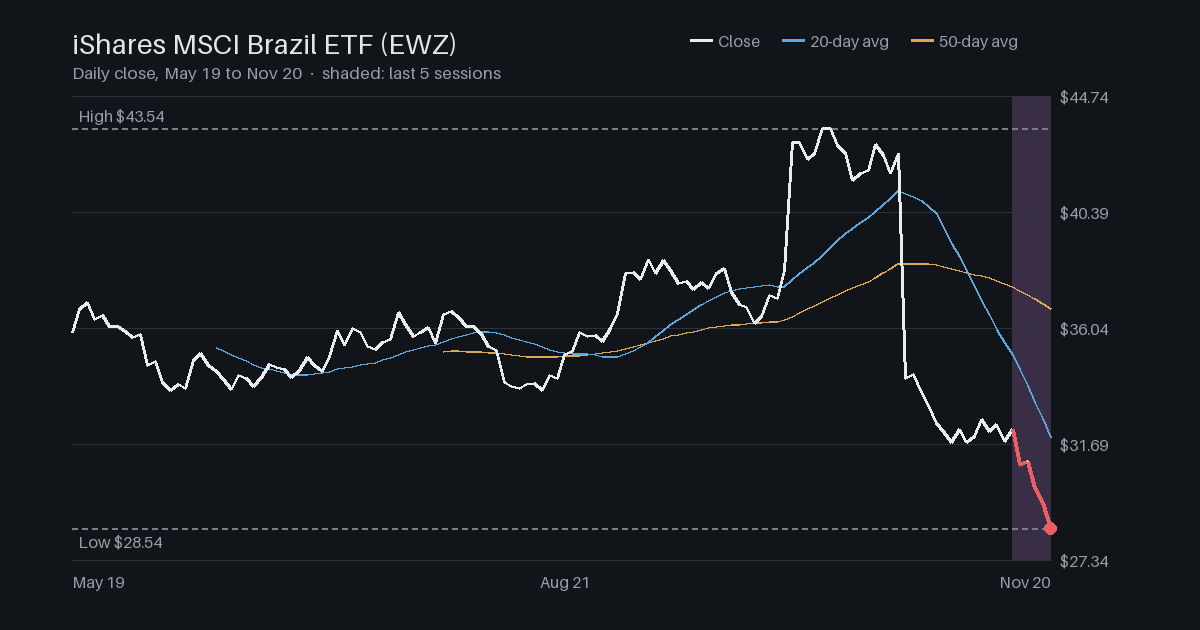
| Last close | $28.54 | Closing price on Nov 20, 2026. |
|---|---|---|
| 5-session move | -11.4% | Change in the closing price over the last five trading days. |
| 20-day average | $31.94 | The average closing price of the last 20 trading days. |
| 50-day average | $36.77 | The average closing price of the last 50 trading days. |
| Period high | $43.54 | Highest price since May 19, 2026. |
| Period low | $28.54 | Lowest price since May 19, 2026. |
Related coverage
 Anthropic Lists BDRs on Brazil Exchange Beside $81B Nasdaq DebutOn November 19, 2026, Anthropic launched an $81 billion Nasdaq IPO while simultaneously debuting ANTH34 BDRs on Brazil's B3 exchange.
 Central Bank Sells $1B in Spot Reserves as Real ReelsThe Central Bank of Brazil sold $1.00 billion in reserves on November 19, 2026, as the real fell to R$ 5.94 following fiscal remarks by President Lula.
 Bradesco CEO Projects 0.4% Brazil GDP, Vowing Credit PrudenceBradesco CEO Marcelo Noronha warns of a Brazil slowdown, projecting just 0.4% GDP growth in 2027 and pledging credit prudence to manage rising defaults.