

Central Bank Orders Card Limit Cuts as Brazil Defaults Hit 8.1%
New rules by Brazil's central bank targeting persistent revolving credit card debt will force digital lenders like Nubank to slash credit card limits.

Key takeaways
- The Central Bank of Brazil approved rules to gradually reduce card limits for persistent revolving debt users, per the Banco Central do Brasil on Nov 25, 2026
- New regulations prohibit offering unsecured credit to individuals with debts overdue by 90 days or more, per UOL on Nov 25, 2026
- Brazilian household default rates under free-resource credit reached a record-high 8.1% in September 2026, per the Banco Central do Brasil on Oct 29, 2026
- Sweeping prudential changes will take effect on July 1, 2027, forcing digital and traditional lenders to adapt, per CNN Brasil on Nov 25, 2026
Retail investors holding New York-listed digital banking giant Nu Holdings face a major regulatory shift after the Central Bank of Brazil approved strict rules on Nov 25, 2026, to force financial institutions to gradually reduce the credit card limits of customers who fail to pay their full balance three or more times in a six-month period.
The new regulations, jointly approved by the Central Bank of Brazil and the National Monetary Council (CMN) according to a Banco Central do Brasil release on Nov 25, 2026, aim to curb chronic consumer defaults. The rules also prohibit issuers from offering new unsecured credit lines to individuals with debts overdue by 90 days or more. These measures are designed to arrest a surging consumer credit crisis: the consumer default rate in the country's free-resource credit market reached a record-high 8.1% in September 2026, as reported by the Banco Central do Brasil on Oct 29, 2026.
Restructuring limit-allocation systems
These sweeping prudential changes will take effect on July 1, 2027, according to CNN Brasil on Nov 25, 2026. This timeline forces major credit providers operating in Brazil—including digital disruptors like Nubank, as well as traditional giants like Itaú Unibanco and Bradesco—to completely restructure their proprietary limit-allocation systems. To identify high-risk borrowers, the central bank's regulations require issuers to monitor a customer's total outstanding debt and revolving credit history across the entire national financial system, rather than just their activity with one individual bank.
For fast-growing fintechs, the rules present a direct challenge to a highly lucrative business model. Digital banking platforms have historically expanded their market share by offering fast, unsecured credit lines to underbanked demographics. Because revolving credit card interest rates in Brazil regularly exceed several hundred percent annually, capping limits and halting credit increases for overdue borrowers directly targets a key interest revenue pool.
In your brokerage app
For retail investors holding Nu Holdings, listed in New York, this regulatory overhaul represents a fundamental shift in the Brazilian consumer finance risk landscape. While the iShares MSCI Brazil ETF offers broader exposure to traditional financial giants like Itaú and Bradesco, those closely tracking digital banking margins will need to monitor how quickly these institutions can transition customers to lower-risk, secured lending alternatives before the July 1, 2027, implementation date.
Analysis · NWX analysis desk
Which Brazil assets this touches
- NU — Named in this story.
Technical picture · Nu Holdings (NU)
Nu Holdings (NU) closed at $12.36 on Nov 25, 2026, up 2.3% from five sessions earlier. The last close is above its 20-day average of $12.03 and below its 50-day average of $13.33. Since May 22, 2026 it has traded between $11.25 (low, Nov 20, 2026) and $16.12 (high, Oct 9, 2026).
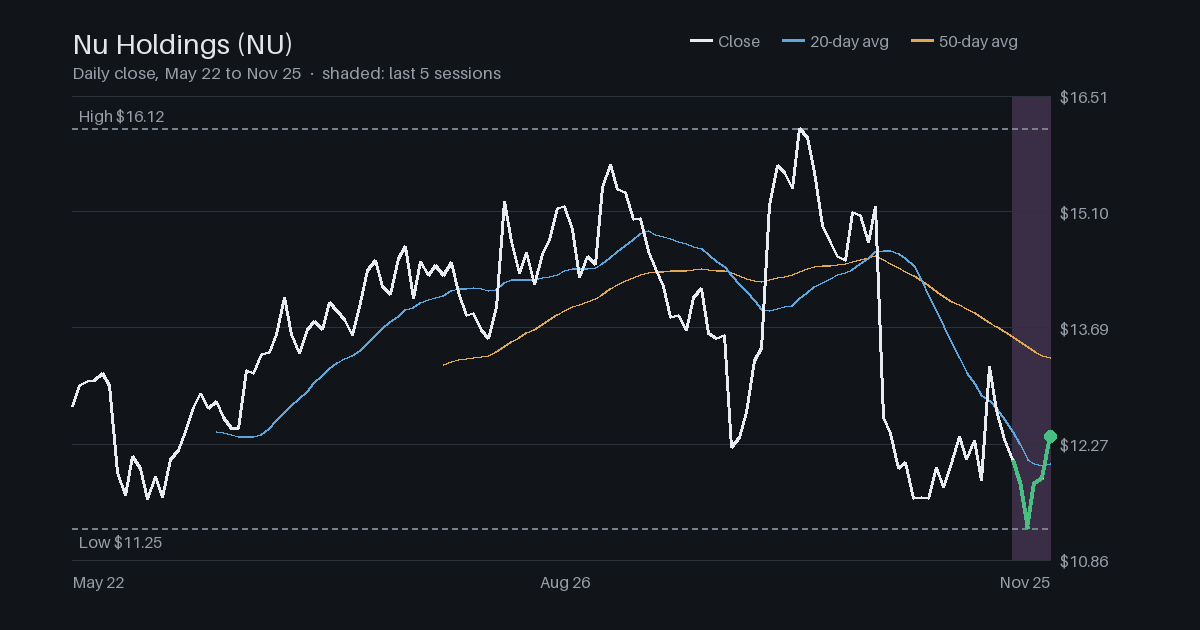
| Last close | $12.36 | Closing price on Nov 25, 2026. |
|---|---|---|
| 5-session move | +2.3% | Change in the closing price over the last five trading days. |
| 20-day average | $12.03 | The average closing price of the last 20 trading days. |
| 50-day average | $13.33 | The average closing price of the last 50 trading days. |
| Period high | $16.12 | Highest price since May 22, 2026. |
| Period low | $11.25 | Lowest price since May 22, 2026. |
Related coverage
 Petrobras Sets December 31 for Extraordinary ADR Dividend PaymentPetrobras filed a SEC 6-K detailing an extraordinary dividend of R$15.60 billion, with New York ADR holders scheduled to receive payments starting December 31.
 Cosan Hires BTG Pactual to Sell Asset Stakes to Tackle $1.6B DebtBrazilian conglomerate Cosan has hired BTG Pactual to sell minority stakes in rail firm Rumo and gas distributor Compass to reduce its $1.6 billion debt.
 Banco do Brasil Slashes Profit Outlook on Agribusiness Default SurgeBanco do Brasil has halved its 2026 profit outlook to BRL 9 billion–11 billion as large agribusinesses in the Central-West reject debt restructuring.