Tyson, Pilgrim's Pride Keep Edge as EU Delays Brazil Poultry Vote
The EU postponed its November 17 vote on lifting the import ban on Brazilian poultry, extending protection for U.S. producers like Tyson and Pilgrim's Pride.
Key takeaways
- SCoPAFF postponed a vote to lift the September 3 ban on Brazilian poultry on November 17, 2026, per EU Commission statements
- The decision has been rescheduled for December 7-8, 2026, according to Brazil's Ministry of Agriculture on November 17, 2026
- Brazil exported 315,000 tons of poultry to the EU from January to October 2026, according to trade data published on November 17, 2026
- Protectionist pressure from European trade group AVEC and requests from France and Romania drove the delay, per Estadão on November 17, 2026
American retail investors in U.S. poultry giants Tyson Foods and Pilgrim's Pride are seeing an unexpected extension of market protection in Europe. On November 17, 2026, the European Union's Standing Committee on Plants, Animals, Food and Feed (SCoPAFF) postponed its highly anticipated vote to lift an import ban on Brazilian poultry and honey, rescheduling the decision for December 7-8, 2026. The delay caused widespread frustration in Brazil’s agriculture sector, as reported by GZH on November 18, 2026. This delay temporarily protects the export margins of U.S. producers while stalling the recovery of major Brazilian competitors like BRF S.A. and JBS S.A., which have been locked out of the lucrative European market since September 3, 2026.
The embargo was originally enacted on September 3, 2026, after the EU raised concerns over Brazil's ability to demonstrate adequate sanitary controls regarding the use of antimicrobials in food-producing animals. Although a favorable EU technical audit in late September 2026 seemed to clear the path for an immediate market reopening, agricultural lobbies in Europe intervened. Organizations such as the European poultry association AVEC heavily pressured member states to defer the vote. The lobby demanded strict import limits and additional safety guarantees to protect European producers from a surge of cheap Brazilian chicken.
Diplomatic sources cited by Estadão on November 17, 2026, confirmed that France and Romania led the pushback inside the SCoPAFF committee, formally requesting more detailed information regarding Brazil’s antimicrobial tracing. While Brazil’s Ministry of Agriculture stated on November 17, 2026, that all technical requirements had already been fully resolved, the European Commission must now compile formal responses to these member-state concerns before the rescheduled vote in December.
The financial stakes are massive for both sides of the trade. Brazil is the world's largest exporter of chicken meat. Despite the recent restrictions, Brazil managed to ship approximately 315,000 tons of poultry to the EU, valued at $925 million, between January and October 2026, according to official trade ministry figures released on November 17, 2026. Without a resolution, Brazilian giants JBS and BRF must continue to divert these high-margin volumes to lower-margin alternative destinations, leaving Tyson Foods and Pilgrim’s Pride with a clearer field in European trade channels.
Looking ahead, the market will closely monitor the next SCoPAFF meeting on December 7-8, 2026, to see if the European Commission can satisfy the French and Romanian demands. Any further postponement of the vote would drag the embargo into 2027, locking in a prolonged trade advantage for North American meatpackers. Meanwhile, the Brazilian Animal Protein Association (ABPA) has demanded that the Brazilian government push for strict trade reciprocity, warning that relations must follow traditional international commerce protocols.
In your brokerage app
This ongoing delay directly benefits U.S.-based poultry producers Tyson Foods Inc. (listed in New York as TSN) and Pilgrim's Pride Corp. (listed in New York as PPC) by limiting global low-cost competition in key export margins. Conversely, it puts a temporary lid on the near-term recovery of Brazilian meat processing giants BRF S.A. (listed in New York as BRFS) and JBS S.A. (listed in Brazil as JBSS3), both of which are prominent holdings within broad-market exchange-traded funds like the iShares MSCI Brazil ETF (EWZ).
Analysis · NWX analysis desk
Which Brazil assets this touches
- BRFS, JBS, PPC, TSN, EWZ, JBSS3 — Named in this story.
Technical picture · JBSS3 (JBSS3)
JBSS3 (JBSS3) closed at R$70.32 on Nov 19, 2026, up 6.2% from five sessions earlier. The last close is above its 20-day average of R$67.74 and above its 50-day average of R$64.45. Since May 25, 2026 it has traded between R$55.44 (low, Oct 1, 2026) and R$73.85 (high, Aug 19, 2026).
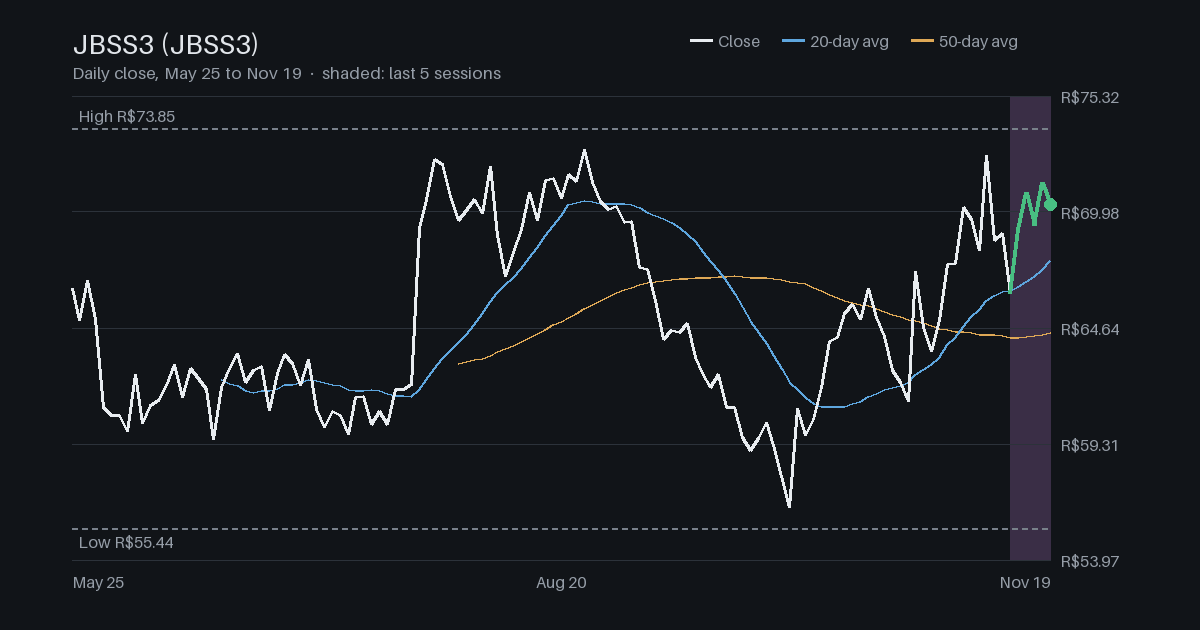
| Last close | R$70.32 | Closing price on Nov 19, 2026. |
|---|---|---|
| 5-session move | +6.2% | Change in the closing price over the last five trading days. |
| 20-day average | R$67.74 | The average closing price of the last 20 trading days. |
| 50-day average | R$64.45 | The average closing price of the last 50 trading days. |
| Period high | R$73.85 | Highest price since May 25, 2026. |
| Period low | R$55.44 | Lowest price since May 25, 2026. |