
Key Soybean Regions in Brazil Under Water Stress as Planting Rains Fail to Arrive
Dry spells in major producing areas like Sorriso-MT and Luís Eduardo Magalhães-BA threaten Brazil's soybean crop at the crucial planting stage.
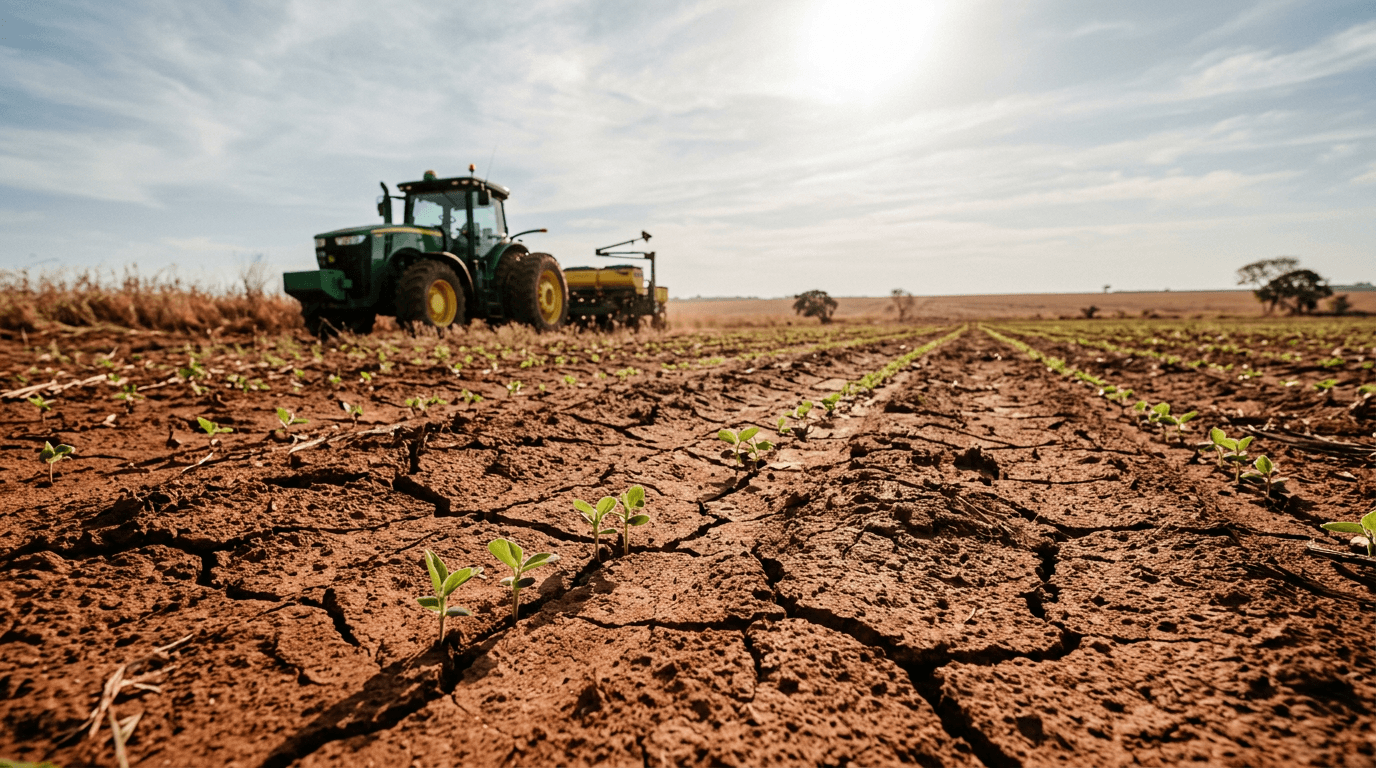
The start of Brazil's crucial soybean planting season is being undermined by a widespread lack of reliable rainfall across the nation’s central and northeastern agricultural heartlands, creating immediate crop stress for newly-sown fields. The drought conditions are most severe in the vital producing areas of Luís Eduardo Magalhães in Bahia (BA), Sorriso in Mato Grosso (MT), and Rio Verde in Goiás (GO), which together anchor the country’s massive oilseed sector. Over the last seven days, Luís Eduardo Magalhães, a key hub in the agricultural expansion frontier known as MATOPIBA, recorded a negligible 0.4 millimeters of rain and seven consecutive dry days. Meanwhile, Sorriso, MT—often called the country's "Soybean Capital"—received only 15.6 millimeters over the week with five dry days, and Rio Verde, GO, saw just 8.3 millimeters across six dry days.
This lack of "planting rain" is hitting the brazil soybean planting window at its most vulnerable stage. The states of Mato Grosso and Goiás form the core of the country's Center-West region, which is the engine of brazil soybean production. Sorriso, in particular, is the single largest producing municipality in the country, harvesting 2.1 million tons in the 2022-23 season alone. With farmers beginning to plant, the dry conditions prevent seeds from germinating or risk the loss of new seedlings that require moisture to establish deep roots. If the dry spell persists, farmers will be forced to postpone or even replant acres, which raises costs and shortens the growing window for the subsequent corn crop—a double loss to the rural economy.
The timing of this weather event carries significant weight for the global commodity market, as Brazil is the world’s leading exporter of the Brazil soybean crop. While Mato Grosso and Goiás are typically the first to plant, farmers are now anxiously awaiting a definitive seasonal shift to initiate widespread sowing. Climatologists have previously warned that the current weather patterns could cause a delayed start to the wet season in parts of Central Brazil, increasing the risk of early-season yield losses or expensive replanting efforts. Farmers across the Cerrado biome, where a majority of the country’s soybean output is concentrated, rely on consistent moisture now to ensure a healthy harvest at the turn of the year.
The immediate outlook depends on the return of precipitation to these regions. Farmers will be watching long-range forecasts closely for signs of a return to normal rainfall patterns in the coming weeks, which will determine both the total planted area and the early health of the new crop. Any material reduction in estimated Brazilian output could further tighten already-sensitive global supply chains.
What it touches
The risk to the world’s largest brazil soybean production has a direct impact on global prices, which were trading up at 1320.0 cents per bushel on Friday, a gain of 0.19%. The local currency, the Brazilian real, stood at 5.1985 to the U.S. dollar, a gain of 0.06% on the day.