
Global Soybean Supply at Risk as Dry Spell Hits Key Brazilian Hubs
A persistent dry spell in Brazil's agricultural heartlands of Mato Grosso and Bahia threatens to delay soybean planting, risking global supply disruptions.
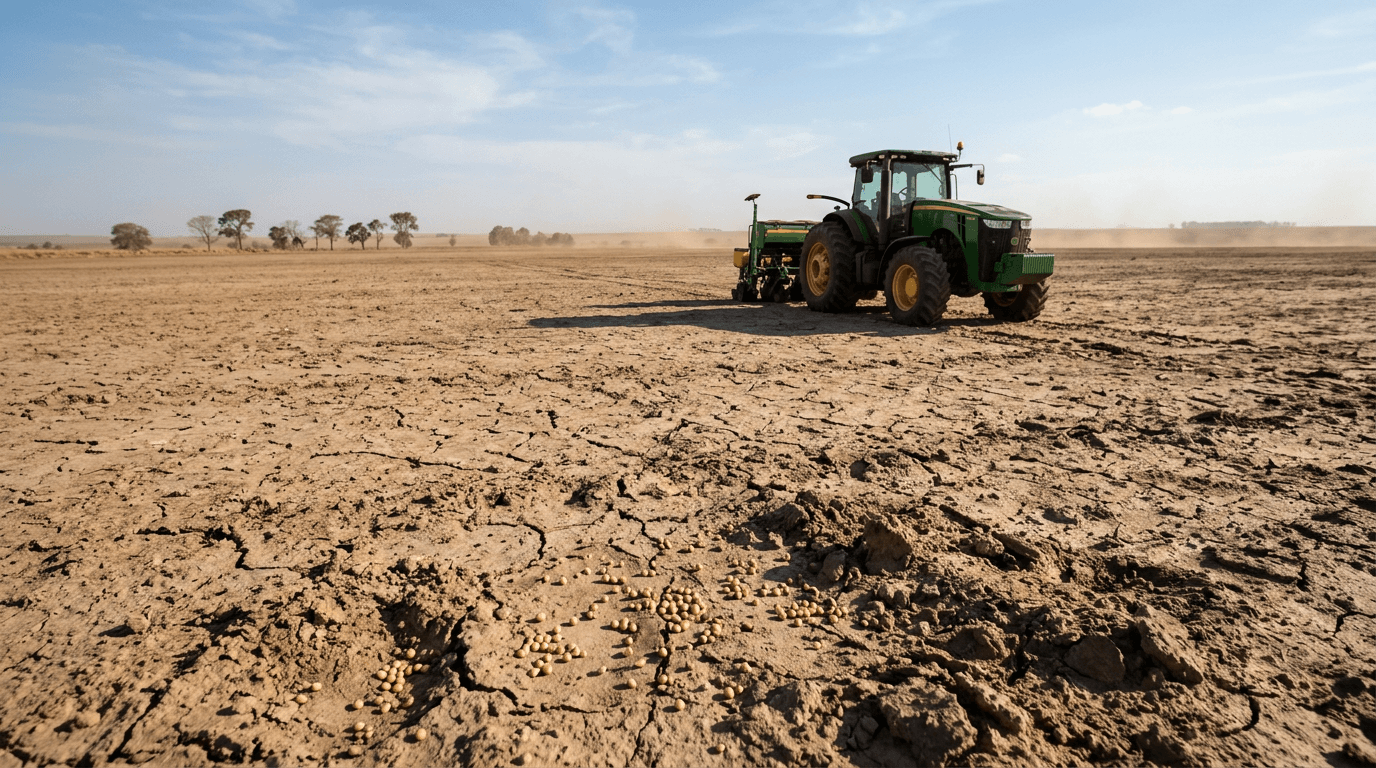
Global food commodity markets are facing a potential supply squeeze as a persistent dry spell hits the heart of South America's agricultural powerhouse. For American retail investors tracking food inflation or holding diversified commodity funds, the weather patterns over South American farmland are rapidly becoming the most critical variable for grain portfolios this autumn. Dry soil conditions threaten to delay the crucial planting window, which could ultimately compress the timeline for the entire global agricultural cycle.
In Brazil, the world's largest exporter of the oilseed, the current planting season is facing immediate water-stress risks in its most productive agricultural hubs. According to municipal weather monitoring data for the week ending October 13, 2026, the agricultural powerhouse of Sorriso, located in the central-western state of Mato Grosso, recorded 5 consecutive dry days with a meager 15.2 millimeters of cumulative rainfall. Meanwhile, in the eastern agricultural expansion frontier of Luís Eduardo Magalhães, in the state of Bahia, farmers experienced an identical 5 dry days, receiving only 22.4 millimeters of rain over the same seven-day period.
Why These Two Regions Matter
To understand the scale of this dry spell, foreign investors must look at the sheer weight of these two regions in the global supply chain. Sorriso is widely recognized as Brazil's national capital of agribusiness. Settled heavily in the late 20th century by southern Brazilian migrants, the municipality alone accounts for over 600,000 hectares of farmland, churning out millions of metric tons of grains annually. It serves as the primary engine for Mato Grosso, a state that produces more soybeans than most sovereign nations.
On the other side of the country, Luís Eduardo Magalhães is the crown jewel of the "Matopiba" region—a massive agricultural frontier spanning the states of Maranhão, Tocantins, Piauí, and Bahia. This region relies on highly mechanized, large-scale farming operations that are highly sensitive to soil moisture levels during the early seeding phase. When planting is delayed in these regions due to dry soil, it creates a domino effect: the subsequent harvest is pushed back, which in turn delays the planting of the second crop (the "safrinha" corn), exposing both yields to heightened climate risks later in the year.
Market Positioning and the Dollar Factor
The dry weather comes at a time when speculative traders are adjusting their exposure to agricultural commodities. According to the U.S. Commodity Futures Trading Commission (CFTC) Commitment of Traders report for the week ending October 13, 2026, non-commercial traders in Chicago Board of Trade (CBOT) soybean futures held 356,266 long contracts compared to 85,167 short contracts. This heavy net-long positioning reflects growing market anxiety over global production volumes.
Adding to the complexity for international buyers is the currency dynamic. The Brazilian real traded at 5.0558 per U.S. dollar on October 13, 2026, representing a slight strengthening of 0.56%. A stronger local currency makes Brazilian exports relatively more expensive in dollar terms, compounding the upward price pressure generated by the dry weather. If the dry spell in Mato Grosso and Bahia persists through the end of October, international buyers may have to rely more heavily on U.S. domestic stockpiles, driving up domestic wholesale prices.
In your brokerage app
Retail brokerage accounts provide access to broad-based agricultural exchange-traded funds (ETFs) and commodity-focused funds that track basket indices of agricultural futures, including soybeans, corn, and wheat. Because these financial products hold derivatives tied directly to global crop prices, their market valuations are highly sensitive to supply shocks and planting delays in major South American agricultural hubs.