
Why soybean traders are building long positions as Brazil starts planting
The CFTC reports net-long soybean positions of 271,099 contracts, as traders watch Brazil's historically slow acreage expansion and early weather risks.
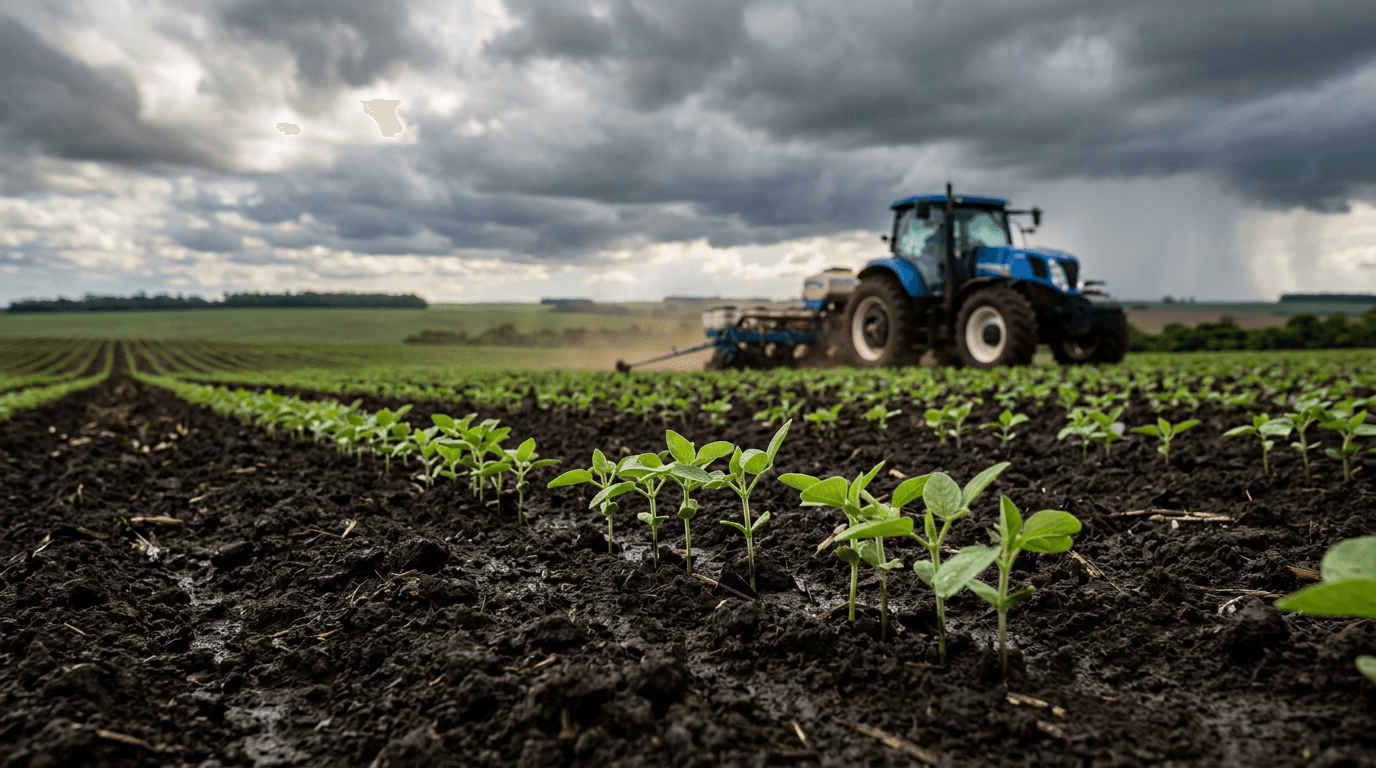
Speculators in Chicago are quietly shifting their weight behind the soybean market, building up a protective cushion of long positions as they watch the skies over South America. For American retail investors holding diversified commodity funds or agricultural equities, the weekly adjustments in futures positioning offer a clear window into how global supply risks are being priced long before harvest combines ever roll.
According to the U.S. Commodity Futures Trading Commission (CFTC) report for the week ending October 13, 2026, non-commercial traders held 356,266 long contracts against 85,167 short contracts in Chicago Board of Trade soybeans (Contract 005602). This resulted in a net-long position of 271,099 contracts, set against a total market open interest of 1,072,235 contracts. While weekly positioning is a measure of current sentiment rather than a guaranteed price forecast, the data shows that professional money managers are leaning positive on the soy complex.
The underlying driver for this market caution lies thousands of miles south in Brazil, the world's largest soybean exporter. Brazilian farmers are currently planting their 2026/27 crop, but they are doing so under a cloud of tight margins and structural changes. On October 15, 2026, Brazil's national supply agency, Conab, projected a record soybean harvest of 181.6 million metric tons. However, Conab also revealed that the country's soybean acreage is projected to grow by just 1.4% to 49.3 million hectares—the slowest expansion of Brazil's soybean footprint in two decades.
Tight margins and weather risks
This sudden deceleration in land expansion is a direct consequence of the economic reality on the ground. Brazilian farmers are grappling with local production costs that have climbed to a decade-high equivalent of 33.2 bags of soybeans per hectare. High domestic borrowing costs under the administration of President Luiz Inácio Lula da Silva, combined with elevated global fertilizer prices, have forced producers to rely on yield optimization rather than aggressively clearing new fields.
At the same time, early-season weather is keeping traders on edge. While private crop consultancy AgRural reported on October 11, 2026, that planting progress had reached 15.6% of the expected area—slightly ahead of the previous year's pace—the early fieldwork has been highly uneven. Heavy rains in the south and moisture deficits in some northern regions mean that early yield assumptions remain highly sensitive to any shift in El Niño weather patterns over the coming weeks.
For global markets, the combination of a historically slow acreage expansion and early weather uncertainty means there is very little margin for error. If Brazil's crop falters, global export demand will pivot sharply back to U.S. supplies, explaining why large speculators are keeping their net-long positions firmly in place as the South American planting season enters its critical phase.
In your brokerage app
For retail investors looking to track this agricultural cycle through the Brazil stock market, Adecoagro S.A. is listed in New York and operates large-scale farming and land transformation businesses across South America. Broader exposure to the Brazilian economy and its agricultural heavyweights can also be found via the iShares MSCI Brazil ETF, a major Brazil stock market etf that tracks the country's largest publicly traded enterprises.