
Global cooking oil supply feels pinch of Brazil canola crop failure
A severe weather-driven 33% drop in Brazil's canola harvest is squeezing raw materials and threatening margins for major agricultural processors like 3tentos.
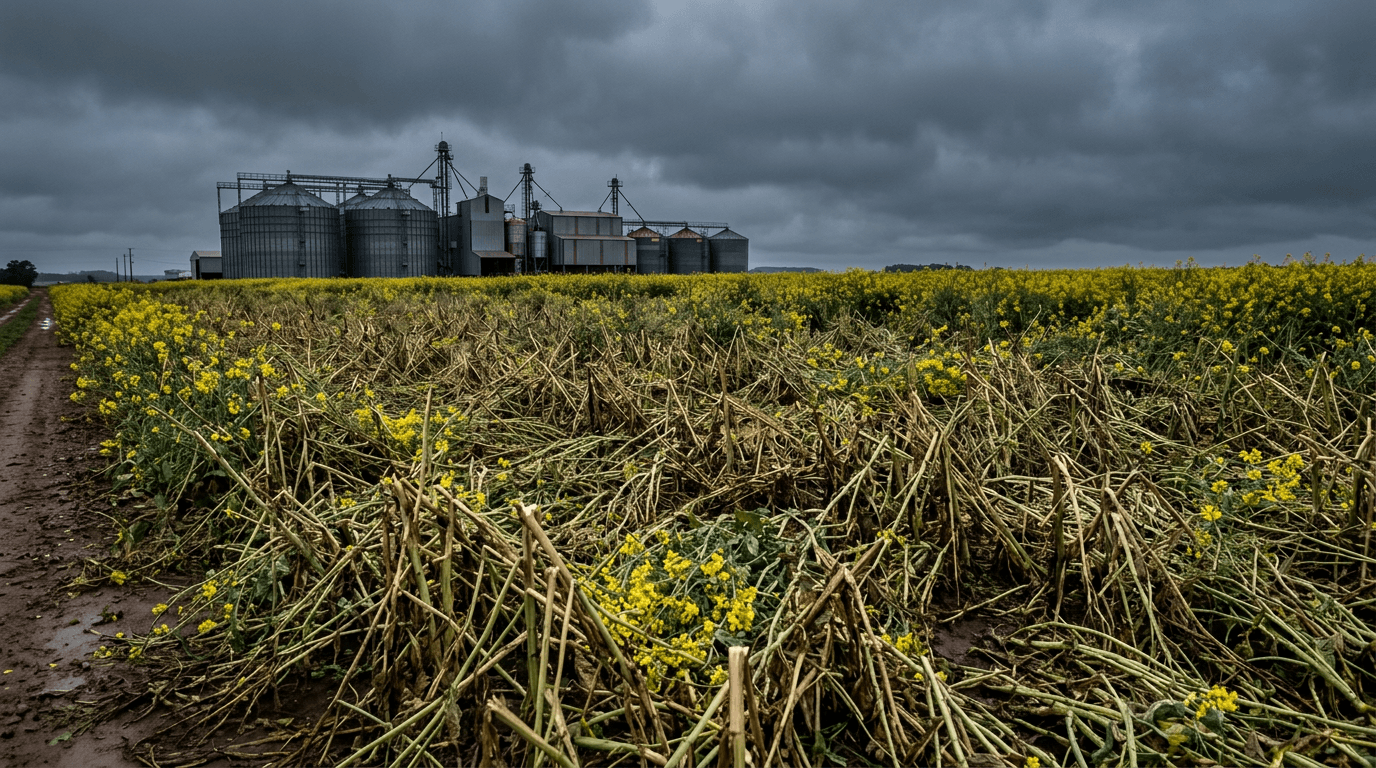
Global grocery shoppers and food conglomerates tracking the cost of vegetable oils are facing a sudden supply squeeze from South America. Severe weather has devastated canola fields across Brazil, driving up the cost of raw materials for agricultural processors and threatening to disrupt international cooking oil supply chains.
In Brazil, a major agricultural powerhouse, a series of intense storms, hail, and frosts has slashed the country's projected canola harvest from an initial estimate of 755,000 tons down to 507,000 tons. The 33% drop, reported on October 15, 2026, by the Brazilian Association of Canola Producers (Abrascanola), highlights how volatile weather patterns are directly impacting alternative oilseed markets.
The crop failure is hitting regional agribusiness giants hard. On October 22, 2026, analysts at Santander estimated that the agricultural processing firm 3tentos will lose roughly R$ 20 million ($3.5 million USD) in EBITDA due to the shortage, primarily dragging down its first-quarter results for 2027. 3tentos, which had positioned its processing plant in Ijuí, Rio Grande do Sul, to run on canola during the soybean off-season, is now facing a severe raw material deficit.
The Ijuí facility, which is capable of crushing 1,200 tons of the oilseed per day, relies heavily on local farmers. However, Santander reported that 3tentos' expected canola origination has plummeted to 120,000 tons, down from the company's initial forecast of 180,000 tons. While the company's fourth-quarter operations for 2026 remain partially protected by existing inventories, the true margin squeeze will be felt in early 2027 when processing lines are forced to run under capacity.
For international observers, the situation underscores the political and environmental risks facing Brazil's agricultural sector as it heads toward the 2026 electoral cycle. While the federal government has promoted biofuels and crop diversification, infrastructure bottlenecks and climate vulnerability remain key hurdles. Investors are closely watching whether state-backed agricultural insurance programs or emergency credit lines will be deployed to support affected farmers in Rio Grande do Sul, a politically vital southern state.
In your brokerage app
While 3tentos is traded locally in Brazil under the ticker TTEN3, retail investors can gain exposure to South American agribusiness and farmland through Adecoagro S.A., which is listed in New York. Additionally, diversified agricultural funds like the iShares MSCI Brazil ETF hold broad baskets of South American consumer and industrial firms that are sensitive to regional crop yields and processing margins.