
Soybean futures face pressure as dry spells test Brazil's top farm belt
A five-day dry spell in Sorriso, Brazil's leading soybean municipality, is raising crop-stress risks for early-planted fields, even as national sowing progress remains ahead of historical averages.
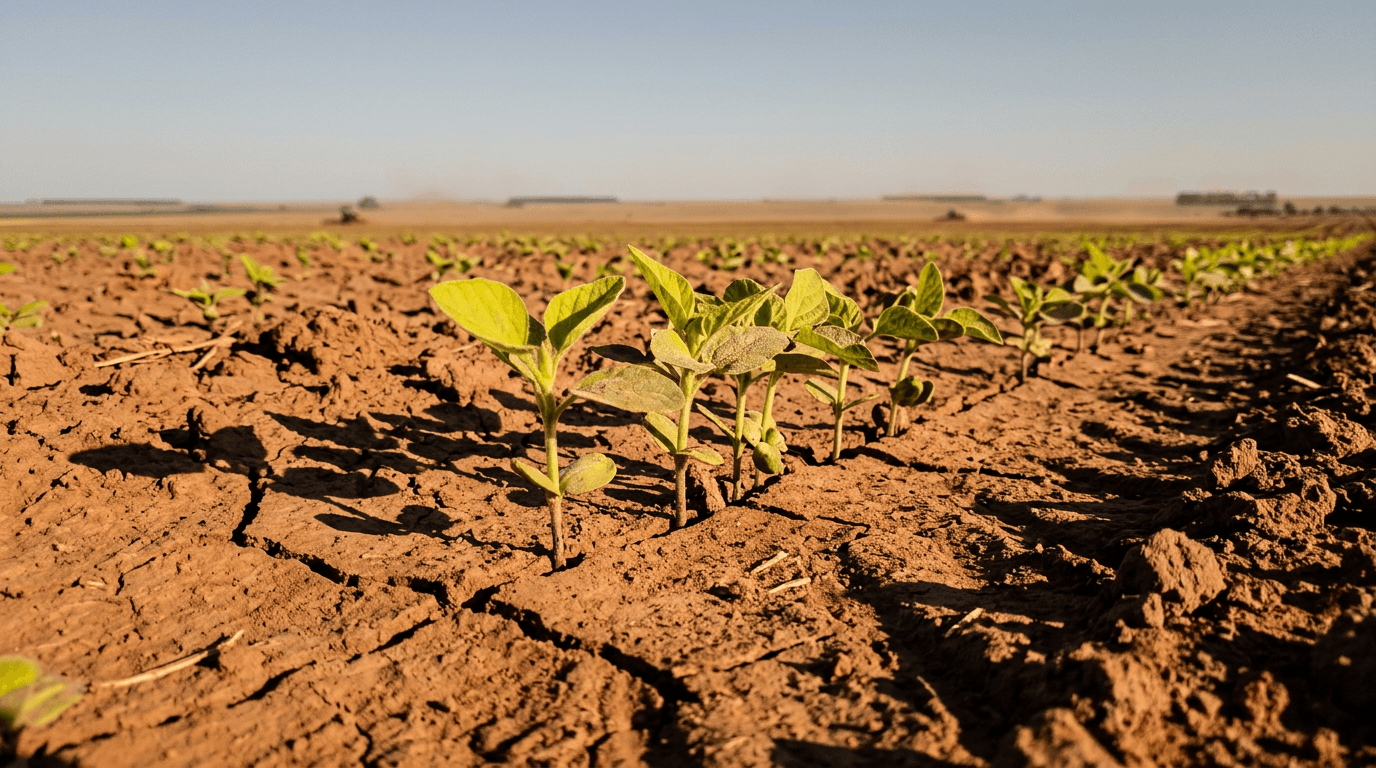
American retail investors holding grain exchange-traded funds or agricultural commodity positions are watching Chicago Board of Trade soybean futures closely. While prices have faced downward pressure due to expectations of a massive South American harvest, localized weather disruptions in South America's agricultural heartland are beginning to threaten early-season crop development.
In Brazil, the world's largest exporter of the oilseed, a persistent dry spell is testing newly planted fields in the key grain-producing state of Mato Grosso. According to regional meteorological data for the week ending October 13, 2026, the agricultural hub of Sorriso, Mato Grosso, recorded five consecutive dry days and received just 11.6 millimeters of cumulative rainfall. Similar dry conditions are emerging across other central grain belts, with Rio Verde, Goiás, registering four dry days and 11.7 millimeters of rain, and Luís Eduardo Magalhães, Bahia, logging three dry days and 12.3 millimeters of rain.
This dry stretch is critical because Brazilian farmers have planted their crops at an unusually rapid pace this season. Data from the Mato Grosso Institute of Agricultural Economics (IMEA) showed that soybean planting in the state was 33% complete as of October 9, 2026, running about 8 percentage points ahead of its historical average. Nationally, Brazil's National Supply Company (Conab) reported on October 15, 2026, that overall soybean sowing had reached nearly 16% of the projected 49.3 million hectares.
While early planting allows farmers to harvest sooner and secure a favorable export window, it also exposes young seedlings to severe germination risks if the wet season falters. Agronomists warn that without immediate, consistent rainfall, these early-planted fields in Mato Grosso may suffer from poor germination, potentially forcing expensive replanting. Furthermore, any delay in the soybean harvest directly threatens the planting window for Brazil's second-crop (safrinha) corn, which is sown immediately after soybeans are cut.
For global markets, the stakes are exceptionally high. Conab's initial October 15, 2026, forecast projected a record-breaking Brazilian soybean harvest of 181.6 million metric tons, representing a 0.7% increase from the previous season. However, because high borrowing costs and elevated fertilizer prices have restricted acreage expansion to just 1.4%—the slowest growth rate in 20 years—global supply growth is entirely dependent on achieving high yields rather than expanding land. Any sustained weather stress in hubs like Sorriso will quickly erode these record yield assumptions.
In your brokerage app
Retail investors can track the direct impact of Brazilian weather on grain prices through the Teucrium Soybean Fund (SOYB), an exchange-traded fund listed in New York that tracks soybean futures contracts. Additionally, global agribusiness giants like Bunge Global SA (BG) and Archer-Daniels-Midland Company (ADM), both listed on the New York Stock Exchange, operate extensive origination and logistics networks throughout Mato Grosso and are highly sensitive to the volume and timing of the Brazilian harvest.