
Dry Start to Brazil’s Soybean Planting Season Raises Crop-Stress Risk in Key Producing States
Major soybean hubs in Mato Grosso and Bahia have recorded seven consecutive dry days, threatening a delayed start to the critical 2026/27 planting cycle.
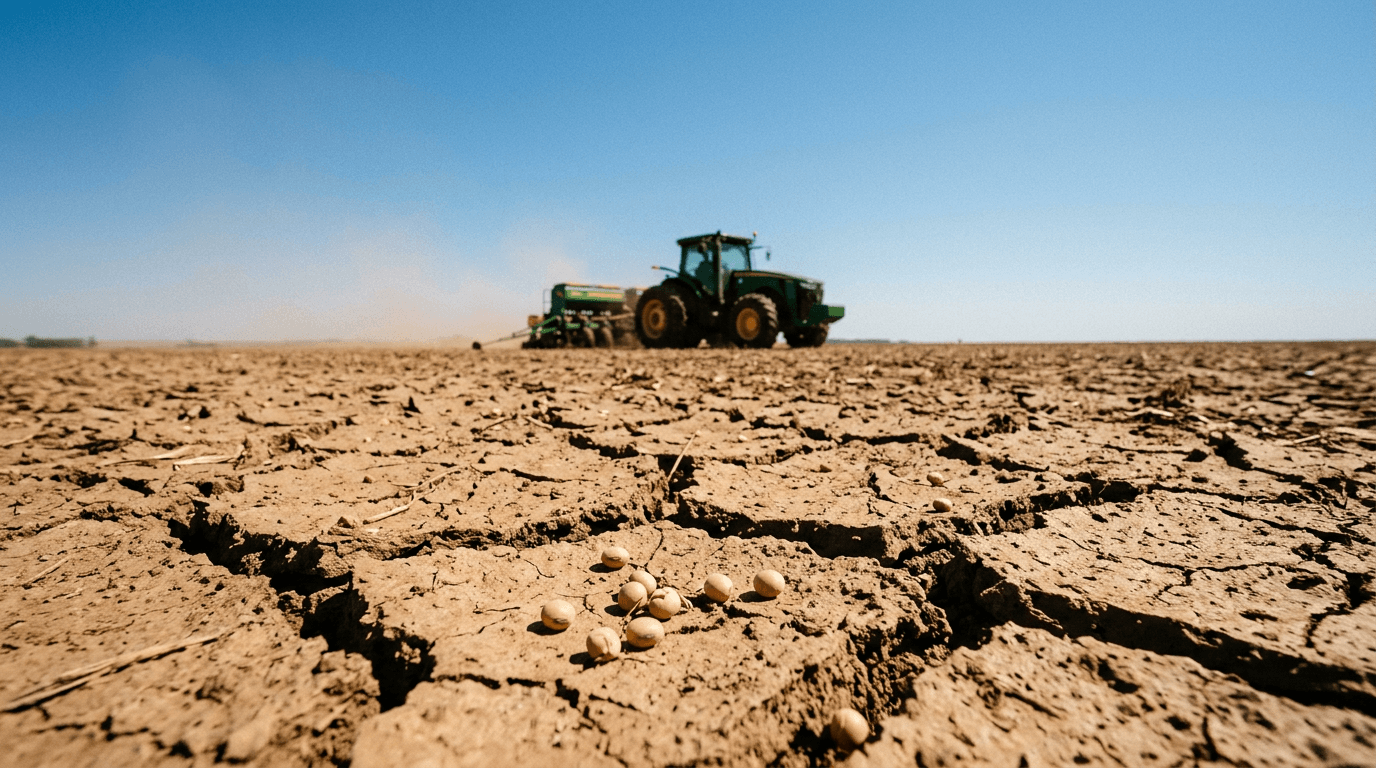
The start of Brazil’s 2026/27 soybean planting season is facing immediate risk of delay after key producing regions registered a week of near-zero rainfall, threatening the early establishment of the world’s most important soybean crop. The core producing municipality of Sorriso in Mato Grosso, alongside Luís Eduardo Magalhães in Bahia, reported seven consecutive dry days, receiving just 0.2 millimeters and 0.0 millimeters of rain, respectively, over that period.
The lack of early-season moisture is of particular concern because the planting window for Brazil's massive soybean crop begins in September. In Goiás, another agricultural powerhouse state, the important hub of Rio Verde saw five dry days and only a marginal 7.6 millimeters of rain over the last week. This water stress, even at the beginning of the cycle, can force farmers to delay planting until soil moisture improves, or face the expensive prospect of replanting if seeds fail to germinate.
Why the Dryness Matters
These three municipalities—Sorriso, Rio Verde, and Luís Eduardo Magalhães—are cornerstones of Brazil’s soybean belt, collectively representing a significant share of the nation's total output. For foreign observers, a delayed start to the soybean crop is a critical signal because it has a cascading effect on the country's entire grain complex. A late soybean harvest compresses the planting window for safrinha, the crucial second-crop corn that Brazil is increasingly known for exporting.
Compacting the safrinha window exposes the subsequent corn crop to greater risk of frost or drought during its development, potentially tightening global supplies of both soybeans and corn. Analysts often watch for a widespread start to planting in September and October to ensure the crop will finish its cycle on time before the dry season returns.
Soybean futures have registered a slight uptick, rising 0.19% to 1299.0 cents per bushel, as the market begins to factor in the potential for reduced early-season yield potential. The Brazilian currency, the Real, weakened slightly, with the US Dollar strengthening 0.61% to trade at R$5.0912. The immediate focus for producers will be weather forecasts for the coming week, as a return of steady rainfall is needed to move planting operations from sporadic to widespread across the central and northern growing regions.
What it touches
The prospect of crop stress in Brazil's core farm belt directly exposes global soybean and corn futures traded in Chicago, as Brazil is the world's largest exporter of both commodities. The US Dollar/Brazilian Real exchange rate (USD/BRL) is also sensitive, as a delayed harvest can affect the timing of export flows, which bring foreign currency into the country.

