
Dry Spell Threatens Start of Brazil Soybean Planting Season in Key States
Water scarcity in major soybean regions like Sorriso and Luís Eduardo Magalhães risks delaying the new Brazil soybean planting cycle.
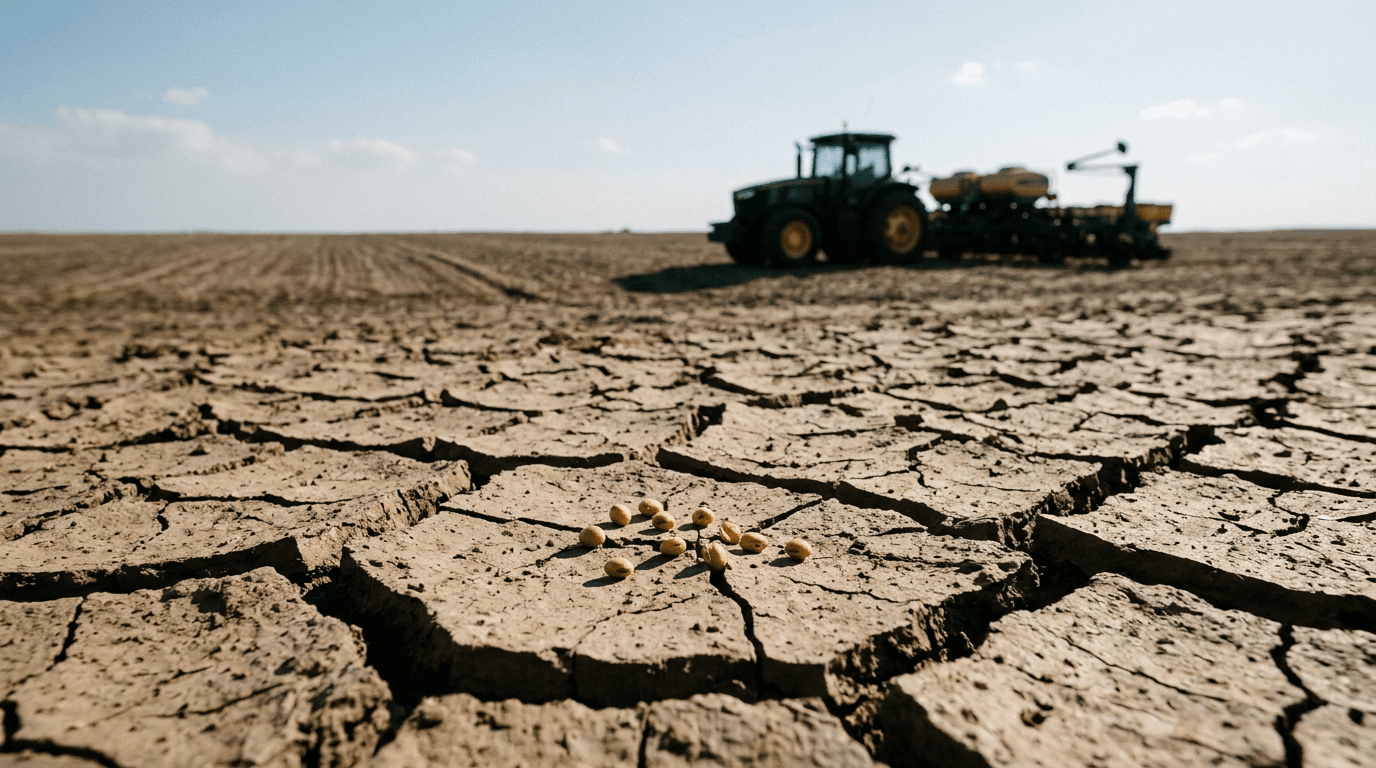
A persistent dry spell in Brazil’s primary growing regions is raising the risk of significant delays for the start of the 2026/2027 Brazil soybean planting season, threatening the outlook for the world's largest soybean producer. Farmers in major cities across Mato Grosso, Goiás, and Bahia are facing a severe shortage of rain just as the window for putting seeds in the ground opens, a critical juncture for the entire Brazil soybean crop. The city of Luís Eduardo Magalhães in Bahia, a pillar of the important Matopiba agricultural frontier, has seen just 3.7 millimeters of rain over the last seven days, following six consecutive dry days, a deficit that makes sowing seeds unviable for many producers.
The challenge is widespread across the heart of Brazil soybean production. In Sorriso, Mato Grosso, the country’s top producing state, growers have also registered five dry days with minimal relief, accumulating only 9.3mm of rain in the last week. Further south, Rio Verde in Goiás has recorded five dry days and 16.0mm of rainfall in seven days, a volume insufficient to replenish soil moisture reserves and ensure good seed emergence. These figures are causing concern among agricultural experts, as poor initial rainfall forces farmers to delay planting or risk expensive re-planting if seeds sprout and then die in dry soil. Only Cascavel in Paraná shows slightly better moisture, with 47.0mm of rain over five dry days.
For the foreign reader, this early-season water stress is crucial because a delay in the planting cycle pushes the critical flowering and pod-filling stages of the Brazil soybean crop later into the summer, potentially exposing the crop to poorer weather and yield-damaging heat later on. These regions, particularly Mato Grosso, Goiás, and Bahia, are responsible for the vast majority of Brazil's massive output, which has surpassed the United States to dominate global exports. The ability of producers to get a healthy, uniform stand of seedlings established in the next two weeks is paramount to avoiding a compressed schedule that could negatively impact final yield totals next year.
The immediate future of the new crop now hinges on the return of regular, heavy rains to the center-west and northeastern areas, with the first two weeks of October being the definitive marker for whether the start of the planting season will be merely delayed or seriously compromised. Failure to receive adequate rain could force the National Supply Company (Conab) to revise its initial optimistic forecasts for another record-breaking harvest.
What it touches The mounting uncertainty over the initial crop stage is reflected in the soybean futures market, which trades at 1319.0 cents per bushel, up 0.11% today, as traders weigh the potential for tightening supply. The local currency, the Brazilian real (BRL), is trading at 5.1985 to the U.S. dollar, up 0.06% on the day, with commodity-price volatility being a key factor influencing the exchange rate.
Related coverage
Agro · PRO
Brazilian Meatpacker JBS S.A. Moves to Delist Local Shares, Centralizing Equity in Dutch Parent
Published
Agro · PRO
UN Warns 'Super El Niño' Threatens Latin America’s GDP, Risks Pushing 4.8 Million Into Poverty
Published
Agro · PRO
Dry Spell Halts Brazil Soybean Planting in Key Central and Northeast Regions
Published