
Trump's Tariffs Spare Brazilian Beef and Coffee but Hit Ethanol
The USTR's new 25% Section 301 tariffs on Brazil exempt multi-billion dollar beef and coffee exports but penalize the sugarcane and biofuel sectors.
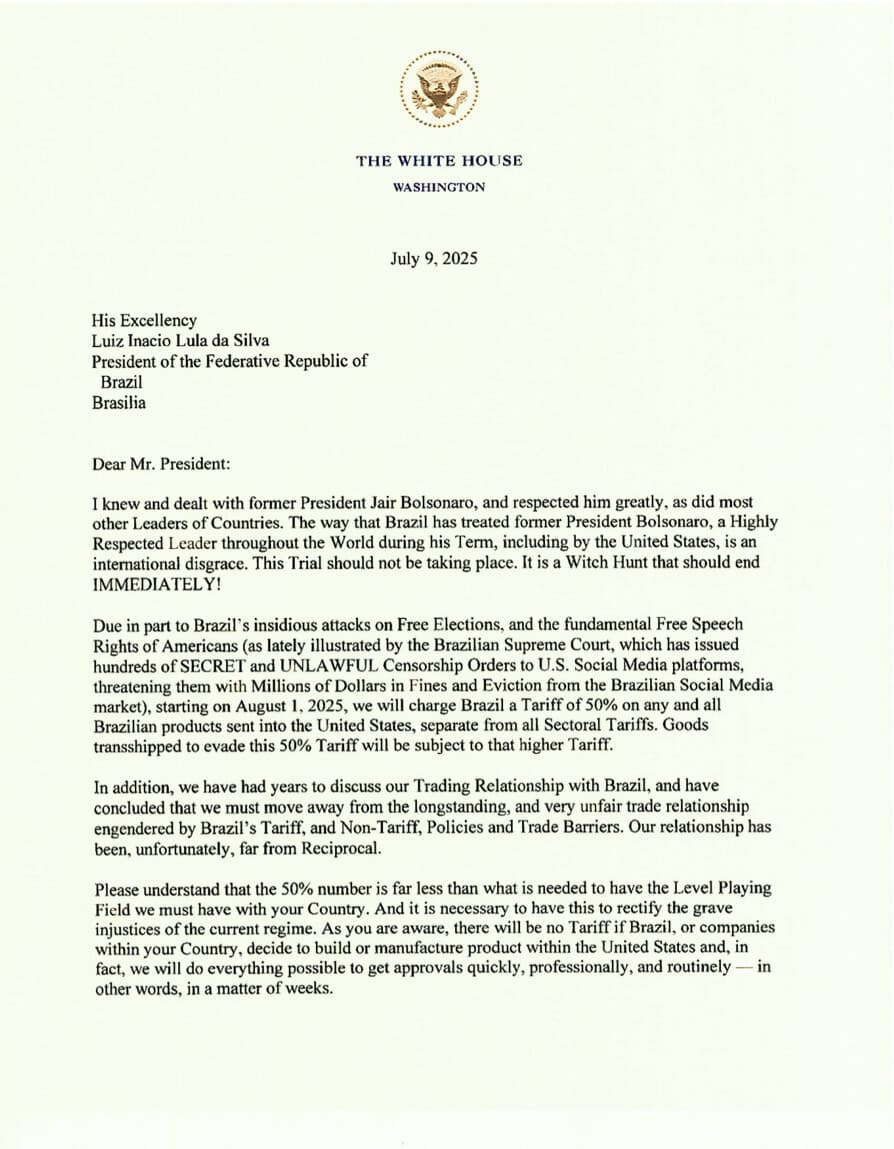
The Office of the U.S. Trade Representative (USTR) has finalized a 25% tariff on a wide range of Brazilian goods starting July 22, 2026, following a year-long Section 301 investigation. While the sweeping trade action targets Brazil's digital policies, intellectual property enforcement, and environmental record, the Trump administration has explicitly exempted key agricultural powerhouses—including beef, coffee, and orange juice—from the final tariff list. The targeted exemptions prevent a worst-case trade collapse for major South American exporters, but the U.S. will heavily penalize Brazil's sugarcane and biofuel sectors.
Under the finalized USTR rules, Brazilian ethanol will face the new 25% surcharge stacked on top of existing duties, driving its total U.S. tariff rate to 37.5%. Although Brazil's direct ethanol exports to the U.S. have dwindled to near zero in recent years, the punitive rate is a strategic move to pressure the administration of President Luiz Inácio Lula da Silva to lower its own barriers to American corn-based ethanol. For Brazilian sugarcane giant São Martinho (SMTO3), the tariff escalation dampens long-term export flexibility, though domestic market dynamics remain the primary driver for local mills.
Conversely, the decision to spare beef and coffee is a major relief for global commodity markets and giant meatpackers like JBS and Minerva (BEEF3). In 2025, Brazil exported a record $1.66 billion in beef and $2.68 billion in coffee to the U.S.. The Trump administration opted for these exemptions to protect American consumers from grocery store inflation and to secure raw materials that cannot be easily substituted domestically. This policy gap has cushioned the Brazilian Real (USD/BRL) and the B3 stock index (IBOV) from a broader trade-induced selloff.
The trade friction comes as Brazilian farmers navigate contrasting regional weather patterns. In Cascavel-PR, heavy rainfall of 102.7 mm over the last week has disrupted fieldwork despite only 5 dry days, whereas key agricultural hubs like Rio Verde-GO, Luís Eduardo Magalhães-BA, and Sorriso-MT remain completely dry, each recording 7 consecutive dry days and virtually no rainfall. Meanwhile, speculative positioning in agricultural futures remains highly active, with CFTC Commitment of Traders (COT) data showing coffee net-long positions at 59,414 contracts versus 33,791 short, corn net-longs at 478,153 contracts versus 377,173 short, and soybeans holding 215,618 long contracts against 102,811 short.