
Dry Spell Risks Brazil Soybean Production in Key Farming Regions
Two of Brazil's largest soybean producers, Sorriso and Luís Eduardo Magalhães, are facing water stress following an extended dry spell, raising crop risk.
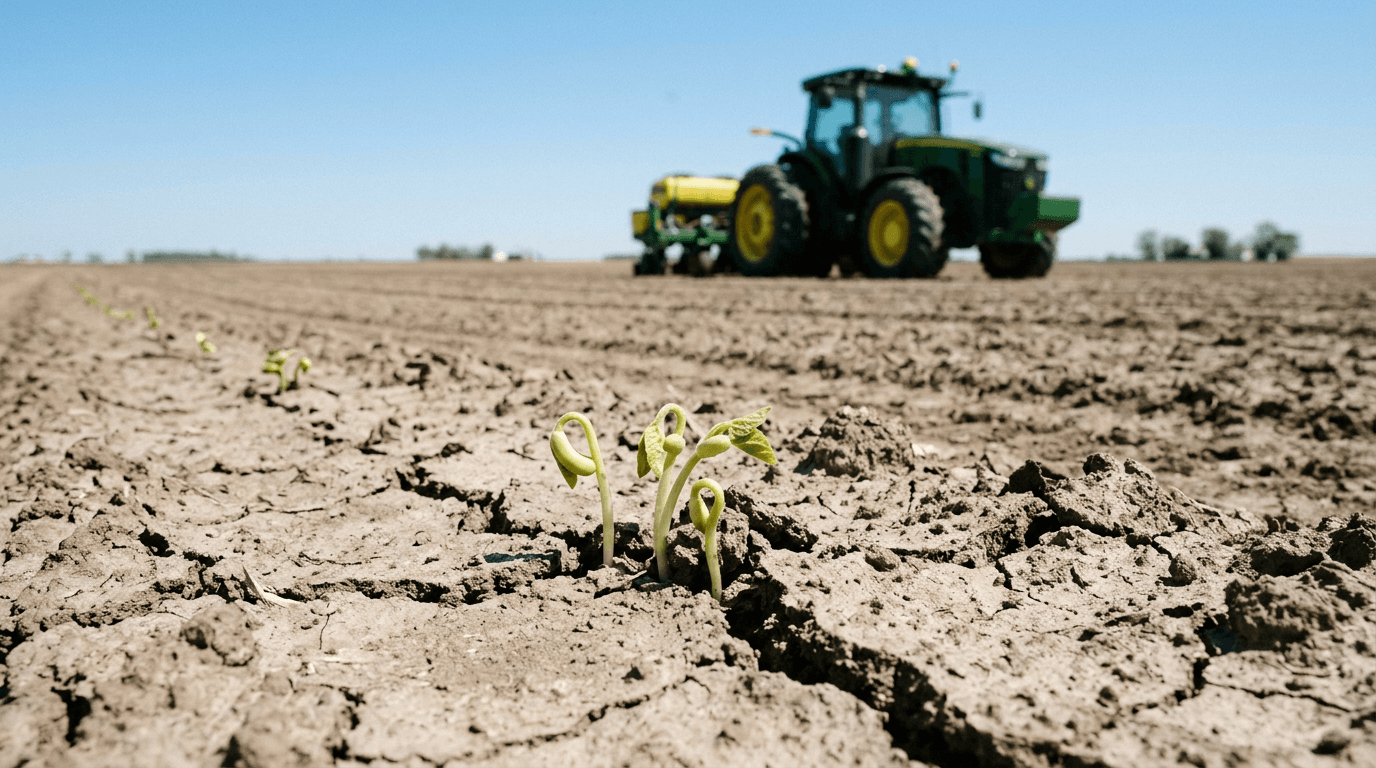
An extended dry spell is threatening newly planted and developing soybean crops in two of Brazil’s most vital agricultural regions, signaling a potential risk to the world's largest soybean supply. The municipalities of Luís Eduardo Magalhães in Bahia (BA) and Sorriso in Mato Grosso (MT) are experiencing insufficient rainfall as farmers enter a critical phase of the 2026/27 growing season, where consistent moisture is crucial for successful germination and early plant development.
In Luís Eduardo Magalhães, a major agribusiness hub in the MATOPIBA agricultural frontier of northeastern Brazil, the region has seen seven consecutive dry days, registering a meager 0.5 millimeters of rain over the last week, according to current data. Further west, in Sorriso—often called the national capital of agribusiness and a cornerstone of Mato Grosso, Brazil's top soybean producing state—five dry days saw only 6.1 millimeters of precipitation in the same period. Mato Grosso's importance cannot be overstated: the state alone accounts for a vast percentage of the global soybean supply, and any significant weather anomaly can have an outsized impact on global food commodities.
The dry conditions could force two negative outcomes for farmers. First, a lack of moisture slows down the planting pace, which can delay the entire harvest cycle. Second, and more critically, it subjects the fragile young seedlings to water stress, potentially requiring farmers to replant entire areas or accept a reduced yield from the start. Both cities are known for high-tech, highly-mechanized farming, but even modern agriculture cannot bypass the fundamental need for rain during the initial planting and emergence phase, which generally runs from September through December. The lack of rain is particularly worrisome in the cerrado biome, where the heat can quickly dry out the soil.
The risk to Brazil's soybean production comes at a time when global demand remains strong, particularly from major importers like China. The coming days will be critical: forecasters will be watching for any sign of a return to consistent rainfall patterns across the Central-West and Northeast. A failure of the weather to cooperate in the near term could lead to revised production forecasts, forcing the government's National Supply Company (Conab) and private consultancies to lower their estimates for the year.
What it touches The risk of a supply shock in Brazil, the world's leading exporter of soybeans, can pressure international prices for the oilseed. The spot price for soybeans is trading today at 1309.75 cents per bushel. Local farmers are simultaneously dealing with the foreign exchange rate, as the Brazilian Real (BRL) trades at 5.1247 per U.S. Dollar (USD), a dynamic that affects their export revenues, paid in local currency, versus the cost of imported inputs, such as fertilizer and chemicals, which are priced in dollars.